Fact-checked by the VisualEnews editorial team
Quick Answer
Spatial computing everyday use is accelerating rapidly beyond gaming. As of June 2025, the global spatial computing market is valued at over $110 billion and is projected to reach $620 billion by 2032. Applications now span healthcare, retail, manufacturing, education, and navigation — reshaping how people work, shop, learn, and move through physical space.
Spatial computing everyday use refers to technologies that blend digital information with the physical world — enabling computers to understand, interact with, and augment real space. The global spatial computing market was valued at $110.6 billion in 2024 according to Grand View Research, with compound annual growth pushing well beyond gaming and entertainment into core industrial and consumer applications.
This expansion matters because the underlying technology — including augmented reality (AR), mixed reality (MR), computer vision, and spatial audio — has matured enough for daily, practical use. In this guide, you will learn exactly where spatial computing is being deployed today, which industries are leading adoption, what devices are driving the shift, and what to expect in the near future.
Key Takeaways
- The spatial computing market is projected to grow at a CAGR of 24.3% through 2032, according to Grand View Research’s 2024 industry report.
- Apple’s Vision Pro, launched in early 2024, introduced spatial computing to mainstream consumers at a $3,499 price point, marking a pivotal commercial milestone (Apple, 2024).
- The healthcare AR segment alone is expected to reach $4.2 billion by 2026, driven by surgical navigation and medical training platforms, per MarketsandMarkets research.
- Industrial AR applications at companies like Boeing have reduced wiring assembly time by 25% and error rates by up to 40%, according to Boeing’s own published findings.
- More than 1.4 billion mobile AR users are active globally as of 2025, making smartphones the dominant spatial computing device for everyday consumers, per Statista’s 2025 AR user data.
In This Guide
- What Is Spatial Computing and How Does It Work?
- How Is Spatial Computing Transforming Healthcare?
- How Is Spatial Computing Changing Retail and Commerce?
- How Is Spatial Computing Reshaping the Workplace and Manufacturing?
- What Role Does Spatial Computing Play in Education and Training?
- Which Devices Are Driving Spatial Computing Everyday Use?
- What Are the Key Challenges and the Near-Term Outlook?
What Is Spatial Computing and How Does It Work?
Spatial computing is the set of technologies that allow machines to perceive, process, and interact with three-dimensional physical space in real time. It combines computer vision, depth sensors, AI-driven scene understanding, and display systems to overlay digital content onto — or integrate it with — the real world.
The term was coined by researcher Simon Greenwold in 2003, but the technology infrastructure to support it at scale has only emerged in the past decade. Key enabling components include simultaneous localization and mapping (SLAM), LiDAR sensors, high-density spatial audio, and real-time edge processing.
The Technology Stack Behind Spatial Computing
Spatial computing relies on several integrated layers. Sensors capture depth and motion data. AI algorithms interpret scene geometry and identify objects. Display systems — ranging from smartphone screens to optical waveguide lenses in headsets — render digital content accurately in context.
As explored in our overview of what edge computing is and how it works, low-latency local processing is essential for spatial computing to function without perceptible delay. Cloud rendering alone cannot meet the sub-20ms latency requirements for seamless AR overlays.
The term “spatial computing” was formally defined by Simon Greenwold at MIT in 2003, but commercial hardware capable of supporting real-time spatial mapping at consumer scale only became viable after 2017 with the introduction of dedicated Neural Processing Units (NPUs) in mobile chips.
How Is Spatial Computing Transforming Healthcare?
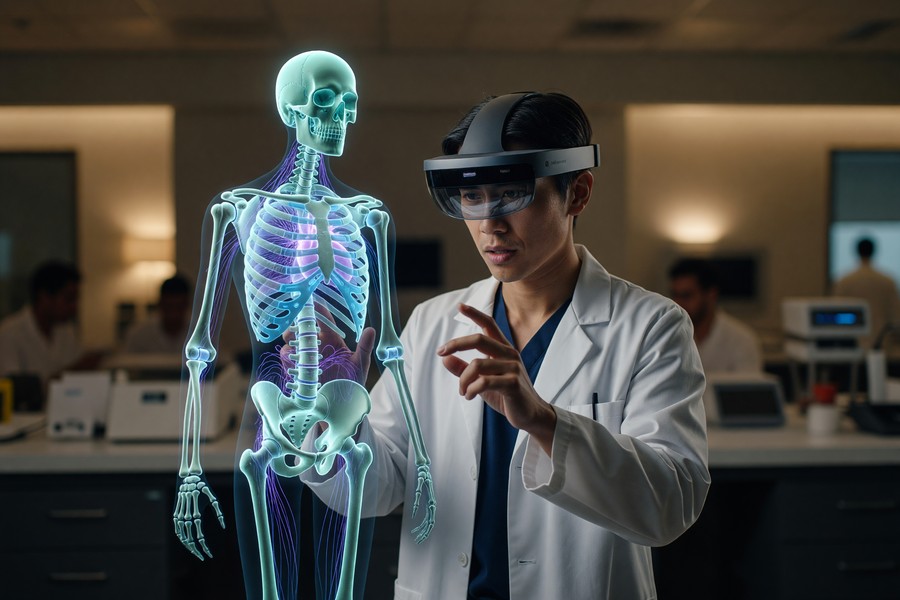
Spatial computing is delivering measurable clinical improvements in surgery, medical training, and patient rehabilitation. Surgeons using AR-guided navigation systems can overlay CT scan data directly onto a patient’s body during procedures, reducing reliance on separate monitor screens and improving precision.
Companies like Medivis and Proprio have developed FDA-cleared surgical AR platforms. Microsoft’s HoloLens 2 is used in operating rooms across major health systems, including the Cleveland Clinic, to project anatomical data in real time during complex surgeries.
Medical Training and Patient Care
Medical schools are adopting spatial computing for anatomy instruction. Case Western Reserve University partnered with Microsoft to replace cadaver-based labs with HoloLens-powered holographic dissection, allowing students to manipulate 3D anatomical models from any angle.
The healthcare AR market is on a steep growth curve. According to MarketsandMarkets, it is expected to reach $4.2 billion by 2026. Rehabilitation applications are also expanding, with spatial computing tools helping stroke patients relearn motor skills through gamified, spatially aware physical therapy sessions.
This mirrors broader trends in how technology is being embedded in personal health — a shift also reflected in the rise of wearable technology transforming personal health tracking, which increasingly integrates with spatial data feeds.
“Spatial computing will fundamentally change how surgeons interact with information during procedures. Having patient data contextually anchored in 3D space — rather than on a flat screen across the room — reduces cognitive load and keeps attention where it belongs: on the patient.”
How Is Spatial Computing Changing Retail and Commerce?
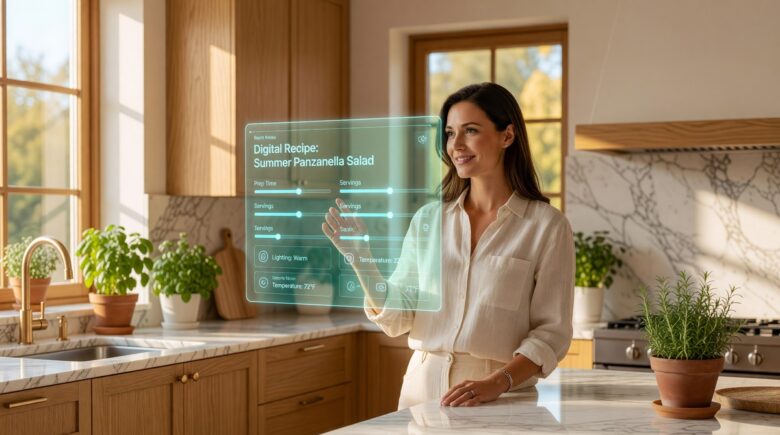
Spatial computing everyday use in retail centers on reducing purchase uncertainty. Shoppers can visualize products at true scale in their own environment before buying, which directly lowers return rates and increases conversion confidence.
IKEA‘s AR app, IKEA Place, allows users to position true-to-scale 3D furniture models in their homes using a smartphone camera. Wayfair reports that customers who use its AR feature are more than twice as likely to complete a purchase compared to those who browse standard product images.
Virtual Try-On and In-Store Navigation
Snap and L’Oreal have built AR try-on tools that let users test cosmetics, eyewear, and apparel using facial recognition and spatial mapping. Sephora‘s Virtual Artist feature has been used by tens of millions of shoppers to preview makeup shades using their phone cameras.
In-store spatial computing is also advancing. Amazon deployed Just Walk Out technology in its Go stores, using overhead computer vision and sensor fusion to eliminate checkout lines entirely. The technology tracks items picked up and automatically charges customers upon exit — a real-world demonstration of spatial computing at retail scale.
Retailers using AR product visualization tools report an average 40% reduction in product return rates, according to a Shopify Commerce study on AR in e-commerce. Fewer returns directly translate to lower logistics costs and improved customer satisfaction scores.
How Is Spatial Computing Reshaping the Workplace and Manufacturing?
In industrial settings, spatial computing everyday use is most advanced. Workers equipped with AR headsets receive step-by-step assembly instructions overlaid directly onto physical components, eliminating the need to reference paper manuals or separate screens.
Boeing uses AR-guided wiring harness assembly in its commercial aircraft production lines. The company’s own research found this approach cut assembly time by 25% and reduced errors by as much as 40%, according to Boeing’s published case findings. Lockheed Martin has reported similar gains in its satellite assembly workflows.
Remote Assistance and Digital Twins
PTC’s Vuforia and Scope AR provide remote expert platforms where a specialist can see what a field technician sees through a headset and annotate the view with instructions in real time. This reduces the need for costly expert travel and compresses repair time significantly.
Digital twins — virtual replicas of physical systems updated with live sensor data — represent the industrial frontier of spatial computing. Siemens and NVIDIA (through its Omniverse platform) are building digital twins of entire factories, allowing engineers to simulate changes before implementing them physically. This directly parallels advances in how emerging computing paradigms are changing everyday technology at the infrastructure level.
| Industry | Primary Application | Reported Efficiency Gain | Key Platform / Company |
|---|---|---|---|
| Aerospace | AR-guided wiring assembly | 25% faster, 40% fewer errors | Boeing, Lockheed Martin |
| Healthcare | Surgical AR navigation | Up to 30% reduction in procedure time | Medivis, Microsoft HoloLens 2 |
| Retail | AR product visualization | 40% lower return rates | IKEA Place, Wayfair, Sephora |
| Education | Holographic anatomy labs | 35% higher knowledge retention | Case Western / HoloLens, zSpace |
| Manufacturing | Digital twin simulation | 20% reduction in downtime | Siemens, NVIDIA Omniverse |
What Role Does Spatial Computing Play in Education and Training?
Spatial computing is transforming education by making abstract concepts tangible and three-dimensional. Students can walk through a virtual Roman forum, manipulate molecular structures, or observe geological formations from the inside — all without leaving the classroom.
Platforms like zSpace and Prisms VR are already deployed in thousands of K-12 classrooms across the United States. Research from EdSurge’s review of classroom VR studies found that immersive spatial learning environments can improve knowledge retention by up to 35% compared to traditional 2D instruction methods.
Corporate and Military Training
Enterprise training is one of the fastest-growing segments. Walmart trained over 1 million employees using VR headsets from Strivr for customer service and safety scenarios. The U.S. Army’s Integrated Visual Augmentation System (IVAS), built on HoloLens technology with a $21.9 billion contract awarded to Microsoft, is designed to give soldiers real-time battlefield spatial awareness.
These applications demonstrate that spatial computing everyday use is not limited to entertainment or consumer novelty — it is being embedded in high-stakes professional training at institutional scale.
The U.S. Army’s IVAS contract with Microsoft — valued at up to $21.9 billion over 10 years — is one of the largest spatial computing procurement agreements in history, signaling government confidence in the technology’s operational reliability for mission-critical environments.
Which Devices Are Driving Spatial Computing Everyday Use?
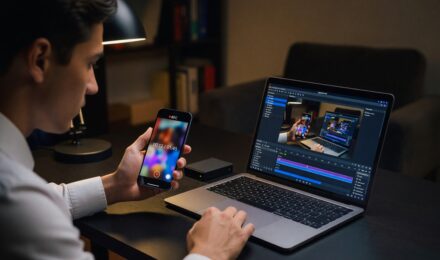
Smartphones are currently the dominant spatial computing device for consumers, with over 1.4 billion mobile AR users globally as of 2025, per Statista’s mobile AR user data. Every modern iPhone and high-end Android device includes LiDAR or depth-sensing cameras capable of real-time spatial mapping.
Dedicated headsets occupy the premium tier. Apple Vision Pro (launched February 2024 at $3,499) introduced a visionOS operating system built entirely around spatial interaction. Meta’s Quest 3, priced at $499, targets the mainstream market with mixed reality passthrough capabilities that let users see and interact with their real environment while wearing the headset.
Smart Glasses and the Next Form Factor
Meta and Ray-Ban partnered to release AI-enabled smart glasses that capture spatial context without full AR overlays, selling over 1 million units in 2024. Google is developing next-generation AR glasses under its renewed Project Astra initiative. Qualcomm’s Snapdragon AR2 Gen 1 chip is purpose-built for lightweight AR glasses, enabling real-time AI processing without the bulk of current headsets.
Connectivity is a critical enabler. As detailed in our comparison of 5G vs Wi-Fi 7 wireless technologies, ultra-low-latency networks are essential for offloading spatial computing workloads from devices to cloud infrastructure — particularly for enterprise AR applications requiring real-time collaboration.

What Are the Key Challenges and the Near-Term Outlook?
Spatial computing faces real barriers to mass adoption despite its momentum. The most significant are hardware cost, form factor limitations, battery life, and privacy concerns around persistent spatial data collection.
Current premium headsets remain too expensive and physically cumbersome for all-day wear. Battery life on standalone headsets like Apple Vision Pro averages roughly 2 hours of active use — insufficient for full workday deployment without tethering. Privacy regulators in the EU, under the General Data Protection Regulation (GDPR), are actively examining how spatial data captured by AR devices is stored and processed.
The Path to Mainstream Adoption
Analysts at IDC’s 2024 AR/VR headset market forecast project that global shipments of spatial computing headsets will exceed 10 million units annually by 2027, with price compression bringing entry-level capable devices below $200. Semiconductor advances — particularly in microLED displays and neural processing units — are expected to enable glasses-form-factor AR by 2027 to 2028.
The broader technology ecosystem is converging to support this shift. Advances in AI reasoning, as covered in our analysis of how AI is changing the way we search the internet, are directly feeding into the scene-understanding capabilities that make spatial computing contextually useful rather than merely visually impressive.
If you are evaluating spatial computing tools for business use today, start with smartphone-based AR platforms rather than dedicated headsets. Mobile AR requires no new hardware investment, reaches the widest user base, and offers mature SDKs from Apple (ARKit) and Google (ARCore) with robust enterprise support.
“We are at the same inflection point with spatial computing that we were with smartphones in 2007. The hardware is imperfect, the use cases are still being discovered — but the trajectory is unmistakable. Within five years, not wearing a spatial interface will feel like choosing not to have a screen.”
Frequently Asked Questions
What is spatial computing in simple terms?
Spatial computing is technology that allows computers to understand and interact with three-dimensional physical space. It uses cameras, sensors, and AI to blend digital information — images, data, instructions — with the real-world environment you can see and touch.
Is spatial computing the same as augmented reality?
No — augmented reality (AR) is one component of spatial computing, not the whole category. Spatial computing also includes virtual reality, mixed reality, computer vision, digital twins, and spatial audio. AR overlays digital content on the real world; spatial computing is the broader system that makes that possible.
What devices support spatial computing right now?
Smartphones with LiDAR or depth cameras — including iPhone 15 Pro and many Android flagships — support mobile AR today. Dedicated headsets include Apple Vision Pro, Meta Quest 3, and Microsoft HoloLens 2. Smart glasses like Meta Ray-Bans offer a lighter form factor with limited but growing spatial capabilities.
How is spatial computing being used in everyday life today?
Spatial computing everyday use currently includes AR furniture placement apps (IKEA Place), virtual cosmetic try-on (Sephora), navigation overlays, workplace training simulations, surgical guidance in hospitals, and factory assembly assistance. Smartphone AR reaches over 1.4 billion users globally as of 2025.
Is spatial computing safe from a privacy standpoint?
Spatial computing devices continuously capture visual and spatial data about your environment, raising legitimate privacy concerns. Regulators including the EU under GDPR and the U.S. Federal Trade Commission are examining how this data is stored and who can access it. Users should review privacy settings carefully before adopting any spatial computing platform.
How does spatial computing differ from the metaverse?
The metaverse refers to persistent, shared virtual social environments — a concept popularized by Meta and others. Spatial computing is the underlying technology infrastructure that can power metaverse experiences but also operates entirely in the physical world without any virtual environment. Spatial computing is broader and more immediately practical.
When will spatial computing become mainstream for consumers?
IDC projects headset shipments will surpass 10 million units annually by 2027. Glasses-form-factor AR — thin enough for all-day wear — is expected by 2027 to 2028 as microLED and chip technology matures. Smartphone-based spatial computing is already mainstream, with over 1.4 billion active mobile AR users today.
Sources
- Grand View Research — Spatial Computing Market Size & Forecast Report
- Statista — Global Mobile Augmented Reality User Count, 2025
- MarketsandMarkets — Augmented Reality in Healthcare Market Report
- Boeing — Augmented Reality Wiring Assembly Case Study
- Apple — Apple Vision Pro Product Page
- IDC — Worldwide AR/VR Headset Market Forecast, 2024
- Shopify — Augmented Reality in E-Commerce: Product Return Rate Data
- EdSurge — VR in Classrooms: What the Research Actually Shows
- Forbes Tech Council — Augmented Reality in Retail: Conversion and Return Rate Impact
- Qualcomm — Snapdragon AR2 Gen 1 Platform Overview