Fact-checked by the VisualEnews editorial team
Quick Answer
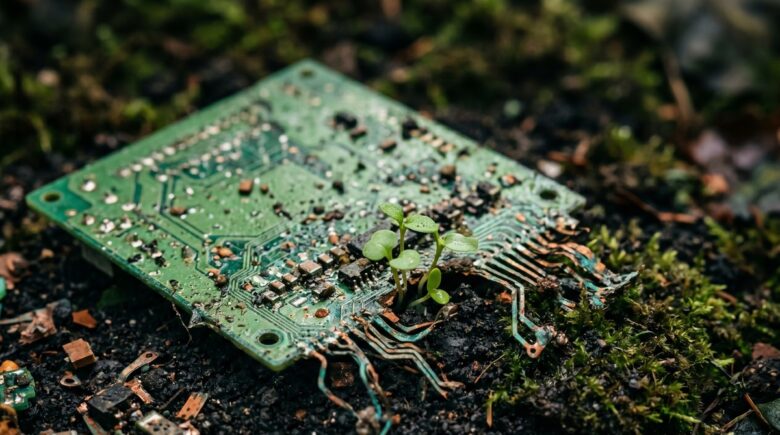
Biodegradable electronics use plant-based polymers, cellulose, and organic semiconductors to build devices that break down safely once they’ve done their job. In 2022, the world generated a record 62 million metric tons of e-waste. Only 22.3% of it was formally collected and recycled, according to the International Telecommunication Union and United Nations Institute for Training and Research. This is exactly the gap biodegradable electronics are meant to close, keeping toxic materials out of landfills and waterways.
Updated August 2026
Biodegradable electronics e-waste is one of the more interesting corners of materials science right now. Engineers are building circuit boards, sensors, and wearable devices out of substances that decompose naturally, cutting down on the toxic residue left behind by discarded tech. The numbers explain the urgency: 62 million metric tons of e-waste in 2022 alone, with projections putting that figure at 82 million metric tons by 2030 if nothing changes, according to ITU and UNITAR’s Global E-waste Monitor.
This guide walks through how these devices actually work, which materials researchers are betting on, where the technology stands today commercially, and what’s still standing in the way of wider adoption.
Key Takeaways
- Global e-waste hit 62 million metric tons in 2022, but only 22.3% was formally collected and recycled, according to ITU and UNITAR’s Global E-waste Monitor 2024.
- Researchers at Stanford University demonstrated a fully biodegradable thin-film transistor made from cellulose nanofibers that degraded in under three weeks in compost conditions, per Nature Electronics.
- The biodegradable electronics market was valued at approximately $847 million in 2023 and is forecast to grow at a CAGR of 9.4% through 2032, according to Precedence Research.
- Electronic waste contains toxic substances including lead, mercury, and cadmium; the U.S. Environmental Protection Agency identifies e-waste as the fastest-growing solid waste stream in the United States.
- Transient electronics, a subset of biodegradable tech, can dissolve in water in as little as 30 minutes, a capability first demonstrated by John Rogers at the University of Illinois and published in Science.
In This Guide
What Are Biodegradable Electronics and How Do They Work?
These are devices built from organic or bio-derived materials that break down through microbial action, hydrolysis, or enzymatic processes, leaving behind non-toxic byproducts once their working life ends. Conventional electronics sit in landfills for centuries. These are built with an expiration date baked into the material itself.
Getting this right is harder than it sounds. A component has to hold up reliably while it’s in use, then fall apart on cue once it’s not needed anymore. Researchers call this transient electronics design. The substrate, the encapsulation layer, or sometimes both are made from materials engineered to protect the device during service and then give way afterward.
Transient vs. Partially Biodegradable Devices
Fully transient devices dissolve completely, substrate, conductors, semiconductors, everything, once triggered by water, heat, or UV light. Partially biodegradable devices take a more modest approach: they swap out the structural, non-functional parts, things like housings and circuit board substrates, for bio-based alternatives, while keeping conventional metal interconnects in place.
Both cut into the biodegradable electronics e-waste problem, though transient electronics get you closer to a complete fix. DARPA’s VAPR program (Vanishing Programmable Resources) poured funding into fully transient military sensors for exactly this reason, as DARPA has detailed.
Materials scientist John Rogers at the University of Illinois pioneered transient electronics back in 2012. His team built a silicon device on a silk substrate that dissolved entirely in saline solution, an experiment that opened the door to implantable medical electronics that never need to be surgically removed.
What Materials Make Electronics Biodegradable?
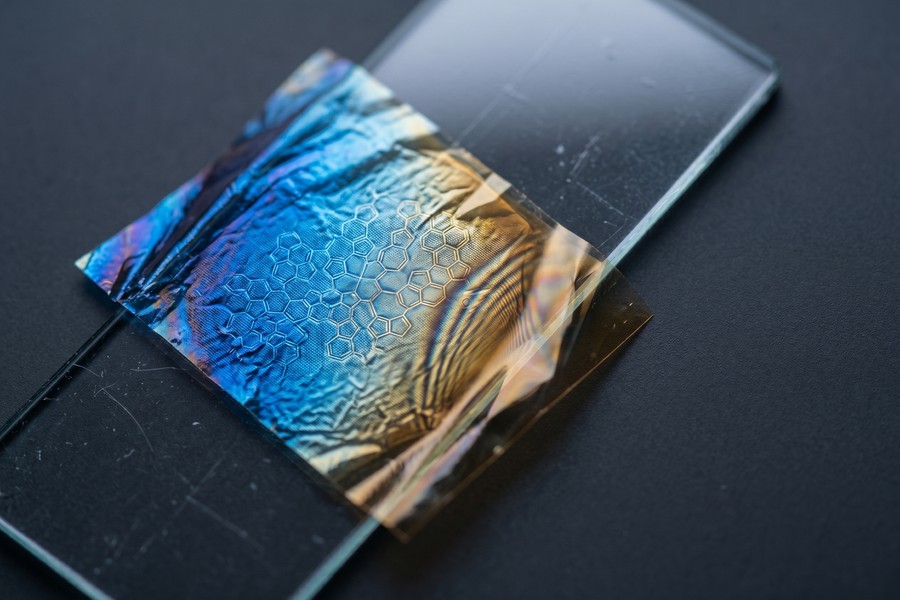
Plant-derived cellulose, silk fibroin, polylactic acid (PLA), and carbon-based organic semiconductors form the backbone of this field. No single material does everything well. Each one trades off mechanical strength, electrical performance, and degradation speed differently.
Substrate Materials
Cellulose nanofibers stand out as a substrate option. They’re cheap, renewable, and stable up to roughly 200°C, which means they can survive standard semiconductor fabrication steps without falling apart prematurely. Researchers at the University of Wisconsin-Madison built cellulose nanopaper circuit boards that shrink to less than 1% of their original volume after composting.
Silk fibroin, pulled from silkworm cocoons, shows up often in biomedical implants because its degradation rate can be tuned to match a treatment window. It’s also optically clear and mechanically flexible, which makes it a candidate for flexible display substrates too.
Conductive and Semiconducting Materials
Organic semiconductors such as pentacene, rubrene, and PEDOT:PSS conduct electricity while staying carbon-based, and in some cases, genuinely biodegradable. PEDOT:PSS (poly(3,4-ethylenedioxythiophene) polystyrene sulfonate) already gets deposited commercially in printed electronics, and it degrades under industrial composting conditions.
Metal conductors are the sticking point. Some labs have turned to magnesium and zinc instead, naturally occurring elements that dissolve without leaving anything harmful behind, a finding documented in Nature Electronics research on transient metal conductors.
| Material | Application | Degradation Time | Key Advantage |
|---|---|---|---|
| Cellulose Nanofiber | PCB substrate | 2–4 weeks (compost) | High thermal stability, abundant |
| Silk Fibroin | Implantable sensors | Days to months (aqueous) | Tunable degradation rate |
| Polylactic Acid (PLA) | Device housing | 3–6 months (industrial compost) | Commercially available at scale |
| Magnesium | Biodegradable conductors | Days to weeks (aqueous) | Non-toxic dissolution products |
| PEDOT:PSS | Organic semiconductor | Months (industrial compost) | High conductivity, printable |
How Bad Is the E-Waste Problem?
E-waste is the fastest-growing solid waste category on the planet, and that scale is exactly why biodegradable electronics e-waste solutions matter now, not five years from now. The EPA classifies e-waste as hazardous, pointing to lead, cadmium, mercury, and brominated flame retardants that leach into soil and groundwater once devices hit a landfill.
ITU and UNITAR’s 2024 report puts hard numbers on it. Of the 62 million metric tons generated in 2022, only about 13.8 million metric tons (22.3%) went through formal processing. The other 48 million metric tons? Informally recycled under unsafe conditions, burned, or simply dumped. Low- and middle-income countries absorb most of that burden, a pattern the Basel Convention has tracked for years.
The Hidden Cost of Conventional Electronics
A single smartphone packs in more than 60 chemical elements, and quite a few of them are hazardous. The Basel Action Network, a watchdog nonprofit, has documented illegal e-waste shipments from wealthy nations landing in West Africa and Southeast Asia, where informal recycling operations expose workers directly to toxic substances. Their findings are posted at ban.org.
Wearables are adding fuel to this fire faster than most people realize. As we’ve covered in how wearable technology is transforming personal health tracking, some devices get replaced every 18 months, and their small size and internal complexity mean they almost never get formally recycled. Right now, e-waste recycling supplies just 1% of global rare earth demand, per ITU/UNITAR data.
E-waste is piling up nearly 3 times faster than any other waste category tracked globally. If nothing changes, annual e-waste will top 82 million metric tons by 2030, according to the ITU and UNITAR. That’s the backdrop that makes biodegradable electronics feel less like a novelty and more like a necessity.
Run the math on this: swap out just 10% of that projected 82 million metric tons with materials that fully decompose, and you prevent more than 8 million metric tons of persistent waste from piling up each year. Picture roughly 1.7 million average-sized garbage trucks simply not needing to make that trip to the landfill.
What Real-World Applications Exist?
Right now, biodegradable electronics e-waste reduction shows up mainly in medical implants, environmental sensors, agricultural monitoring, and consumer packaging electronics. What pushes adoption differs quite a bit from one category to the next.
Medical Implantable Devices
This is where the technology is furthest along commercially. Pressure sensors, temperature monitors, and drug delivery controllers can be implanted, do their job for a set stretch of time, then dissolve, sparing patients a second surgery just to take the device back out. Northwestern University and Washington University in St. Louis have both published clinical findings on fully absorbable neural implants.
The FDA has been in conversation with several manufacturers hunting for a clear regulatory path for transient implantables. The FDA’s Digital Health Center of Excellence now offers a framework that increasingly reaches bioresorbable device categories.
Environmental and Agricultural Sensors
Farmers can scatter biodegradable soil sensors across a field to track moisture, pH, and nutrient levels, then simply leave them there once the season ends. There’s nothing to retrieve. That alone removes the collection headache that makes large conventional sensor networks so unwieldy.
ETH Zurich built a fully biodegradable humidity and temperature sensor on a cellulose substrate back in 2022. It performed on par with conventional MEMS sensors, then broke down completely in soil within a few months. This fits into a broader shift toward sustainable tech infrastructure, not unlike the edge computing networks we cover in our explainer on what edge computing is and how it works.
Zhenan Bao’s lab at Stanford is pushing the same idea further, using biodegradable substrates to rethink what hardware even needs to look like. Once a device is designed to physically vanish after its job is done, engineers can chase applications that would never make sense with permanent hardware.
Consumer Packaging and Single-Use Electronics
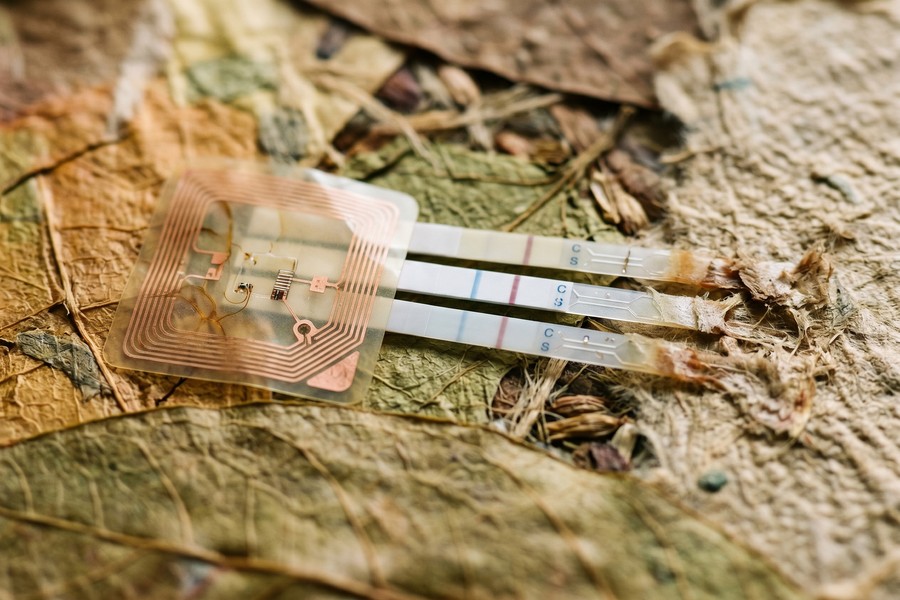
RFID tags, smart labels, and single-use diagnostic strips are high-volume and short-lived, exactly the kind of category where biodegradable materials pay off immediately. Stora Enso, the Finnish paper and packaging giant, already sells printed biodegradable RFID antennas on wood-fiber substrates for supply chain tracking, detailed on their intelligent packaging page. Products like these are already cutting into the biodegradable electronics e-waste tied to billions of label shipments every year.
What Are the Key Challenges?
Adoption is being held back by a mix of performance gaps compared to conventional materials, manufacturing that hasn’t scaled yet, and the stubborn problem of replacing metal conductors. None of this is unsolvable. It’s just going to take years. So let’s be blunt about the tradeoff: even the best biodegradable electronics on the market today can’t touch the speed of a cheap silicon chip. If your project needs high-speed processing in a phone or laptop, this isn’t the technology for you yet. It works well for low-power sensing, monitoring, and packaging, not performance-critical computing.
Performance and Reliability Gaps
Organic semiconductors generally have much lower carrier mobility than silicon does. That caps biodegradable electronics at low-frequency uses for now, think sensors and simple logic circuits rather than anything resembling a processor. Nature Electronics has documented that closing this gap will take real breakthroughs in molecular design, and researchers are still working on it.
Moisture is a separate headache entirely. Plenty of biodegradable substrates start breaking down the moment humidity rises, which is the whole point until it isn’t. Engineers have to strike a balance between designed degradability and enough shelf stability to actually be useful, often relying on thin encapsulation layers that also need to be biodegradable.
Manufacturing and Cost Scalability
Semiconductor manufacturing as it exists today was built around silicon. Retooling factories for cellulose or organic semiconductor deposition means building new processes from scratch. Roll-to-roll printing looks like the best bet for scaling biodegradable electronics production, though yield and resolution still trail behind what photolithography can do with silicon.
Cost is still a wall for consumer products. Biodegradable RFID tags from companies like Stora Enso are close to price parity with conventional plastic tags, but anything more complex, biodegradable sensor boards, for instance, runs 2 to 5 times the cost of a standard equivalent at current production volumes.
Look for third-party certification of degradation conditions before trusting a “biodegradable” label. That word alone can mean the device only breaks down under industrial composting at 60°C, a condition most municipal waste systems simply don’t offer. Ask for ISO 14855 or ASTM D6400 compliance documentation.
Take a supply chain running 10 million RFID units a year. Switching to biodegradable tags would add $2 to $5 million in material costs at today’s prices. But factor in avoided landfill fees, compliance penalties, and the reputational hit from unsustainable packaging, and the math can flip in favor of biodegradable, particularly in regions with tight environmental rules.
What Does the Future Look Like?
Expect biodegradable electronics e-waste solutions to become standard in specific niches by 2030, with wider consumer electronics adoption showing up sometime in the following decade. Three forces are pushing this forward: regulation, material science, and supply chain integration.
Regulatory Drivers
The European Union’s Ecodesign for Sustainable Products Regulation (ESPR), adopted in 2024, sets binding rules around repairability and recyclability for electronics, effectively creating demand for biodegradable design choices. The European Environment Agency has flagged biodegradable substrates as a priority material category under the EU Circular Economy Action Plan.
In the U.S., a handful of states have passed extended producer responsibility (EPR) laws for electronics, giving manufacturers a real incentive to plan for end-of-life. Technology keeps burrowing deeper into everyday life, from the quantum systems we cover in our explainer on how quantum computing will change everyday technology to the edge hardware in our 5G vs Wi-Fi 7 comparison. As it does, the material footprint of connected devices turns into a policy question, and that pressure will only push biodegradable adoption faster.
Material Science on the Horizon
Teams at MIT and IMEC (the Belgian nanoelectronics research center) are working on biodegradable gate dielectrics and higher-mobility organic semiconductors, work that could narrow the gap with silicon within five years. Landmark work published in Science already showed that silicon itself, thinned down to the nanoscale, can become transient. That hints at a shorter path forward: thinning silicon instead of replacing it outright.
AI-driven materials discovery is speeding things along too. Machine learning models now sift through molecular structures looking for the right balance of electrical performance and degradability, compressing what used to take years of trial and error. It’s a pattern that echoes what we’ve seen in other fields, something we cover in how AI is changing internet search.
Picture a manufacturer weighing a new line of biodegradable agricultural sensors. The upfront cost runs three times higher than conventional hardware. But once you factor in the savings from skipping collection and disposal logistics, especially across remote fields, the total cost of ownership can actually come out lower after two years. Deploy more than 10,000 sensors across multiple sites, and those efficiency gains start to justify the initial spend pretty quickly.
Who Should Skip This?
If you need high-performance computing, dense memory, or long-term data storage, biodegradable electronics aren’t ready for you yet. The same goes for battery-powered devices expected to last five years or more. Laptops, smartphones, and industrial control systems are all off the table for now. This technology shines in short-term, low-power applications where environmental impact matters more than raw performance.
Frequently Asked Questions
Are biodegradable electronics currently available to buy?
Yes, within limited categories. Biodegradable RFID tags, smart packaging labels, and some medical sensors are already sold by companies including Stora Enso and a handful of biomedical device makers. Fully biodegradable consumer electronics are still in research and prototype stages as of mid-2025.
How long do biodegradable electronics take to decompose?
It depends heavily on the material and the environment it’s exposed to. Silk fibroin devices can dissolve in water within days to weeks. Cellulose substrates usually break down in two to four weeks under industrial composting. PLA housings need three to six months at elevated temperatures in certified industrial facilities, they won’t break down quickly in a backyard compost pile or a landfill.
Do biodegradable electronics perform as well as conventional ones?
Not for anything demanding yet. Current biodegradable electronics fit best in low-power, low-frequency roles, sensors, displays, RFID tags. Organic semiconductors simply can’t match silicon’s carrier mobility. For a lot of IoT and medical sensing work, this level of performance is more than enough.
What happens to the metals inside biodegradable electronics?
This is the piece nobody’s fully solved yet. Researchers are swapping copper and gold for magnesium, zinc, and iron, metals that dissolve without causing harm. Even so, many current devices still rely on small amounts of conventional metal for high-performance interconnects, which means they’re only partially biodegradable until that substitution problem gets fixed.
What is the difference between biodegradable and recyclable electronics?
Recyclable electronics depend on materials being recovered and reused, which requires collection and processing infrastructure that currently handles less than 22.3% of global e-waste. Biodegradable electronics skip that requirement entirely, breaking down on their own. The two approaches complement each other rather than compete.
Are biodegradable electronics safe to dispose of in regular compost?
Most need industrial composting, generally above 55°C, not a backyard bin. Look for ASTM D6400 or EN 13432 certification if industrial compostability matters to you, and always check the manufacturer’s specs. Devices with even trace metal components shouldn’t go in home compost until conductor substitution is fully worked out.
Which companies are leading biodegradable electronics development?
Stora Enso leads on biodegradable RFID and printed packaging electronics. On the biomedical side, Roper Technologies and several university spinouts are active. Research leadership clusters around Stanford, MIT, Northwestern, ETH Zurich, and IMEC. Nobody owns the full spectrum of this space yet.
How much more expensive are biodegradable electronics?
It varies a lot. Simple printed biodegradable RFID tags sit close to price parity with plastic ones. More complex circuits, biodegradable sensor boards especially, run 2 to 5 times standard production costs at current volumes. As manufacturing scales up and roll-to-roll printing matures, expect that gap to shrink over the next decade.
Do biodegradable medical devices need separate FDA approval?
Yes. Since these implants dissolve inside the body, they go through strict biocompatibility and degradation-product safety testing. The FDA’s Digital Health Center of Excellence guides manufacturers through bioresorbable device approvals, usually requiring the same clinical data traditional implants need.
Will we ever see a fully biodegradable smartphone?
Not this decade, probably. High-performance processors, dense memory, and long-lasting batteries all lean on materials that don’t have biodegradable substitutes yet. Individual pieces, casings, circuit substrates, sensors, could get there sooner though, and a “mostly biodegradable” phone isn’t out of the question by the mid-2030s if material science keeps up its current pace.
Sources
- ITU and UNITAR, Global E-waste Monitor 2024
- ITU and UNITAR, E-waste Rising Five Times Faster than Recycling
- Nature Electronics, Biodegradable and Transient Electronic Devices
- Science, A Physically Transient Form of Silicon Electronics (Rogers et al.)
- U.S. Environmental Protection Agency, Cleaning Up Electronic Waste (E-Waste)
- Precedence Research, Biodegradable Electronics Market Size and Forecast
- U.S. FDA, Digital Health Center of Excellence: What Is Digital Health
- Basel Convention, E-Waste Overview and International Controls
- Stora Enso, Intelligent Packaging and Biodegradable Electronics
- Basel Action Network, E-waste Export Documentation