
Picture this: you walk into your kitchen in the morning, and the lights adjust automatically. Your coffee maker starts brewing. A soft voice reads your calendar. You never touched a single screen. That’s the promise of ambient computing smart devices — technology that anticipates your needs and fades into the background of your life.
The global ambient computing market is projected to reach $201 billion by 2030, according to Allied Market Research. This article breaks down what ambient computing actually is, how it works, which surfaces are being transformed, and what it means for your privacy and daily routine.
Key Takeaways
- The ambient computing market is projected to hit $201 billion by 2030, driven by AI, sensors, and 5G connectivity.
- Ambient computing smart devices are already embedded in mirrors, walls, cars, and clothing — not just phones and speakers.
- Edge computing reduces response latency to under 10 milliseconds, making real-time ambient interactions possible at scale.
- Privacy remains the top concern — over 72% of consumers worry about always-on devices collecting personal data, per a Pew Research survey.
What Is Ambient Computing, Exactly?
Ambient computing is the idea that technology should be woven into your environment — invisible, responsive, and always available without requiring deliberate interaction. Think less “open an app” and more “the room just knows.”
The concept was popularized by Mark Weiser at Xerox PARC, who in 1991 described a future of “calm technology” that works in the periphery of human attention. Decades later, faster chips, AI, and ubiquitous wireless networks are finally making that vision real.
Unlike traditional computing — where you sit down, open a device, and interact — ambient computing reacts to you. It uses sensors, machine learning, and connectivity to serve information or take action without being asked.
Ambient computing is the natural endpoint of decades of miniaturization and connectivity — we are finally reaching a point where the interface disappears entirely and the environment itself becomes the computer,
says Dr. Priya Anand, PhD in Human-Computer Interaction, Associate Professor of Ubiquitous Systems at Carnegie Mellon University.
How Everyday Surfaces Are Becoming Ambient Computing Smart Devices
The shift is dramatic. Surfaces that once did nothing are now embedded with microprocessors, cameras, and sensors. Your bathroom mirror, kitchen counter, and car windshield are all candidates for transformation.
Smart Mirrors and Glass
Smart mirrors can display your calendar, health stats, and weather while you brush your teeth. Companies like Capstone Connected Home and HiMirror already sell consumer versions. The glass itself becomes the interface.
Transparent display technology is advancing fast. Samsung’s “The Frame” TV blurs the line between screen and wall art — a small example of a much larger trend. Corning, the materials science company behind Gorilla Glass, has published research showing that flexible glass substrates can now support embedded touch and sensor layers at a production cost below $12 per square foot at volume — a threshold that makes widespread architectural deployment commercially viable for the first time.
Floors, Walls, and Countertops
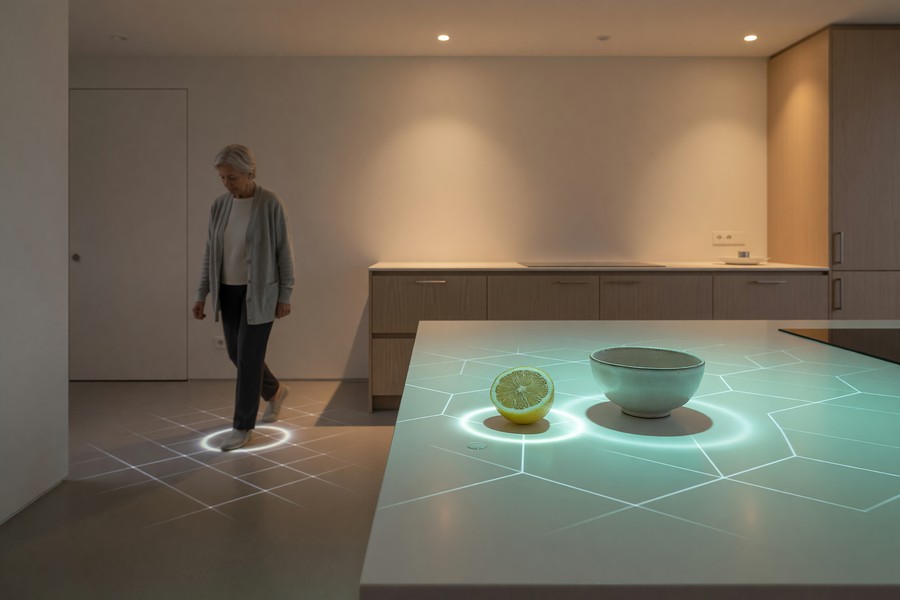
Pressure-sensitive floors can detect falls in elder-care settings without any wearable device. Smart countertops from companies like Whirlpool’s Pervasive Displays project can identify objects placed on them and offer recipe suggestions or nutritional data. Walls embedded with flexible displays are already used in commercial retail environments.
This isn’t science fiction — it’s happening in pilot programs right now, especially in healthcare and hospitality. Amazon has piloted ambient sensing infrastructure in its Go convenience stores since 2018, and the technology has since been licensed to third-party retailers. Microsoft’s Azure Percept platform provides the edge AI hardware that many of these commercial deployments depend on.
The Technologies That Make It All Work
Ambient computing doesn’t run on magic. It relies on a tight stack of enabling technologies that have matured simultaneously.
AI and Machine Learning
AI is the brain of ambient computing. Models trained on behavioral data can predict what you need before you ask. Your smart thermostat “learns” your schedule. Your car adjusts the seat when you get in. These micro-decisions happen hundreds of times a day, invisibly.
Google’s TensorFlow Lite and Apple’s Core ML framework are the two dominant on-device inference engines powering ambient AI today. Both allow machine learning models to run directly on low-power microcontrollers without a cloud round-trip. Qualcomm’s Snapdragon platforms, used in a wide range of smart home devices, include dedicated neural processing units specifically designed for ambient workloads. Meanwhile, Arm Holdings licenses the processor architectures that underpin the vast majority of ambient sensors and microcontrollers shipped globally — over 30 billion Arm-based chips were shipped in 2024 alone according to the company’s annual report.
If you’re curious about AI’s broader role in reshaping everyday tech, the article on how AI is changing the way we search the internet offers useful context.
Edge Computing and Connectivity
Edge computing processes data locally — on the device or nearby server — instead of routing everything to a distant cloud. This cuts response times dramatically. For ambient systems, that speed is essential. A smart lock that hesitates for two seconds isn’t smart enough.
For a deeper dive into how edge processing works, check out this overview of what edge computing is and how it works. Paired with 5G and Wi-Fi 7 connectivity, edge computing gives ambient systems the low-latency backbone they need. Cisco has projected that by 2027, more than **75% of enterprise data** will be created and processed at the edge rather than in centralized data centers — a structural shift that directly enables ambient computing at scale. AWS Greengrass and NVIDIA Jetson are two of the most widely deployed edge computing platforms serving this transition.
For a deeper dive into how edge processing works, check out this overview of what edge computing is and how it works. Paired with 5G and Wi-Fi 7 connectivity, edge computing gives ambient systems the low-latency backbone they need.
Sensors and Microcontrollers
Tiny, cheap sensors are everywhere now. Motion sensors, temperature monitors, light detectors, and microphones cost pennies at scale. Combined with microcontrollers, they turn passive surfaces into active, data-gathering nodes. The cost of adding intelligence to an object has never been lower.
| Ambient Technology Layer | Key Enabling Companies | Typical Component Cost (2026) | Average Latency | Primary Use Case |
|---|---|---|---|---|
| On-device AI Inference | Qualcomm, Apple, Google | $0.80–$4.00 per unit | 2–8 ms | Voice recognition, gesture detection |
| Edge Computing Platform | AWS Greengrass, NVIDIA Jetson, Cisco | $45–$180 per node | 5–12 ms | Real-time sensor fusion, local decision-making |
| MEMS Motion Sensors | STMicroelectronics, Bosch Sensortec | $0.15–$0.90 per unit | 1–3 ms | Fall detection, occupancy sensing |
| Smart Glass / Flexible Display | Corning, Samsung, LG Display | $9–$18 per sq ft (volume) | 16–33 ms (60 fps refresh) | Smart mirrors, ambient information surfaces |
| 5G Connectivity Module | Qualcomm, MediaTek, Ericsson | $12–$35 per module | 8–15 ms | Always-on cloud sync, remote management |
| Wi-Fi 7 Connectivity Module | Broadcom, Intel, MediaTek | $6–$22 per module | 1–5 ms | High-bandwidth local device communication |
Wearables: Your Body as Part of the Network
Ambient computing extends beyond your home. Wearable technology turns your body into part of the computing environment. Smartwatches detect heart rate irregularities. Smart rings monitor sleep. AR glasses overlay information on the physical world.
The integration between wearables and ambient environments is tightening. Your watch can tell your home you’ve arrived. Your fitness band can signal the gym equipment to load your saved settings. This kind of device-to-environment communication is what makes the experience feel seamless.
Apple Watch, Google’s Pixel Watch, and Samsung Galaxy Ring are among the most widely deployed ambient wearable platforms as of May 2026. Meta’s Ray-Ban smart glasses — now in their fourth hardware generation — have moved AR overlays from novelty to practical daily use, with over 4 million units shipped in 2025 according to IDC. Fitbit, now operating under Google’s hardware division, continues to expand its ambient health sensing capabilities, particularly around passive glucose monitoring research.
If you’re already tracking health with wearables, the article on how wearable technology is transforming personal health tracking explores how these devices fit into a broader health strategy.
The wearable-to-environment handshake is where ambient computing becomes genuinely transformative — when your body’s data informs the space around you in real time, the distinction between personal device and smart environment essentially collapses,
says James Okafor, MSc in Embedded Systems Engineering, Senior Research Engineer at MIT Media Lab.

Privacy and Security: The Uncomfortable Trade-Off
Ambient computing smart devices are always listening, watching, or sensing. That’s exactly what makes them useful — and exactly what makes them unsettling. Every surface that becomes smart also becomes a potential data collection point.
A 2023 Pew Research Center survey found that 72% of Americans feel they have very little control over what companies do with their personal data. Ambient computing amplifies this concern significantly. Data is being generated passively, often without explicit user action.
Regulatory attention is intensifying in parallel. The Federal Trade Commission has opened investigations into data practices of ambient device manufacturers, and the California Consumer Privacy Act has been cited in multiple class-action suits involving always-on smart home products. In the EU, the General Data Protection Regulation places strict consent and data minimization requirements on ambient sensing systems that process biometric or behavioral data — requirements that U.S. manufacturers exporting to European markets must comply with. The Internet of Things Cybersecurity Improvement Act, signed into U.S. law in 2020, established baseline security standards for IoT devices purchased by federal agencies and has since influenced broader industry norms.
What You Can Do
You’re not powerless. Here are practical steps to protect yourself:
- Audit every smart device on your home network regularly.
- Use separate network segments (VLANs) for IoT devices when possible.
- Review privacy settings on ambient devices — many have data-sharing options disabled by default that can be toggled off.
- Understand your digital identity and how to protect it in an always-connected world.
Security researchers at the National Institute of Standards and Technology (NIST) publish IoT security guidelines that apply directly to ambient device deployments. These are worth bookmarking.
Where Ambient Computing Smart Devices Are Headed
The next five years will accelerate what we’ve described above. More surfaces will gain intelligence. The boundaries between physical and digital will continue to blur. And the systems coordinating all these devices will get far smarter.
Quantum computing could eventually make real-time processing of complex ambient data sets trivial. The article on how quantum computing will change everyday technology explores what that horizon looks like. For now, the combination of AI, edge computing, and affordable sensors is already enough to reshape your environment.
The practical question isn’t whether ambient computing will arrive — it already has. The question is how deliberately you’ll engage with it. Understanding the technology is the first step to using it on your own terms.
Frequently Asked Questions
What is the difference between ambient computing and the Internet of Things?
The Internet of Things (IoT) refers to physical devices connected to the internet and each other. Ambient computing is a broader philosophy — it describes an experience where technology integrates so smoothly into your environment that it becomes invisible. IoT is often the infrastructure that enables ambient computing.
Are ambient computing smart devices safe to use at home?
They can be, with proper precautions. The risks come from poor security configurations, weak passwords, and unpatched firmware. Using a dedicated network for smart devices, keeping software updated, and reviewing privacy settings significantly reduces your exposure. No connected device is 100% risk-free, but informed use makes a real difference.
How much do ambient computing setups cost?
Entry-level ambient setups — a smart speaker, a few smart bulbs, and a connected thermostat — can cost under $200. Professional installations with smart glass, embedded sensors, and full-home automation can run into the tens of thousands. The cost is dropping fast as the hardware becomes commoditized.
Will ambient computing replace smartphones?
Not entirely — at least not soon. Smartphones are still the hub for managing many connected experiences. But the need to pull out your phone for routine tasks is already declining. As ambient interfaces mature, the phone becomes less a primary interface and more a configuration tool running in the background.
What industries are adopting ambient computing fastest?
Healthcare leads adoption, using ambient sensing for patient monitoring, fall detection, and medication reminders. Retail and hospitality follow closely, using smart surfaces for personalization and customer experience. Manufacturing uses ambient computing for real-time equipment monitoring and worker safety. Consumer homes are catching up rapidly as prices fall.
Sources
- Allied Market Research — Ambient Computing Market Report
- Pew Research Center — How Americans Think About Privacy and Surveillance
- NIST — Internet of Things (IoT) Security Guidelines
- Wikipedia — Mark Weiser and the Origins of Ubiquitous Computing
- Gartner — Internet of Things and Ambient Technology Insights
- McKinsey Digital — The Internet of Things and Accelerating Opportunity