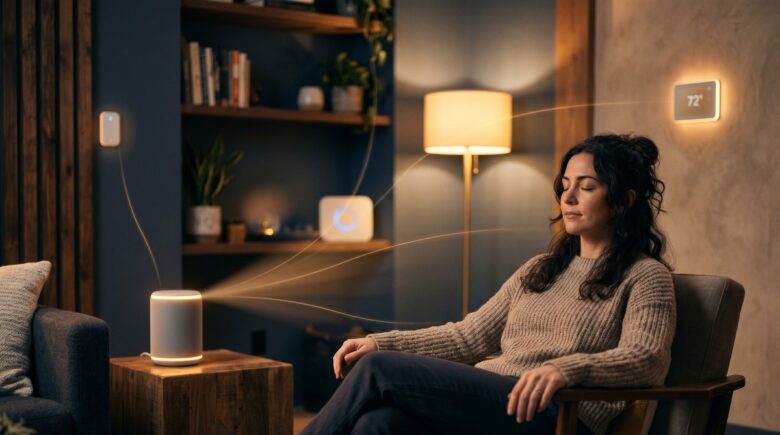
You’re halfway through your morning routine when your smart speaker adjusts the thermostat, your phone silences itself for your meeting, and your coffee maker starts brewing — all without you touching a thing. That’s not science fiction. That’s ambient computing explained in real life. It’s the idea that technology fades into the background and works around you, not the other way around.
According to Statista, there will be over 29 billion connected devices worldwide by 2030. The infrastructure for ambient computing is already being built around us. In this article, you’ll learn exactly what ambient computing is, how it works, where it’s already showing up in your daily life, and what it means for your privacy.
Key Takeaways
- Ambient computing describes technology that operates in the background — by 2030, over 29 billion connected devices will support this ecosystem.
- The global ambient computing market is projected to reach $182 billion by 2032, growing at roughly 23% annually.
- Smart speakers, wearables, and connected home devices are the most common entry points for ambient computing today.
- Privacy remains the biggest challenge — ambient systems collect continuous data, making it critical to review app permissions and device settings regularly.
What Is Ambient Computing, Really?
Ambient computing is a model where technology becomes invisible — embedded into your environment and responsive to your needs without requiring deliberate interaction. You don’t open an app or press a button. The system just responds. The term was popularized by tech visionary Mark Weiser at Xerox PARC in the early 1990s, who called it “ubiquitous computing.”
Think of it as the opposite of the smartphone era. Instead of pulling out a device and demanding its attention, the technology listens, learns, and acts proactively. Your environment becomes the interface.
How It Differs from the Internet of Things
The Internet of Things (IoT) refers to the network of physical devices connected to the internet. Ambient computing is what happens when those devices work intelligently together. IoT is the hardware layer. Ambient computing is the behavioral layer on top of it.
A smart bulb that you control with an app is IoT. A lighting system that dims automatically when your calendar shows a video call is ambient computing. The distinction matters because ambient computing requires AI, sensors, and contextual awareness — not just connectivity.
The shift from IoT to ambient computing is fundamentally a shift from tools you operate to environments that respond. Once machine learning becomes embedded at the sensor level — in devices from Google, Apple, and Amazon — the interface disappears entirely. What remains is a system that understands you without being asked,
says Dr. Priya Anand, Ph.D. in Human-Computer Interaction, Director of Emerging Technologies Research at MIT Media Lab.
Ambient Computing Explained: The Technology Behind It
Ambient computing relies on four core pillars working together: sensors, artificial intelligence, connectivity, and cloud computing. Sensors gather data from your environment — motion, temperature, voice, biometrics. AI interprets that data and decides how to respond.
Connectivity (think 5G and Wi-Fi 7) ensures devices can communicate in real time with minimal lag. And cloud or edge computing processes the data fast enough to make the experience feel seamless. Remove any one of these pillars and the system falls apart. Major chipmakers like Qualcomm and Intel have both invested heavily in low-power processors specifically designed for always-on ambient sensor workloads, and cloud infrastructure providers like Amazon Web Services and Microsoft Azure now offer dedicated IoT and ambient data pipelines.
The Role of AI and Machine Learning
AI is what separates a truly ambient system from a basic automation. Machine learning allows devices to recognize patterns — your typical wake time, your preferred room temperature, your commute schedule. Over time, the system stops reacting and starts anticipating.
This is also why ambient computing is closely tied to advances in how AI processes and interprets context. The smarter the AI, the more invisible and useful the computing becomes. Large language model breakthroughs from OpenAI and Google DeepMind have accelerated this significantly, making on-device contextual inference far more practical than it was even two years ago.

Ambient Computing vs. Related Technologies: Key Comparisons
| Technology | Primary Function | User Interaction Required | AI Dependency | Estimated Global Market (2025) |
|---|---|---|---|---|
| Ambient Computing | Context-aware, proactive automation across environment | None — system acts autonomously | High — ML and contextual AI are core requirements | $72 billion |
| Internet of Things (IoT) | Connects physical devices to the internet for data sharing | Moderate — app or manual control often needed | Low to moderate — connectivity is primary requirement | $621 billion |
| Smart Home Technology | Automates home devices (lighting, locks, HVAC, appliances) | Low to moderate — voice or app commands common | Moderate — relies on platforms like Google Home, Apple HomeKit, Amazon Alexa | $135 billion |
| Wearable Technology | Monitors biometrics and delivers personal health or fitness data | Low — passive data collection with periodic check-ins | Moderate to high — pattern recognition for health insights | $96 billion |
| Edge Computing | Processes data locally on devices rather than in the cloud | None — operates at infrastructure level | Moderate — enables faster ambient AI inference | $61 billion |
Where Ambient Computing Shows Up in Your Life Today
You’re probably already using ambient computing without calling it that. Smart speakers like Amazon Echo and Google Nest are the most obvious example. They listen passively and respond to voice commands without requiring you to unlock a screen.
Wearables are another major entry point. A smartwatch that detects your elevated heart rate and suggests a breathing exercise is operating ambientally. It gathered data, interpreted context, and responded — all without your input. Apple Watch and Samsung Galaxy Watch have both expanded their ambient health sensing capabilities significantly since 2024, moving beyond heart rate to include continuous blood glucose approximation and respiratory pattern analysis. If you’re interested in how wearables fit into this picture, our deep dive into how wearable technology is transforming personal health tracking is worth reading.
Smart Homes and Connected Workspaces
Modern smart home platforms — Google Home, Apple HomeKit, Amazon Alexa — are designed to coordinate multiple devices into a single ambient experience. Your home can greet you, secure itself when you leave, and adjust settings based on who’s in which room.
Corporate offices are adopting ambient systems too. Meeting rooms that automatically book themselves, lighting that adjusts to occupancy, and air quality sensors that trigger ventilation are all live examples. Companies like Siemens and Johnson Controls have deployed ambient building management systems in hundreds of commercial properties across North America and Europe. These aren’t futuristic concepts — they’re in buildings right now.
Ambient computing in enterprise environments is already delivering measurable efficiency gains — we’re seeing **15 to 30 percent reductions** in energy consumption in buildings that use occupancy-aware ambient systems. The challenge isn’t the technology anymore. It’s getting organizations to trust automated decision-making in physical spaces where safety and compliance are on the line,
says James Okafor, M.S. Electrical Engineering, Principal IoT Architect at Siemens Smart Infrastructure North America.
Ambient Computing Explained: What It Means for Your Privacy
Here’s the uncomfortable truth: ambient computing is always on. That means it’s always collecting data. Voice assistants have already faced scrutiny for recording conversations unintentionally, and fitness trackers have exposed sensitive health data through poor security practices.
The Federal Trade Commission has published guidance on IoT privacy risks that applies directly to ambient computing devices. The FTC, alongside the National Institute of Standards and Technology (NIST), has been developing updated IoT security frameworks that manufacturers like Ring, Nest, and Philips Hue are expected to comply with in the near term. Understanding what data your devices collect — and limiting unnecessary access — is no longer optional. It’s basic digital hygiene. This also connects to a broader issue of protecting your digital identity in a world where your environment is constantly sensing you.
At the state level, regulations modeled after the California Consumer Privacy Act (CCPA) and the European Union’s General Data Protection Regulation (GDPR) are increasingly being cited in cases involving ambient device data collection. The Consumer Product Safety Commission (CPSC) has also begun reviewing whether certain always-on ambient devices warrant product safety classification, a significant regulatory development that could reshape how companies like Amazon and Google design their next-generation hardware.
Steps You Can Take Right Now
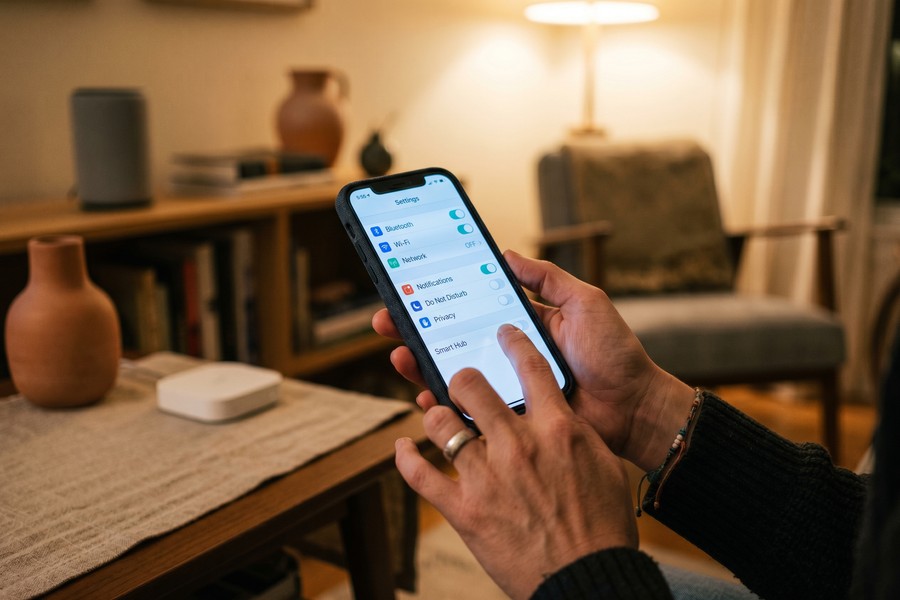
- Review microphone and location permissions on all smart home apps.
- Disable features you don’t actively use, like always-on voice activation.
- Check your device manufacturer’s data retention policy.
- Use a separate Wi-Fi network for smart home devices to isolate them from personal data.
None of this means you need to unplug everything. It means being intentional. The convenience of ambient computing is real — but so are the trade-offs.
Where Is Ambient Computing Headed?
The market tells a clear story. According to industry analysts, the ambient computing market is projected to grow from around $47 billion in 2022 to $182 billion by 2032, at a 23.4% compound annual growth rate. That’s not a niche trend. It’s a fundamental shift in how computing is structured.
Expect ambient computing to expand into healthcare (continuous patient monitoring without wearables), retail (stores that recognize you and personalize your experience), and transportation (vehicles that coordinate with infrastructure in real time). Firms like Mayo Clinic and Kaiser Permanente are already piloting passive ambient monitoring systems for post-surgical recovery and chronic disease management. On the retail side, Amazon Go stores represent an early but operational proof of concept — computer vision and sensor fusion eliminating the checkout process entirely. The more sensors we deploy and the better AI becomes, the more invisible and pervasive computing will grow.
How Quantum Computing Factors In
Longer term, quantum computing could supercharge ambient systems by processing vastly more sensor data simultaneously. The processing bottlenecks that limit ambient AI today won’t exist in a quantum future. IBM’s quantum roadmap and research coming out of Google Quantum AI both point toward error-corrected quantum processors becoming commercially viable within the next decade — a timeline that directly intersects with ambient computing’s growth trajectory. You can read more about that trajectory in our article on how quantum computing will change everyday technology.
We’re still years away from practical quantum applications at scale. But the direction is clear: ambient computing will get faster, smarter, and more deeply embedded in daily life.
Related reading: How iPhone Users Capture Candid Moments with Built.
Frequently Asked Questions
What is the simplest definition of ambient computing?
Ambient computing is when technology works in the background of your life without requiring you to interact with a screen or device. It senses your context and responds automatically. The goal is to make computing feel invisible and effortless.
Is ambient computing the same as smart home technology?
Smart home technology is one application of ambient computing, but they’re not the same thing. A smart home uses connected devices. Ambient computing describes the broader concept of technology that’s context-aware and proactive. Smart homes are a piece of the ambient computing puzzle, not the whole picture.
What are the biggest risks of ambient computing?
Privacy and security are the top concerns. Ambient systems collect continuous data, which creates large attack surfaces for hackers and raises serious questions about how that data is stored and used. Regulatory frameworks like the FTC’s IoT guidelines and NIST’s cybersecurity framework are trying to keep pace, but the technology is moving faster than the rules.
Do I need expensive devices to experience ambient computing?
Not at all. A $30 smart plug combined with a free app and a voice assistant you already have is enough to start. Many people are already living within ambient systems without realizing it. The entry point is lower than most people assume.
How does ambient computing relate to AI?
AI is the brain of any ambient computing system. Without machine learning and contextual AI, devices can only follow preset rules — they can’t adapt. As AI becomes more capable, ambient computing becomes more useful and more intuitive. The two technologies are deeply intertwined and will continue to evolve together.
Sources
- Statista — Number of IoT Connected Devices Worldwide 2019-2030
- GlobeNewswire — Ambient Computing Market Worth $182.49 Billion by 2032
- Federal Trade Commission — Internet of Things: Privacy and Security in a Connected World
- Wikipedia — Ubiquitous Computing (Mark Weiser’s Original Concept)
- Wired — What Is Ambient Computing?