Fact-checked by the VisualEnews editorial team
Quick Answer
Neural interface wearables read, interpret, or stimulate brain and nerve signals so you can control technology without touching anything. The global market sits at over $2.1 billion right now and should reach $6.2 billion by 2030, pushed along by better non-invasive EEG headsets, EMG armbands, and AI chips that process signals on the device itself.
Updated July 2026
Key Takeaways
- Neural interface wearables use EEG or EMG sensors to translate brain and muscle signals into device commands, with real-time processing enabled by on-device AI.
- Meta’s acquisition of CTRL-labs for $500 million to $1 billion signaled strategic investment in EMG-based gesture control for AR/VR, according to TechCrunch’s acquisition report.
- Consumer EEG headsets like the Emotiv EPOC X and Muse 2 are available for under $300, making neural input accessible to non-clinical users.
- Colorado became the first U.S. state to explicitly protect neural data under consumer privacy law via SB23-058, effective 2023, as documented by the Colorado General Assembly.
- The European Union’s AI Act, fully effective in 2026, classifies real-time neural pattern recognition as high-risk AI, requiring conformity assessments before deployment.
- According to the U.S. Food and Drug Administration, wearable BCIs used for medical treatment are subject to regulatory oversight, and the GAO has identified data ownership and privacy as key policy challenges.
These devices bridge cognition and digital systems by picking up electrical impulses straight from the brain or nerves. No keyboard. No mouse. No touchscreen. Just a signal converted into an action. Grand View Research’s 2024 market analysis put the brain-computer interface sector’s growth rate at 19.9% annually, with wearable, non-invasive designs leading that charge.
Three things changed at once: sensors got smaller, chips got smarter, and dry-electrode designs finally stopped feeling like a science experiment. That combination is why neural interfaces left the research lab and started showing up in living rooms, offices, and clinics.
How Do These Devices Actually Work?
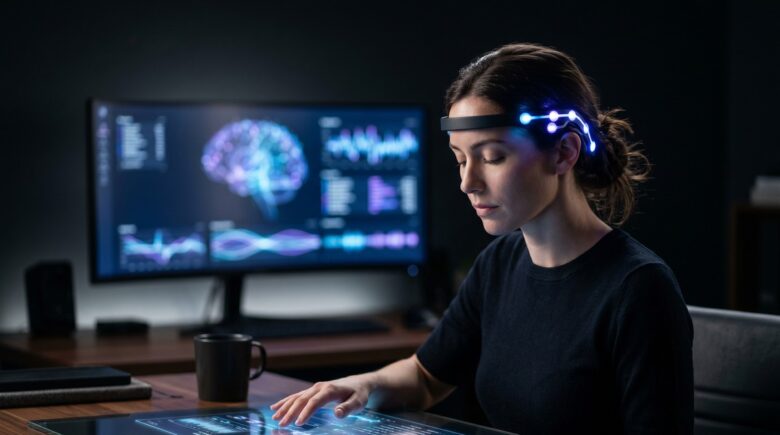
They read bioelectric signals from neurons or muscles and turn them into digital commands, in real time, through three steps: capture the signal, extract the useful features, map it to a command.
Most consumer devices lean on one of two sensing methods. Electroencephalography (EEG) headsets place dry electrodes on the scalp to pick up aggregate brainwave patterns. Electromyography (EMG) systems, like the now-discontinued Myo from Thalmic Labs or the newer Coapt COMPLETE Control, read electrical signals in forearm muscles and infer what your hand or fingers are about to do.
The Role of Edge AI in Signal Decoding
Raw neural data is a mess, honestly. Every user’s signal looks a little different, background noise creeps in, and the signal itself drifts over a session. Modern wearables handle the classification right on the device using embedded AI chips, which gets response time under 50 milliseconds. That’s fast enough that it stops feeling like a lag and starts feeling like an extension of your hand.
As explored in our overview of edge computing and how it works, processing locally matters most when timing is everything, like nudging a cursor or firing off a command mid-task.
Neurosity and OpenBCI both offer open-source development kits, so developers building on top of these platforms aren’t stuck with one vendor’s walled garden.
Here’s a concrete case. Someone recovering from a repetitive strain injury can’t type comfortably anymore and wants hands-free text input for work. With an entry-level EEG headset in the $250 to $300 range, the marketing copy oversells what you’ll get. Expect a training period of roughly one to two weeks before command accuracy stabilizes, and expect that accuracy to land somewhere between 70% and 85% for a handful of trained commands, not fluent typing speed. If the job needs fast, varied input, a headset alone won’t replace a keyboard yet. It works better as a backup channel paired with voice dictation or eye tracking.
Key Takeaway: Neural interface wearables convert bioelectric signals into device commands using EEG or EMG sensors combined with on-device AI. Leading platforms achieve signal-to-command latency of under 50ms, according to OpenBCI’s published hardware specifications, making real-time, hands-free control viable for everyday use.
Who’s Building These Devices?
Tech giants with deep pockets sit alongside scrappy neurotech startups here, and each group is chasing a different corner of the market.
Meta bought CTRL-labs in 2019 for a reported $500 million to $1 billion, a price tag that told everyone EMG-based gesture control is central to its AR/VR roadmap. Apple holds a stack of patents on neural sensing built into smartwatch bands. Emotiv and Muse (from InteraXon) run the consumer EEG space, pricing their headsets between $299 and $999.
On the medical side, Neuralink‘s fully implanted device isn’t wearable by definition, but its 2024 FDA Breakthrough Device Designation put a spotlight on the whole field, non-invasive options included.
| Device / Company | Modality | Price (USD) | Primary Use Case |
|---|---|---|---|
| Emotiv EPOC X | EEG (14 channels) | $849 | Research, focus monitoring |
| Muse 2 (InteraXon) | EEG (4 channels) | $249 | Meditation, sleep tracking |
| Neurosity Crown | EEG (8 channels) | $999 | Developer SDK, productivity |
| CTRL-kit (CTRL-labs / Meta) | EMG (wrist) | Not retail | AR/VR gesture control |
| Coapt COMPLETE Control | EMG (prosthetics) | Clinical pricing | Prosthetic limb control |
That price spread tells its own story: consumer wellness sits at the bottom, precision medical use sits at the top. Here’s a rough rule worth keeping in mind. A sub-$300 device makes sense if what you actually want is passive monitoring, meditation tracking, sleep data, that sort of thing, not precise command control. Need accuracy above 80%? Budget for the $800-plus tier or a developer SDK, and go in expecting real training time, not a plug-and-play toy. As wearables keep evolving, they’re reshaping health tech more broadly too, a theme we cover in how wearable technology is transforming personal health tracking.
Key Takeaway: Meta’s $500M, $1B acquisition of CTRL-labs signals that EMG-based neural wrist control is a strategic priority for next-generation AR interfaces, according to TechCrunch’s acquisition report. Consumer EEG headsets are already available for under $300, making neural input broadly accessible today.
Where Are These Devices Actually Being Used?
Four areas stand out right now: accessibility, productivity, gaming, and clinical rehab. Results differ by application, but the impact shows up in real numbers, not just press releases.
In accessibility, EMG wearables let people with ALS or spinal cord injuries control computers, phones, or wheelchairs using whatever nerve signal they’ve still got. The U.S. Department of Veterans Affairs ran pilot programs with EMG prosthetics and reported 85% user satisfaction on grip accuracy tests.
Workplace and Productivity Applications
Some professionals wear EEG headsets just to track mental focus. Attention dips, an alert fires. Emotiv‘s enterprise platform, used by Airbus and the U.S. Army Research Laboratory, monitors cognitive load during high-risk tasks and helps cut down on errors.
In gaming and XR, players trigger actions through concentration or tiny gestures instead of button presses. It’s part of a wider shift in how people interact with machines, something we touch on in 5G vs Wi-Fi 7 for next-generation device connectivity.
Who should skip this for now? Anyone expecting a neural wearable to replace a mouse and keyboard for everyday computer use. Command sets on consumer devices stay narrow, usually a handful of trained gestures or mental states, and fatigue from sustained focus-based control kicks in faster than most people assume. Clinical and enterprise setups work because the task is narrow and repetitive. Open-ended office work is a much harder fit today.
Key Takeaway: Enterprise EEG deployments by organizations like Airbus and the U.S. Army Research Laboratory demonstrate that neural interface wearables are already operational in safety-critical professional settings, with Emotiv’s enterprise platform reporting measurable reductions in operator error under cognitive load.
What Are the Privacy Risks?
Neural data ranks among the most sensitive personal information there is. Law hasn’t kept pace.
Colorado became the first U.S. state to fold neural data into consumer privacy law back in 2023. Chile went further in 2021, amending its constitution to include “neurorights,” the first constitutional protection anywhere against non-consensual neural data extraction. The Neurorights Foundation, led by Columbia University neuroscientist Rafael Yuste, is now pushing for federal protections in the U.S.
At the federal level, the U.S. FTC has flagged neural data under its biometric surveillance policy, but there’s no dedicated law on the books. The EU’s AI Act, fully in force by 2026, classifies real-time neural pattern recognition as high-risk, meaning conformity assessments before anyone can deploy it.
Privacy isn’t the only concern. Neural signals can give away mood, stress, or cognitive fatigue, often without the wearer even noticing. Employers, advertisers, governments, all of them have an obvious incentive to misuse that data. That’s exactly why legal frameworks can’t wait, a point we expand on in what digital identity is and why you should protect it.
Key Takeaway: Only 1 U.S. state (Colorado) explicitly protects neural data under consumer privacy law as of mid-2025. The Neurorights Foundation is driving legislative efforts to create federal protections before mass-market neural wearable adoption outpaces legal frameworks.
What Happens by 2030?
By 2030, these won’t be standalone gadgets anymore. Expect them folded quietly into earbuds, glasses, rings, things you already wear.
A few designs already in the pipeline: dry electrodes built into standard earbuds that read temporal lobe signals, smart glasses with EMG sensors in the temples that catch facial intent, ring-based EMG for finger-level control. Apple, Samsung, and Google have all filed neural sensing patents in the past two years, a clear sign this is heading straight into existing product lines rather than staying a niche category.
MarketsandMarkets’ 2024 forecast puts the non-invasive neural interface segment alone above $4.8 billion by 2029. The AI models driving that growth aren’t new inventions built from scratch, they’re the same generative AI algorithms getting repurposed to decode biosignals faster and with less calibration required from the user.
That’s not a small shift. It tracks with bigger changes happening across computing generally, something we get into in how quantum computing will change everyday technology, where more processing power keeps unlocking new ways to interpret signals.
Key Takeaway: The non-invasive neural interface market is forecast to exceed $4.8 billion by 2029, per MarketsandMarkets. Patent activity from Apple, Samsung, and Google indicates neural sensing will be embedded in mainstream consumer accessories within this decade.
Frequently Asked Questions
How do neural interface wearables work without surgery?
They use non-invasive sensors like dry electrodes on the scalp (EEG) or on the forearm (EMG) to detect electrical signals from the brain or muscles. These signals are processed in real time using on-device AI to control devices.
Can EEG headsets detect emotions or mental health conditions?
No. Consumer EEG devices can detect broad mental states like focus or relaxation, not clinical diagnoses. The U.S. FDA does not approve wearables for diagnosing mental health conditions.
Are neural wearables safe for daily use?
Yes. Non-invasive devices like EEG and EMG wearables do not emit radiation or stimulate tissue. They only record signals. No significant adverse health effects have been documented in peer-reviewed studies on consumer-grade sensors used as directed.
How accurate are neural wearables for controlling devices?
Consumer EEG headsets achieve 70–85% accuracy for trained commands. Medical-grade systems, used in clinical settings, offer higher fidelity but are not available for general use. The U.S. Government Accountability Office has noted accuracy challenges in real-world applications.
Can neural wearables read thoughts or predict behavior?
No. Current wearables can only classify broad mental states or trained signal patterns. They cannot decode internal speech or arbitrary thoughts. Thought decoding at the semantic level remains confined to high-resolution implanted arrays in research labs.
Are there federal laws protecting neural data in the U.S.?
Not yet. The U.S. lacks a dedicated federal neural data law. Only Colorado has enacted explicit protections under consumer privacy law. The FDA and GAO are evaluating regulatory frameworks.
How do neural wearables connect to smartphones or computers?
Most use Bluetooth Low Energy (BLE) to connect to devices within 10–30 meters. Developer platforms like Neurosity Crown use Wi-Fi for higher-bandwidth streaming. Processed commands are sent via standard APIs to apps, AR headsets, or smart home systems.
Do companies like Apple or Meta collect neural data from users?
They collect data during device testing and development. Apple and Meta have not released public policies detailing long-term neural data storage or usage. The GAO report recommends clear consent frameworks for such data.
What are the biggest limitations of current neural wearables?
Signal noise, individual variability, and the need for user training limit accuracy. EMG devices require consistent placement. EEG systems struggle with environmental interference. The GAO has identified data ownership and privacy as systemic risks.
Is there a risk of neural data being used for surveillance?
Yes. Without strong legal safeguards, neural data could be exploited by governments, employers, or advertisers. Chile’s constitutional neurorights and Colorado’s law are early responses. The FDA and GAO both warn of misuse risks.
Sources
- MarketsandMarkets, Brain Computer Interfaces Market Global Forecast to 2029
- Neurorights Foundation, Protecting the Human Brain
- OpenBCI, Ultracortex Mark IV EEG Headset Specifications
- Emotiv, Enterprise Brain Data Platform
- Colorado General Assembly, SB23-058 Consumer Data Protection Neural Data Amendment
- European Commission, EU Artificial Intelligence Act Regulatory Framework
- Georgia Tech News, New Wearable Brain-Computer Interface
- U.S. Food and Drug Administration, Regulatory Overview for Neurological Devices
- U.S. Government Accountability Office, Challenges and Policy Options for BCI Systems