Fact-checked by the VisualEnews editorial team
Quick Answer
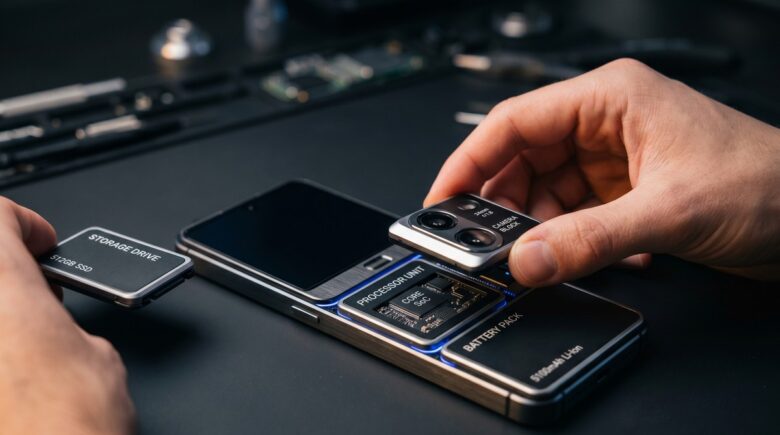
Stackable modular smartphone design 2026 represents a fundamental shift away from sealed, single-unit handsets. As of July 2026, at least three major manufacturers have announced modular phone platforms, with the global modular device market projected to reach $1.41 billion by 2027. Users can swap cameras, batteries, and processors without replacing the entire device.
Modular smartphone design 2026 is no longer a concept reserved for trade show prototypes. It describes a new class of stackable handsets built around interchangeable hardware blocks — discrete modules for the camera, battery, processor, and connectivity — that users can swap, upgrade, or replace independently. According to Grand View Research’s modular smartphone market analysis, the sector is expanding at a compound annual growth rate of 8.9%, driven by consumer demand for longevity and right-to-repair legislation.
This matters now because the traditional sealed-glass slab has reached a design plateau. Manufacturers are competing on thinness and camera megapixels while consumers bear the full cost of planned obsolescence — making stackable modularity the most disruptive hardware pivot of the decade.
What Exactly Is Modular Smartphone Design in 2026?
A modular smartphone is a device built from physically separable hardware units that attach, detach, and communicate over a standardized interface layer. Unlike conventional phones where every component is soldered to a single board, modular designs treat each function — display, battery, camera, modem — as a discrete, swappable block.
The 2026 generation differs from earlier attempts like Project Ara (Google’s cancelled modular initiative) in one critical way: standardized magnetic and electro-optical connectors now achieve data transfer speeds fast enough to support flagship-grade performance across module joints. Phonebloks, the community concept that inspired Project Ara, demonstrated consumer appetite as early as 2013, but manufacturing tolerances and latency between modules were prohibitive. Today’s photonic interconnects have cut inter-module latency to under 5 nanoseconds, making the performance gap negligible.
How Modules Attach and Communicate
Current stackable systems use a spine or backbone rail — a rigid central column housing the primary SoC and power management chip. Peripheral modules clip onto this rail using magnetic alignment pins and pogo connectors. The system exposes a GSMA-referenced open hardware interface that third-party manufacturers can build against, enabling an ecosystem model similar to app stores but for physical hardware.
Key Takeaway: Modern modular smartphone design 2026 uses a central spine architecture with photonic inter-module connectors, cutting latency to under 5 nanoseconds — solving the performance bottleneck that killed Google’s Project Ara in 2016.
Which Companies Are Leading Modular Smartphone Design in 2026?
Fairphone, Motorola, and a cluster of emerging Asian OEMs are the three credible commercial players advancing modular smartphone design 2026 at scale. Each company has taken a distinct approach to what “modular” means in practice.
Fairphone’s approach prioritizes repairability over configurability. The Fairphone 5, released in 2023, offered 10 user-replaceable parts and a promised software support window of 8 to 10 years, according to Fairphone’s official product announcement. This positions it less as a performance customization platform and more as a sustainability statement.
Motorola’s Moto Mods ecosystem took a different path: snap-on accessories that extend function without replacing internal hardware. Mods added projectors, speaker systems, and extended batteries to the Moto Z line. The limitation was that Mods did not touch the core SoC, meaning users still needed to buy a new phone to upgrade processing power.
New Entrants Pushing True Stackability
Chinese OEM CMF by Nothing and startup Modular Technologies Group are pursuing genuine hardware stacking — where the processing module itself is replaceable. This is the most ambitious interpretation of modular smartphone design 2026, as it requires each module to carry its own partial firmware and negotiate capability handshakes with the spine controller in real time.
| Company | Modular Approach | Replaceable Core SoC | Est. Module Price Range |
|---|---|---|---|
| Fairphone | Repairability-first | No | $10–$80 per part |
| Motorola (Moto Z) | Snap-on accessories | No | $50–$300 per Mod |
| CMF by Nothing | Accessory rail system | Partial | $20–$150 per module |
| Modular Technologies Group | Full stack replacement | Yes | $100–$400 per module |
| Project Ara (Google) | Full modularity (cancelled 2016) | Yes | N/A (never shipped) |
Key Takeaway: No single company has cracked full-stack modularity at mass-market scale yet. Fairphone leads on repairability with 10 user-replaceable components, while startups like Modular Technologies Group target true SoC-level swaps — a far harder engineering and supply-chain problem.
How Does Modular Design Challenge the Traditional Phone Model?
Traditional phone design is built on a planned-obsolescence cycle averaging 2.5 to 3 years per device, according to Statista’s global smartphone replacement cycle data. Modular design attacks this model at its economic root by letting users upgrade only the component that has become obsolete.
The implications for manufacturers are significant. A company that sells modules individually earns recurring revenue from upgrade cycles rather than a single high-margin device sale every three years. This mirrors the software-as-a-service transition that reshaped the app economy — a shift our analysis of digital subscription models and their hidden costs explored in depth.
For consumers, the calculus is straightforward: replacing a camera module at $120 is cheaper than buying a new $900 flagship. The environmental case is equally strong. The United Nations Global E-waste Monitor reported that 62 million metric tons of e-waste were generated globally in 2022 — the highest figure ever recorded — and sealed smartphones are a primary contributor.
“Modularity is not just a design preference — it is a necessary response to the environmental and economic costs of the current replacement cycle. A phone that lasts ten years with component-level upgrades could reduce handset-related e-waste by up to 40 percent in mature markets.”
Key Takeaway: Modular smartphone design 2026 directly challenges the 2.5-to-3-year upgrade cycle by enabling component-level replacement. The UN reports 62 million metric tons of annual e-waste — a figure modular platforms could meaningfully reduce by extending device lifespans.
What Are the Technical Barriers Still Blocking Mass Adoption?
Three engineering constraints continue to limit modular smartphone design 2026 from achieving mainstream penetration: thermal management, waterproofing, and connector durability. These are not minor friction points — they represent fundamental physics tradeoffs.
Heat dissipation in a sealed unibody phone relies on graphene vapor chambers bonded directly to the SoC. In a modular design, that thermal pathway is interrupted at every module joint. Engineers must either accept reduced thermal performance or engineer active cooling into each module — adding weight, cost, and failure points.
Waterproofing is equally challenging. An IP68 rating requires a sealed enclosure. Every module junction is a potential water ingress point. Current solutions use compressible gaskets rated for approximately 200 insertion cycles, after which seal integrity degrades. That is a real-world constraint for a device users are expected to modify frequently. This problem is analogous to the durability tradeoffs discussed in our comparison of storage hardware reliability and lifespan.
Regulatory and Right-to-Repair Tailwinds
Despite these barriers, regulatory pressure is creating powerful incentives to solve them. The European Union’s Right to Repair Directive, which came into force in 2024, mandates that manufacturers supply spare parts and repair documentation for a minimum of 5 to 10 years post-sale. This effectively rewards modular architecture because it reduces the compliance cost of meeting spare-parts obligations. The broader connectivity infrastructure supporting these devices is also maturing, as our coverage of 5G versus Wi-Fi 7 performance tradeoffs detailed.
Key Takeaway: Thermal management and waterproofing remain the hardest engineering problems in modular smartphone design 2026. However, the EU’s Right to Repair Directive — requiring parts availability for up to 10 years post-sale — is accelerating manufacturer investment in modular-compatible architectures.
What Does the Future of Modular Smartphone Design Look Like Beyond 2026?
The trajectory of modular smartphone design 2026 points toward a bifurcated market: a mainstream tier focused on repairability and longevity, and a performance tier where power users swap AI-processing modules and specialized sensors the way PC enthusiasts swap GPUs.
Artificial intelligence hardware is accelerating this split. Dedicated NPU (Neural Processing Unit) modules — designed exclusively for on-device AI inference — are already under development at Qualcomm and MediaTek. These could allow users to upgrade AI capabilities without replacing the entire SoC. Given how rapidly AI capabilities are reshaping device functionality, as explored in our coverage of AI’s impact on how we interact with technology, the ability to upgrade just the AI module may become the most compelling modular use case by 2027.
The wearables sector is also converging with modular phone architecture. Health-tracking modules — containing biosensors for continuous glucose monitoring, SpO2, and ECG — could snap into a modular spine, blurring the line between smartphone and health device. Our analysis of wearable technology’s transformation of personal health tracking outlines how sensor miniaturization is making this convergence feasible within a two-to-three-year window.
Key Takeaway: By 2027, swappable NPU modules from Qualcomm and MediaTek may let users upgrade on-device AI performance independently of the base SoC — making AI processing the highest-value upgrade slot in the modular smartphone design 2026 ecosystem.
Related reading: aio data study: ai identifies.
Frequently Asked Questions
What is a modular smartphone and how does it work?
A modular smartphone is a device built from physically separable hardware blocks — camera, battery, processor, and connectivity — that attach to a central spine via standardized connectors. Users can detach and replace individual modules without replacing the entire device. Current systems use magnetic alignment pins and pogo connectors to achieve data transfer across module joints.
Are modular smartphones available to buy in 2026?
Yes, limited commercial options exist. Fairphone 5 is the most widely available modular-friendly handset, offering 10 replaceable components and an 8-to-10-year support commitment. CMF by Nothing offers a rail-based accessory system. Full SoC-swappable modular phones remain in development or limited beta availability from startup manufacturers.
Why did Google’s Project Ara fail and can modular phones succeed now?
Google cancelled Project Ara in 2016 primarily due to inter-module latency, manufacturing cost, and insufficient consumer demand at the time. The key difference in 2026 is photonic interconnect technology, which has reduced latency to under 5 nanoseconds, and EU right-to-repair legislation, which creates regulatory incentives that did not exist a decade ago.
Do modular smartphones have worse water resistance than regular phones?
Currently, yes. Modular connector gaskets are typically rated for around 200 insertion cycles before seal integrity degrades, making a full IP68 water resistance rating difficult to maintain long-term. Some manufacturers achieve IPX4 splash resistance, but sustained submersion protection remains an engineering challenge for the category.
How much does it cost to upgrade a modular smartphone versus buying a new phone?
Camera module replacements typically range from $20 to $150, while processor-tier modules from emerging manufacturers are priced between $100 and $400. Compared to a flagship smartphone replacement cost of $800 to $1,200, targeted module upgrades offer significant savings — provided the user keeps the same base device for five or more years.
Will major brands like Apple or Samsung ever adopt modular smartphone design?
Neither Apple nor Samsung has announced modular hardware plans. Both companies rely on integrated design for competitive differentiation and margin protection. However, EU right-to-repair regulations are forcing both to increase parts availability, which creates indirect pressure toward more serviceable internal architectures over the next three to five years.
Sources
- Grand View Research — Modular Smartphone Market Size, Share and Trends Analysis Report
- Fairphone — Fairphone 5: A Phone Made to Last (Official Announcement)
- Statista — Average Smartphone Replacement Cycle Worldwide
- United Nations Environment Programme — Global E-waste Monitor 2024
- European Commission — Right to Repair Directive Overview
- The Verge — Google Cancels Project Ara Modular Phone
- GSMA — Network Technologies and Open Hardware Standards
- Qualcomm — Snapdragon Mobile Platform (NPU Architecture)