Fact-checked by the VisualEnews editorial team
Quick Answer
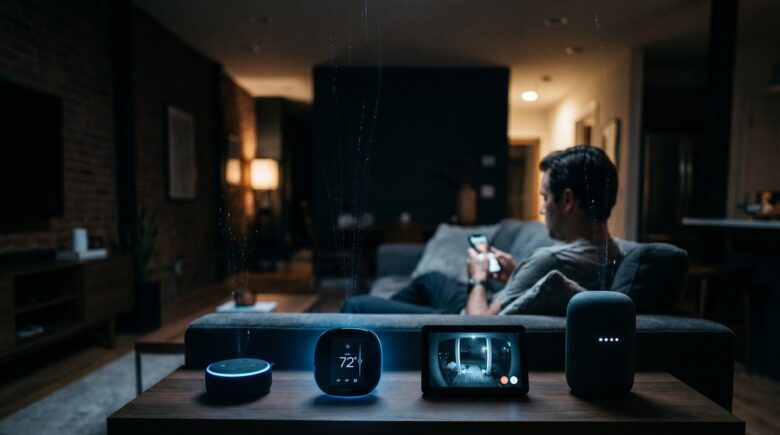
Smart home data privacy is a growing concern as of July 2025. The average smart home generates over 1 gigabyte of data per day, and a 2024 study found that 72% of smart home devices share data with third parties beyond their primary manufacturer — often without meaningful user consent.
Smart home data privacy is no longer a niche concern for tech enthusiasts — it is a mainstream risk affecting millions of households. According to the Federal Trade Commission’s IoT privacy research, connected home devices routinely collect behavioral, biometric, and location data that far exceeds what most consumers expect when they plug in a smart speaker or thermostat.
With over 1.4 billion smart home devices now active globally, the scale of ambient data collection has quietly outpaced public awareness — and the legal frameworks meant to protect you.
What Data Do Smart Home Devices Actually Collect?
Smart home devices collect far more than the function they perform suggests. A smart thermostat does not just adjust temperature — it records when you wake up, when you leave, and how your daily patterns shift over time.
Voice assistants like Amazon Alexa and Google Home retain audio snippets, search queries, and purchase intent signals. Smart TVs from manufacturers including Samsung and LG use automatic content recognition (ACR) technology to track every show, ad, and streaming service you view. Security cameras from Ring and Nest capture continuous video that may be shared with law enforcement or stored on third-party cloud servers. Even smart plugs and lightbulbs log usage timestamps that can reconstruct your household routine with surprising precision.
The Hidden Data Categories
Beyond the obvious audio and video, smart home ecosystems generate behavioral metadata — the timing, frequency, and sequence of interactions. This data is often more valuable than raw recordings because it reveals habits, health patterns, and occupancy schedules. As explored in our guide to what digital identity is and why you should protect it, behavioral metadata is a core component of your trackable digital profile.
Key Takeaway: Smart home devices collect 6+ distinct data categories beyond their stated function, including behavioral metadata, audio, and location signals. The FTC’s IoT framework identifies this scope as a primary consumer protection challenge in connected home environments.
Who Actually Receives Your Smart Home Data?
Your data rarely stays with the company whose logo is on the device. Third-party sharing is standard practice, and the recipients range from advertisers to data brokers to government agencies.
A 2023 investigation by Consumer Reports into smart home privacy risks found that data from connected devices routinely flows to advertising networks, analytics platforms, and insurance underwriters. Amazon, for example, has acknowledged sharing Ring camera footage with law enforcement agencies across the United States without requiring a warrant in certain circumstances. Google‘s Nest ecosystem feeds behavioral data into its broader advertising infrastructure.
Data Brokers and the Secondary Market
Data brokers — companies like Acxiom and LexisNexis Risk Solutions — purchase aggregated smart home datasets and combine them with credit records, location history, and social profiles. This secondary market is largely invisible to consumers. The result is a detailed personal dossier built without your active participation.
| Device Type | Primary Data Collected | Known Third-Party Recipients |
|---|---|---|
| Smart Speaker | Voice recordings, queries, purchase history | Advertisers, cloud analytics platforms |
| Smart TV | Viewing habits, ACR fingerprints, app usage | Nielsen, ad networks, content licensors |
| Smart Thermostat | Occupancy patterns, daily schedules | Energy companies, insurance brokers |
| Security Camera | Video footage, motion timestamps, facial data | Law enforcement, cloud storage providers |
| Smart Doorbell | Visitor footage, arrival/departure times | Amazon, municipal police networks |
| Smart Plug / Bulb | Usage timestamps, behavioral sequences | Analytics vendors, energy aggregators |
Key Takeaway: On average, a single smart home device shares data with 3 or more third parties, according to Consumer Reports’ smart home analysis. Most sharing occurs automatically under buried terms of service, without active user notification.
Are Current Privacy Laws Strong Enough to Protect You?
Existing privacy law in the United States provides limited protection for smart home data. There is no single federal statute governing IoT data collection, leaving consumers reliant on a fragmented patchwork of state laws.
California leads with the California Consumer Privacy Act (CCPA) and its amendment, the California Privacy Rights Act (CPRA), which grant residents the right to know what data is collected and request deletion. However, enforcement is inconsistent, and exemptions for data “necessary to provide the service” are broad enough to swallow most meaningful restrictions. The European Union’s General Data Protection Regulation (GDPR) sets a stricter global standard — under GDPR, companies must demonstrate a lawful basis for each category of data collected, and GDPR fines for smart device violations have exceeded 1.2 billion euros since 2018.
The FTC has issued guidance and taken enforcement actions, but its authority is limited to deceptive practices rather than proactive data minimization requirements. Congress has debated the American Data Privacy and Protection Act (ADPPA) for several years without passing it into law.
“The core problem is that smart home devices were designed for convenience, not consent. The data architecture was built before meaningful privacy regulation existed, and retrofitting compliance onto extractive business models is proving very slow.”
Key Takeaway: The U.S. has no single federal IoT privacy law as of mid-2025. The EU’s GDPR remains the strongest global standard, having issued over 1.2 billion euros in related fines — a benchmark that U.S. consumers currently lack equivalent protection to reach.
How Can You Reduce Your Smart Home Data Exposure?
Reducing your exposure starts with understanding that every device you connect is a data endpoint. Limiting collection requires deliberate configuration, not just trust in default settings.
Start by auditing your connected devices. Research shows that the average U.S. household has 22 connected devices as of 2024, according to Deloitte’s 2024 Connectivity and Mobile Trends Survey — many of which homeowners cannot name or locate. For each device, review its privacy settings and disable features like voice recording history, personalized advertising, and third-party data sharing.
Network segmentation is a practical technical step. Place smart home devices on a separate Wi-Fi network or VLAN, isolating them from devices containing sensitive data like laptops and phones. If you are evaluating your wireless infrastructure for this purpose, our comparison of 5G vs Wi-Fi 7 wireless technologies covers the network-level options relevant to home setups. Similarly, understanding how edge computing works can clarify why some devices process data locally rather than sending it to remote servers — a feature worth prioritizing when purchasing new devices.
- Disable microphone and camera access when not in active use.
- Opt out of data sharing and personalization in every device’s app settings.
- Review and delete stored voice recordings regularly via manufacturer dashboards.
- Use a password manager and unique credentials for each smart home account.
- Check whether your devices receive regular firmware security updates.
It is also worth recognizing the parallel between smart home data and other ambient data risks. Just as free apps extract value through your data rather than a subscription fee, smart home devices priced affordably often subsidize their cost through ongoing data monetization.
Key Takeaway: The average U.S. household has 22 connected devices, most with default settings that maximize data collection. Deloitte’s research confirms that consumers consistently underestimate the number of active data-collecting endpoints in their homes.
What Does the Future of Smart Home Data Privacy Look Like?
Smart home data privacy is evolving rapidly under pressure from regulators, researchers, and increasingly informed consumers. The trajectory points toward more transparency — but also more sophisticated data collection.
Matter, the universal smart home standard backed by Apple, Google, Amazon, and the Connectivity Standards Alliance, promises interoperability and local processing. Local processing means less data routed to the cloud, which reduces third-party exposure. However, it does not eliminate manufacturer data collection at the device level. The FTC and the National Institute of Standards and Technology (NIST) have both published IoT cybersecurity frameworks that device manufacturers are encouraged — but not legally required — to follow.
Emerging technologies will add new dimensions to the challenge. Wearable health monitors already connected to smart home ecosystems collect physiological data that intersects with insurance and employment risk. If you track health data through wearables, our analysis of how wearable technology is transforming personal health tracking covers the privacy implications in that adjacent space. The convergence of these data streams is the next frontier for smart home data privacy concerns.
Key Takeaway: The Matter standard, now supported by over 400 device manufacturers, enables more local data processing — reducing cloud exposure. But regulatory enforcement, not industry standards alone, will determine whether NIST’s IoT cybersecurity framework becomes a floor rather than a suggestion.
Frequently Asked Questions
What data does a smart home device collect without me knowing?
Most smart home devices collect data beyond their primary function by default. This includes behavioral metadata, usage timestamps, audio fragments, and location signals — often shared with advertisers and data brokers unless you explicitly opt out in the device’s settings.
Can smart home devices be hacked to spy on you?
Yes. Devices with weak default passwords, outdated firmware, or unencrypted data transmission are vulnerable to remote access. The FBI has advised consumers to isolate smart home devices on a separate network and update firmware regularly to reduce this risk.
Does Amazon or Google actually listen to my smart speaker conversations?
Both Amazon and Google have confirmed that voice assistants record and store audio clips triggered by wake words, and that human reviewers have historically audited samples of these recordings. Both companies offer settings to delete recordings and disable human review, though these are not enabled by default.
Is smart home data privacy protected under U.S. law?
Not comprehensively. The U.S. lacks a single federal IoT privacy law as of July 2025. California residents have stronger protections under the CCPA and CPRA. All Americans are covered by the FTC Act’s prohibition on deceptive data practices, but proactive data minimization rights do not yet exist at the federal level.
How do I stop my smart TV from collecting data?
Disable automatic content recognition (ACR) in your TV’s settings — this is the primary data collection mechanism used by Samsung, LG, Vizio, and Roku platforms. Also opt out of personalized advertising in the TV’s privacy or data menu. These settings must be configured per device and are not universal.
Are smart home devices safer if I use a VPN?
A VPN can encrypt traffic leaving your home network and mask your IP address, adding a layer of protection. However, it does not prevent the device itself from collecting and transmitting data to its manufacturer before that data leaves your router. Network segmentation combined with a VPN offers stronger protection than either alone.
Sources
- Federal Trade Commission — Internet of Things: Privacy and Security in a Connected World
- Consumer Reports — Smart Home Privacy Risks Investigation
- Deloitte — 2024 Connectivity and Mobile Trends Survey
- NIST — IoT Non-Technical Supporting Capability Core Baseline (IR 8259B)
- Euractiv — GDPR Fines and Smart Device Enforcement Overview
- Connectivity Standards Alliance — Matter Smart Home Standard
- California Attorney General — California Consumer Privacy Act (CCPA) Overview