Fact-checked by the VisualEnews editorial team
Quick Answer
Neuromorphic chip technology mimics the structure of the human brain to process information using spiking neural networks, consuming up to 1,000 times less energy than conventional processors. As of July 2025, Intel, IBM, and Samsung are leading commercial development, with the global neuromorphic computing market projected to reach $8.9 billion by 2030.
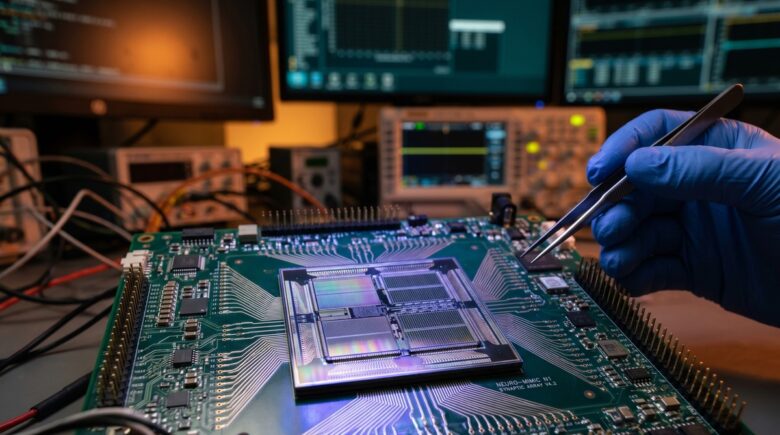
Neuromorphic chip technology is a computing paradigm that replicates the brain’s neural architecture in silicon, enabling processors to handle complex AI tasks at a fraction of traditional energy costs. According to MarketsandMarkets’ neuromorphic computing research, the sector is growing at a compound annual rate of 22.3% through 2030, driven by demand for edge AI, autonomous systems, and ultra-low-power inference.
This matters now because conventional GPU-based AI is hitting hard physical limits — power consumption and heat dissipation are becoming unsustainable at scale, making brain-inspired alternatives not just interesting, but necessary.
What Exactly Is Neuromorphic Chip Technology?
Neuromorphic chip technology is hardware designed to emulate the brain’s neurons and synapses, processing data through electrical spikes rather than continuous mathematical operations. Unlike traditional von Neumann architectures — where memory and processing are separate — neuromorphic chips integrate computation and memory at each node, dramatically cutting data transfer overhead.
The term was coined by Carver Mead at Caltech in the late 1980s, but modern implementations bear little resemblance to those early prototypes. Today’s chips, like Intel’s Loihi 2 and IBM’s NorthPole, use spiking neural networks (SNNs) — algorithms that fire only when a threshold is crossed, just like biological neurons. This event-driven model means the chip does zero work when there is no relevant input, slashing idle power consumption to near zero.
How Spiking Neural Networks Differ From Deep Learning
Standard deep learning runs on dense matrix multiplications that consume power continuously. SNNs, by contrast, communicate in sparse, timed pulses. This makes them poorly suited for tasks requiring massive parallel precision — like rendering — but ideal for real-time sensor fusion, pattern recognition, and anomaly detection on low-power devices. The tradeoff is a key reason researchers at Intel Labs’ neuromorphic research division focus on robotics and edge inference rather than large language model training.
Key Takeaway: Neuromorphic chip technology processes information through event-driven spiking neural networks, a fundamentally different model from GPU-based deep learning. Intel’s Loihi 2 exemplifies this approach, integrating memory and compute in a single node to cut energy use by up to 1,000 times versus conventional chips.
Which Companies and Labs Are Leading Neuromorphic Development?
Intel, IBM, and Samsung are the dominant commercial players, but significant research also comes from government-funded institutions and startups. The competitive landscape is moving fast, and the architecture choices made today will define AI hardware for the next decade.
Intel’s Loihi 2, released in 2021, contains 1 million neurons and supports up to 120 million synapses on a single chip. IBM’s NorthPole, unveiled in late 2023, takes a related but distinct approach — it eliminates off-chip memory access entirely, achieving 25 times better energy efficiency per inference than comparable GPU architectures, according to IBM’s NorthPole research published in Science. Meanwhile, BrainScaleS-2 from Heidelberg University operates at 1,000 times biological real-time speed for certain simulations.
Key Players at a Glance
| Organization | Chip / Platform | Key Specification |
|---|---|---|
| Intel | Loihi 2 | 1 million neurons, 120M synapses |
| IBM | NorthPole | 25x better energy efficiency vs. GPU |
| Samsung | ENPU (Neural Processing Unit) | Integrated in Exynos for on-device AI |
| Heidelberg University | BrainScaleS-2 | 1,000x biological real-time speed |
| SpiNNaker (Manchester) | SpiNNaker 2 | 10 million neurons per board |
The Human Brain Project, a flagship EU science initiative, has invested over 600 million euros in neuromorphic research infrastructure including the SpiNNaker 2 platform at the University of Manchester. This public funding accelerates timelines that purely commercial R&D could not sustain alone. Just as quantum computing is reshaping computational limits, neuromorphic chips are redefining what is physically possible in AI inference hardware.
Key Takeaway: The neuromorphic chip race is led by Intel, IBM, and Samsung, with IBM’s NorthPole delivering 25 times better energy efficiency per inference than traditional GPU designs — a benchmark that signals commercial viability is no longer theoretical.
Why Does Neuromorphic Chip Technology Matter for Real-World AI?
Neuromorphic chip technology matters because the AI industry’s energy problem is accelerating faster than efficiency gains from conventional scaling. Training a single large language model can emit as much carbon as five transatlantic flights, according to a widely cited MIT and University of Massachusetts study on AI’s carbon footprint. Neuromorphic architectures attack this problem at the hardware level, not just through software optimization.
The practical implications span multiple industries. In healthcare, neuromorphic processors embedded in wearable health monitoring devices could run continuous anomaly detection — detecting arrhythmias or early seizure signals — for weeks on a single battery charge. In autonomous vehicles, they can process LiDAR and camera feeds in real time with microsecond latency. In data centers, replacing certain GPU workloads with neuromorphic accelerators could cut inference energy budgets by orders of magnitude.
“The brain performs incredibly complex computations on roughly 20 watts. If we can get even a fraction of that efficiency into silicon, it changes every calculation we make about sustainable AI deployment.”
Edge computing is perhaps the highest-impact near-term application. As edge computing architectures push AI inference closer to end devices, the need for ultra-low-power chips becomes critical. Neuromorphic processors are uniquely suited to this environment because they consume power only when processing meaningful events — a perfect fit for intermittent sensor data at the network edge.
Key Takeaway: AI’s energy crisis makes neuromorphic chip technology strategically essential. The human brain operates on just 20 watts, and chips like Intel’s Loihi 2 are closing that gap — making sustainable, always-on AI inference viable in edge and wearable deployments for the first time.
What Are the Current Limitations of Neuromorphic Chips?
Neuromorphic chip technology has significant constraints that prevent it from replacing conventional processors today. The most fundamental is programmability: writing software for spiking neural networks requires specialized frameworks and expertise that simply do not exist at scale yet.
Standard machine learning models — built in PyTorch or TensorFlow — cannot run directly on neuromorphic hardware without conversion, and that conversion often degrades accuracy. Intel’s Lava software framework and IBM’s development tooling are improving this, but the ecosystem is years behind the CUDA ecosystem that underpins GPU AI workloads. Additionally, neuromorphic chips excel at sparse, temporal tasks but underperform on dense, precision-heavy computations like training large models or running complex matrix algebra.
Standardization is another barrier. Unlike the GPU market, where Nvidia’s CUDA has created a de facto standard, neuromorphic chip technology lacks a universal programming interface. This fragmentation increases development cost and slows enterprise adoption. The situation is analogous to the early years of wireless networking — multiple competing standards before one ecosystem consolidated. Understanding how standards wars play out in hardware is directly relevant to how competing wireless technologies like 5G and Wi-Fi 7 eventually reach consumer devices.
Key Takeaway: Neuromorphic chip technology faces a critical software gap — no equivalent to Nvidia’s CUDA exists, and converting standard AI models to spiking neural networks often cuts accuracy. Intel’s Lava framework is a step toward closing this gap, but enterprise-ready tooling remains at least 3–5 years from maturity.
What Does the Future of Neuromorphic Chip Technology Look Like?
The trajectory of neuromorphic chip technology points toward hybrid architectures — chips that combine conventional compute cores with neuromorphic accelerators, letting engineers assign workloads to whichever substrate handles them most efficiently. This hybrid model mirrors how modern CPUs already include dedicated AI accelerators as distinct processing blocks.
By 2027, industry analysts at Gartner’s emerging technology research expect neuromorphic capabilities to appear in mainstream edge AI chips for smartphones and IoT devices. The integration of memristors — resistive memory devices that can store analog weight values in the same physical space as computation — is expected to push energy efficiency another order of magnitude lower. Companies like Knowm and academic labs at Stanford and MIT are actively developing memristor-based synaptic arrays.
The longer-term vision extends to brain-computer interfaces. DARPA’s Neural Engineering System Design program has funded research exploring neuromorphic processors as the signal-processing backbone for implantable neural devices. Meanwhile, changes in how AI is deployed across devices — from data centers to endpoints — will continue to reshape the broader AI search and retrieval landscape, as explored in how AI is transforming how we search the internet.
Key Takeaway: Neuromorphic chip technology is moving toward hybrid integration with conventional processors, with Gartner projecting mainstream edge AI adoption by 2027. Memristor-based synaptic arrays could push energy efficiency another 10 times lower than current spiking neural network chips.
Frequently Asked Questions
What is a neuromorphic chip in simple terms?
A neuromorphic chip is a processor designed to mimic how the human brain works, using artificial neurons and synapses that communicate through electrical spikes. Unlike standard chips that run constant calculations, neuromorphic chips only “fire” when relevant input arrives, saving significant energy. Think of it as a processor that rests until it has something to do.
How is neuromorphic chip technology different from a regular AI chip?
Standard AI chips like Nvidia’s GPUs perform dense, continuous math operations and require constant power. Neuromorphic chips use spiking neural networks that process only when triggered, consuming power only during active computation. This makes neuromorphic designs far more efficient for real-time, sensor-based AI tasks, though they are less suited to model training.
Is neuromorphic chip technology available commercially today?
Yes, but in limited form. Intel’s Loihi 2 and IBM’s NorthPole are available to research partners and select enterprise customers, not the general public. Samsung has integrated neuromorphic-inspired neural processing units into its Exynos line. Broad commercial availability for consumer applications is expected between 2026 and 2029.
What industries will benefit most from neuromorphic chips?
Autonomous vehicles, healthcare wearables, robotics, and edge computing stand to benefit most in the near term. These sectors require real-time sensor processing with minimal latency and power budgets that conventional AI hardware cannot meet. Defense and space exploration are also significant early adopters due to strict size, weight, and power constraints.
Will neuromorphic chips replace GPUs?
No — at least not in the foreseeable future. Neuromorphic chip technology and GPUs target fundamentally different workloads. GPUs excel at training large-scale AI models through dense parallel computation. Neuromorphic chips excel at low-power inference at the edge. The most likely outcome is a hybrid computing landscape where each handles its optimal task.
How does neuromorphic chip technology relate to quantum computing?
Both are post-conventional computing paradigms, but they solve different problems. Quantum computing targets specific optimization and cryptography problems using quantum states. Neuromorphic chip technology targets energy-efficient AI inference by mimicking neural biology. The two are complementary, not competitive, and both are likely to coexist with classical silicon architectures.
Sources
- MarketsandMarkets — Neuromorphic Computing Market Global Forecast to 2030
- Intel Research — Neuromorphic Computing Overview and Loihi 2
- Science Journal — IBM NorthPole: An Architecture for Neural Network Inference with a Tightly Integrated Data and Compute Array
- arXiv / University of Massachusetts — Energy and Policy Considerations for Deep Learning in NLP
- Gartner — Neuromorphic Computing Emerging Technology Insights
- Human Brain Project — Neuromorphic Computing Platforms (SpiNNaker and BrainScaleS)
- DARPA — Neural Engineering System Design Program