Fact-checked by the VisualEnews editorial team
Quick Answer
As of July 2025, AI deepfake detection systems can identify synthetic media with accuracy rates exceeding 93% in controlled environments, using techniques such as neural network analysis and biometric inconsistency scanning. Leading platforms process video in under 500 milliseconds, enabling genuinely real-time detection at scale across social media, news, and live broadcast pipelines.
AI deepfake detection has become one of the most critical applications of machine learning in 2025, as synthetic media now accounts for a rapidly growing share of online misinformation. As of July 2025, researchers estimate that over 500,000 deepfake videos are circulating across major social platforms at any given time, according to Deeptrace’s State of Deepfakes report. The technology required to create convincing fakes has become democratized, making detection an urgent priority for governments, media companies, and cybersecurity firms alike.
The stakes are enormous. According to the World Economic Forum’s 2024 Global Risks Report, AI-generated misinformation was ranked as the single greatest short-term risk to global stability. Deepfakes are no longer limited to celebrity face-swaps — they are being weaponized in financial fraud, political interference, and corporate espionage campaigns, costing businesses an estimated $25 billion annually (Gartner, 2024).
This guide explains exactly how modern AI deepfake detection works, which organizations are leading the field, what detection accuracy rates look like in practice, and what steps individuals, journalists, and businesses can take right now to protect themselves from synthetic media threats.
Key Takeaways
- Modern AI deepfake detection systems achieve accuracy rates above 93% in controlled lab settings (MIT Media Lab, 2024), though real-world performance drops to roughly 65–80% on compressed or re-encoded video.
- The global deepfake detection market was valued at $4.1 billion in 2024 and is projected to reach $15.7 billion by 2029 (MarketsandMarkets Research, 2024), driven by demand from financial services and government agencies.
- Deepfake-related financial fraud incidents increased by 3,000% between 2022 and 2024 (Onfido Identity Fraud Report, 2024), making AI deepfake detection a top priority for banking compliance teams.
- Google’s SynthID watermarking tool, deployed across Gemini and YouTube in 2024, embeds invisible signals in AI-generated content that survive compression and re-upload with over 98% retention (Google DeepMind, 2024).
- The U.S. Department of Defense’s DARPA Media Forensics (MediFor) program has invested over $68 million since 2016 to develop automated tools for AI deepfake detection and media authenticity verification (DARPA, 2024).
- Real-time deepfake detection requires analyzing 30 or more frames per second simultaneously, demanding GPU processing power that was commercially unavailable at this scale just three years ago (IEEE Spectrum, 2024).
In This Guide
- What Is AI Deepfake Detection and How Does It Work?
- What Detection Techniques Do AI Systems Use to Spot Deepfakes?
- How Does Real-Time Deepfake Detection Work in Practice?
- Which AI Deepfake Detection Tools Are Leading the Industry?
- How Accurate Is AI Deepfake Detection — and What Are Its Limits?
- What Role Do Government Agencies Play in Deepfake Detection?
- How Are Businesses Using AI Deepfake Detection to Prevent Fraud?
- What Is the Future of AI Deepfake Detection Technology?
What Is AI Deepfake Detection and How Does It Work?
AI deepfake detection is the use of machine learning algorithms to identify video, audio, or image content that has been synthetically generated or manipulated using artificial intelligence. Detection systems work by training neural networks on millions of known authentic and fake media samples, teaching the model to recognize subtle artifacts that human eyes and ears cannot perceive.
Deepfakes are created using a class of AI architecture called Generative Adversarial Networks (GANs), where one neural network generates fake content and another attempts to distinguish it from real content. Detection technology essentially reverses this process — using similarly sophisticated neural networks to find the fingerprints left behind by the generation process.
The Core Detection Pipeline
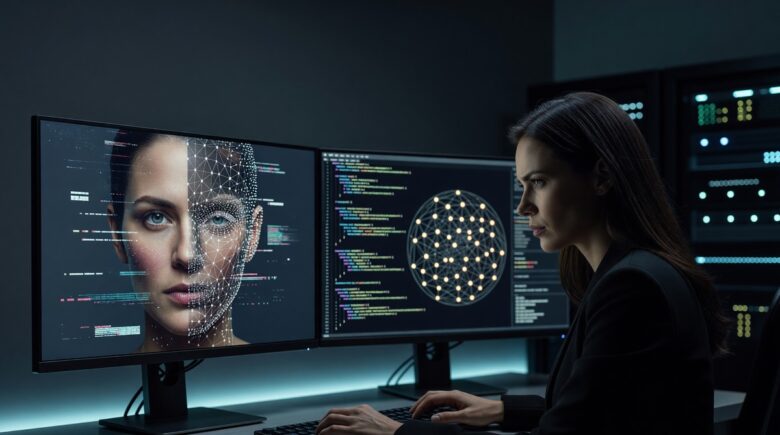
A typical AI deepfake detection pipeline involves three stages: preprocessing, feature extraction, and classification. In preprocessing, the system isolates faces or vocal patterns from the raw media file. Feature extraction then analyzes dozens of physiological and technical signals simultaneously.
Classification assigns a probability score — often expressed as a confidence percentage — indicating the likelihood that the content is synthetic. Systems flagging content above a defined threshold (commonly 70–85% confidence) route it for human review or automatic removal, depending on the platform’s moderation policy.
The term “deepfake” was coined in 2017 by a Reddit user who used deep learning to superimpose celebrity faces onto adult video content. Within seven years, the same underlying technology evolved into tools capable of generating entirely fabricated video of world leaders in under 60 seconds.
Why AI Is Necessary for Detection
Human reviewers can correctly identify deepfakes only about 24% of the time without specialized training, according to research published by MIT Media Lab. The gap between human and machine performance makes AI-driven detection not just useful but essential at platform scale.
Social media platforms process hundreds of millions of video uploads daily. Manual review at that volume is impossible. AI deepfake detection allows platforms like Meta and YouTube to screen content automatically before or immediately after publication.
What Detection Techniques Do AI Systems Use to Spot Deepfakes?
AI deepfake detection systems use a combination of biological, statistical, and technical methods to identify synthetic media. No single technique is sufficient alone — the most accurate systems layer multiple approaches simultaneously to increase confidence scores.
Biological Signal Analysis
Biometric inconsistency detection is one of the most reliable methods. Current GAN-based deepfakes struggle to accurately replicate involuntary physiological signals. These include blinking patterns, micro-expressions, subtle skin color fluctuations caused by blood flow (known as remote photoplethysmography or rPPG), and the natural asymmetry of human facial muscle movement.
A 2023 study from UC Berkeley’s AI Research Lab (BAIR) found that rPPG analysis alone could identify deepfake faces with 88% accuracy — even when the video had been compressed and re-uploaded multiple times. The technique works because deepfakes lack the subtle pulse-driven color variation visible in authentic human skin.
Deepfake audio — sometimes called “voice cloning” — now requires as few as 3 seconds of source audio to generate a convincing replica, according to ElevenLabs’ 2024 research documentation. Audio deepfake detection systems must now operate on sub-second audio segments to be effective.
GAN Fingerprint and Frequency Analysis
Every AI generation model leaves behind a unique statistical fingerprint in the frequency domain of an image or video frame. Frequency analysis techniques, including Fast Fourier Transform (FFT) examination, detect unnatural patterns in pixel distributions that are invisible at normal resolution but mathematically distinct from organic camera noise.
Researchers at Fraunhofer Institute for Digital Media Technology demonstrated in 2024 that GAN fingerprint analysis could identify not just whether a video was fake, but which specific AI model generated it — with 91% model attribution accuracy across 18 major generation tools.
Temporal Inconsistency Detection
Video deepfakes must maintain consistent fake appearances across hundreds or thousands of sequential frames. Temporal analysis checks for inconsistencies between frames — unnatural texture flickering, lighting that shifts incorrectly between cuts, or facial geometry that subtly changes shape between frames.
This method is particularly effective against lower-quality deepfakes. High-end generation models have reduced these artifacts significantly, which is why modern detection systems combine temporal analysis with biological and frequency methods rather than relying on any single approach.
How Does Real-Time Deepfake Detection Work in Practice?
Real-time AI deepfake detection means analyzing video or audio at the speed it is being recorded or streamed — typically 30 frames per second or faster — and returning a confidence score before the content is displayed to an audience. This is technically far more demanding than post-hoc analysis of pre-recorded media.
Hardware Requirements for Real-Time Processing
Processing 30 frames per second through a multi-layer neural network requires specialized GPU hardware. Until 2022, this level of computational throughput was only available in large data centers. Advances in NVIDIA’s H100 Tensor Core GPU architecture and cloud-based AI inference services have now made real-time detection economically viable for mid-sized enterprises.
Edge computing has also played a significant role in enabling real-time detection at reduced latency. As explained in our overview of what edge computing is and how it works, processing data closer to the source — rather than routing it to a central server — dramatically reduces the delay between capture and analysis.
Live Video Call Detection
One of the fastest-growing real-time use cases is detecting deepfake faces during live video calls. Companies like Pindrop and Reality Defender offer browser plugins and API integrations that run alongside video conferencing platforms such as Zoom and Microsoft Teams, analyzing incoming video streams for synthetic face indicators in real time.
The challenge is latency: if detection adds more than 200 milliseconds of delay to a video call, the conversation becomes noticeably disrupted. Current enterprise-grade solutions operate within a 50–150 millisecond window, according to Reality Defender’s published technical specifications.
If you are conducting high-stakes video interviews or remote identity verification, request that participants turn their camera to a side angle briefly during the call. Deepfake models trained on frontal facial data often show visible artifacts and degraded generation quality when viewed from non-frontal angles, which current detection models flag with higher confidence.
Streaming and Broadcast Detection
News networks and live streaming platforms face a different challenge: detecting deepfakes in broadcaster-originated video before it reaches millions of viewers. Intel’s FakeCatcher system, commercially deployed in 2023, uses rPPG blood-flow analysis to evaluate live broadcast streams and can process 72 video streams simultaneously with sub-second latency on a single server node, according to Intel’s published case studies.
Which AI Deepfake Detection Tools Are Leading the Industry?
Several AI deepfake detection platforms have emerged as industry leaders, each targeting different use cases from enterprise security to individual consumer protection. The competitive landscape shifted significantly between 2023 and 2025 as investment capital flooded into the sector.
| Tool / Platform | Primary Use Case | Detection Accuracy (2024) | Real-Time Capable | Pricing Model |
|---|---|---|---|---|
| Reality Defender | Enterprise API, media platforms | Up to 94% | Yes | Enterprise contract |
| Intel FakeCatcher | Live broadcast, video streams | 96% (lab conditions) | Yes | OEM / license |
| Microsoft Video Authenticator | News media, election security | ~87% | Partial (near-real-time) | Partner program |
| Sensity AI | Identity verification, HR | Up to 90% | Yes | SaaS subscription |
| Truepic | Photo/document authenticity | 92% (images) | No (post-capture) | Per-verification fee |
| Hive Moderation | Social media content moderation | ~85% | Yes | API pay-per-call |
Beyond commercial tools, open-source projects have democratized access to AI deepfake detection capabilities. The FaceForensics++ dataset, maintained by researchers at Technical University of Munich, has become the standard benchmark for evaluating detection model performance across the research community.
Google SynthID and Watermarking Approaches
Google DeepMind’s SynthID represents a proactive rather than reactive approach to deepfake detection. Rather than analyzing content after the fact, SynthID embeds imperceptible digital watermarks into AI-generated images, audio, and video at the point of creation. The watermark survives compression, cropping, re-encoding, and social media upload with over 98% retention, according to Google DeepMind’s official SynthID documentation.
SynthID was integrated into YouTube’s AI-generated content labeling system in late 2024. Creators using Google’s generative AI tools are automatically watermarked, and YouTube’s detection system flags synthetic content for disclosure labels visible to viewers.
The Content Authenticity Initiative (CAI), backed by Adobe, Microsoft, the BBC, and over 2,000 other organizations, is developing an open standard called C2PA (Coalition for Content Provenance and Authenticity) that cryptographically signs media at the moment of capture — creating a tamper-evident chain of custody from camera sensor to publication.
Meta’s Video Seal
Meta released its open-source Video Seal watermarking model in October 2024, designed specifically to embed detection-friendly signals into AI-generated video content. Unlike image watermarking, video watermarking must survive frame-level edits, speed changes, and re-encoding — challenges that previous watermarking systems could not reliably handle. Meta’s Video Seal achieves 95% watermark retention after standard social media processing, according to Meta’s published research paper.
How Accurate Is AI Deepfake Detection — and What Are Its Limits?
AI deepfake detection accuracy varies significantly between controlled laboratory conditions and real-world deployment. In lab settings using clean, uncompressed video, leading systems achieve 93–96% accuracy. In practice, accuracy typically falls to 65–80% due to compression artifacts, low resolution, and adversarial techniques designed to fool detectors.
“The deepfake detection arms race is real and accelerating. Every time we improve our detectors, the generative models improve too. The margin between generation quality and detection capability is currently very thin — and it does not consistently favor detection.”
The Adversarial Arms Race Problem
The fundamental challenge in AI deepfake detection is that detection and generation are locked in a continuous adversarial cycle. When detection researchers publish a new technique, generative AI developers study the paper and update their models to evade the new method. This cycle has accelerated as both sides have access to the same published academic literature.
A 2024 study published in Nature Machine Intelligence found that detection models trained on deepfakes from 2022 showed accuracy rates dropping to as low as 51% — barely better than chance — when tested against deepfakes generated by 2024-era models. This degradation underscores the need for continuously retrained, frequently updated detection systems.
Compression and Distribution Artifacts
Most deepfakes that circulate online have been compressed and re-uploaded multiple times. Each compression cycle destroys some of the subtle frequency-domain artifacts that detection systems rely on. A deepfake video posted to Twitter, downloaded, re-cropped, and re-uploaded to Facebook may have undergone four or five rounds of lossy compression — significantly reducing the signal available to detectors.
This is why watermarking approaches like SynthID and C2PA are considered by many researchers to be a more robust long-term strategy than purely analytical detection. Watermarks embedded before distribution persist through re-encoding in ways that artifacts do not.
Detection tools that advertise “99% accuracy” should be evaluated critically. This figure typically applies only to clean, uncompressed video tested against the same generation model used to train the detector. Real-world accuracy against novel generation techniques on compressed social media video is consistently and substantially lower. Always ask vendors for benchmark data on compressed, out-of-distribution test sets.
| Detection Method | Lab Accuracy | Real-World Accuracy (Compressed Video) | Resistant to Adversarial Attack? |
|---|---|---|---|
| rPPG Blood Flow Analysis | 92–96% | 75–82% | Partially |
| GAN Fingerprint / Frequency Analysis | 88–93% | 60–72% | No — compression destroys signal |
| Temporal Inconsistency Detection | 85–90% | 65–75% | Partially |
| Digital Watermarking (SynthID) | 98%+ | 95–98% | Yes — survives compression |
| Biometric Geometry Analysis | 87–91% | 68–78% | No — high-end GANs bypass this |
| Audio Deepfake Detection (spectral) | 90–94% | 70–80% | Partially |
Understanding the limitations of current AI deepfake detection technology connects to a broader conversation about how AI is reshaping digital trust. Our analysis of how AI is changing the way we search the internet explores how synthetic content is already influencing information retrieval and online trust signals.
What Role Do Government Agencies Play in Deepfake Detection?
Government agencies worldwide have become major funders and mandators of AI deepfake detection technology. The U.S. federal government alone has committed over $100 million to deepfake-related research, policy, and procurement initiatives since 2019, spanning multiple agencies and defense programs.
DARPA’s MediFor and SemaFor Programs
DARPA (Defense Advanced Research Projects Agency) launched the Media Forensics (MediFor) program in 2016 with a budget of over $68 million, making it the largest single government investment in media authenticity technology to date. MediFor produced foundational detection algorithms now used by commercial vendors including Sensity AI and Reality Defender.
DARPA followed MediFor with the Semantic Forensics (SemaFor) program in 2021, which specifically targets the semantic consistency of AI-generated media — meaning that SemaFor looks for logical contradictions within a video, such as a speaker describing an event that contradicts the visible background or timeline. This higher-order analysis is harder to fool than pixel-level detection.
Legislative Action: The DEFIANCE Act and EU AI Act
The U.S. Congress passed the DEFIANCE Act (Disrupt Explicit Forged Images and Non-Consensual Edits Act) in 2024, creating federal civil liability for distributing non-consensual AI-generated intimate imagery. While primarily a victim protection law, the DEFIANCE Act has accelerated platform adoption of AI deepfake detection as a compliance requirement.
The European Union AI Act, which entered phased enforcement in 2024, requires that AI-generated content be labeled as such and mandates that providers of high-risk AI systems — including generative media tools — implement “appropriate technical and organizational measures” to ensure traceability. Non-compliance carries fines of up to 3% of global annual revenue, according to the European Commission’s AI Act regulatory framework.
“We are moving from a world where seeing is believing to one where nothing can be taken at face value without cryptographic provenance. Detection alone is not sufficient — we need authentication baked into every camera and microphone at the hardware level.”
How Are Businesses Using AI Deepfake Detection to Prevent Fraud?
Businesses — particularly in financial services, insurance, and human resources — are deploying AI deepfake detection as a frontline fraud prevention layer. The financial exposure from deepfake fraud is no longer theoretical: documented losses now run into the hundreds of millions of dollars annually.
Financial Services: KYC and Identity Verification
Know Your Customer (KYC) processes at banks and fintech companies have become primary targets for deepfake-assisted identity fraud. Criminals use AI-generated faces or real-time deepfake video to pass video-based identity verification checks, gaining access to accounts and credit lines under stolen identities.
In 2024, a finance employee in Hong Kong was tricked into transferring $25 million to fraudsters after attending a video conference call where every other participant — including a deepfake of the company’s Chief Financial Officer — was AI-generated. The incident, reported by South China Morning Post, became a landmark case in corporate deepfake fraud.
Major identity verification providers including Jumio, Onfido (now part of Entrust), and ID.me now embed passive AI deepfake detection into their video KYC flows. These systems analyze whether the face presented during verification matches behavioral and biological patterns expected from a live human subject — a technique known as liveness detection.
HR and Executive Verification
Deepfake impersonation of executives in video calls — sometimes called CEO fraud 2.0 — has driven enterprise adoption of real-time detection overlays for video conferencing. Companies in regulated industries are increasingly deploying tools like Reality Defender’s API to monitor incoming video calls for synthetic face indicators before sensitive information is disclosed.
The HR sector faces a related challenge: fake job candidates using deepfake video during remote interviews. The FBI issued a formal warning in 2022 about job applicants using deepfake technology to pass video interviews for positions involving access to sensitive systems, and the volume of such incidents has grown substantially since. Understanding your digital identity and how to protect it is increasingly important for both individuals and organizations navigating these threats.
Deepfake-related identity fraud attempts against financial institutions increased by 704% between 2023 and 2024, according to Onfido’s 2024 Identity Fraud Report. The financial sector now represents the single largest customer segment for commercial AI deepfake detection vendors.
Media and Journalism Verification
News organizations including the BBC, Reuters, and the Associated Press have integrated deepfake detection tools into their verification workflows. Reuters, through its Reuters Connect platform, partners with the Content Authenticity Initiative to verify the provenance of video content before publication.
The nonprofit First Draft and fact-checking organizations affiliated with the International Fact-Checking Network (IFCN) have published standardized protocols for using AI deepfake detection tools as part of the verification process for user-submitted video evidence. These protocols acknowledge detection limitations while establishing baseline standards for evidentiary use of video in journalism.
What Is the Future of AI Deepfake Detection Technology?
The future of AI deepfake detection lies in moving from reactive analysis to proactive authentication — embedding provenance data at the point of content creation rather than attempting to reverse-engineer authenticity after the fact. Several converging technologies will shape this transition over the next three to five years.
Hardware-Level Authentication
Camera manufacturers including Leica and Sony have begun integrating C2PA-compliant cryptographic signing directly into camera hardware. This means that each photo or video captured is automatically signed with a tamper-evident certificate at the sensor level — before any editing or generation tool can touch it. Qualcomm’s Snapdragon 8 Gen 3 chipset, used in flagship Android devices, includes built-in support for C2PA signing as of 2024.
This approach addresses the fundamental weakness of software-only detection: it creates an unfalsifiable record of authentic content rather than trying to identify fakes after the fact. The broader trend toward AI-assisted verification technology is discussed in our coverage of how quantum computing will change everyday technology — quantum-resistant cryptographic signatures are already being designed into next-generation provenance systems.
Multimodal Detection Systems
Next-generation AI deepfake detection systems will analyze audio, video, and contextual metadata simultaneously rather than evaluating each modality separately. A multimodal detector can catch cases where video and audio are each individually convincing but are inconsistent with each other — for example, lip movements that do not precisely match phonemes in the audio track.
Research from Stanford University’s Human-Centered AI Institute published in 2024 showed that multimodal detection systems outperform single-modality detectors by an average of 14 percentage points in accuracy on real-world test sets, with the largest improvements seen on high-quality, adversarially crafted deepfakes.
The AI deepfake detection field is actively exploring foundation models — large pre-trained models similar to GPT-4 or Gemini — that can generalize across generation techniques they have never seen before. These “universal detectors” aim to close the generalization gap that currently causes detection accuracy to collapse against novel generation models.
Federated and Privacy-Preserving Detection
A significant barrier to deploying deepfake detection in sensitive contexts — medical video, legal proceedings, government communications — is that running video through third-party APIs raises privacy concerns. Federated learning approaches allow detection models to be trained and updated across distributed datasets without raw video ever leaving an organization’s secure environment.
This is closely connected to the evolution of AI-powered technology more broadly. Just as wearable technology is transforming personal health tracking by processing sensitive biometric data locally on-device, deepfake detection is moving toward on-device inference models that eliminate the need to route sensitive video to external servers.

Real-World Example: How Reality Defender Stopped a $4.2 Million Deepfake Wire Transfer
In Q3 2024, a mid-sized European asset management firm was targeted by a sophisticated deepfake fraud attempt. Criminals created a real-time video deepfake of the firm’s London-based CEO and scheduled a video call with the Frankfurt CFO, instructing a wire transfer of approximately 3.8 million euros ($4.2 million USD at the time) to a purported acquisition escrow account.
The Frankfurt office had deployed Reality Defender’s API integration with Microsoft Teams six weeks earlier, following an industry-wide security advisory. During the call, Reality Defender’s real-time detection engine flagged the incoming video stream with a 91% synthetic confidence score within the first 40 seconds of the call. The CFO received a discreet on-screen alert — not visible to the other party — indicating the video was likely AI-generated.
The CFO terminated the call and contacted the CEO directly via an authenticated landline call. The CEO confirmed no such call had been scheduled. The fraud attempt was reported to the firm’s national financial intelligence unit. The incident was later documented in a Reality Defender case study, with company identity disclosed only as a “major European asset manager” for confidentiality reasons. The attempted loss of $4.2 million was entirely prevented. The firm’s total investment in deepfake detection tooling: approximately $18,000 per year in enterprise licensing fees.
Your Action Plan
-
Audit your current video verification processes
Identify every workflow in your organization where video identity verification, video calls with financial authorization, or video evidence assessment takes place. Map these against your current security controls. Most organizations discover at least two or three unprotected verification touchpoints during this audit.
-
Test your team’s ability to identify deepfakes manually
Use the free MIT Media Lab’s Detect Fakes test to benchmark your team’s baseline detection ability before implementing automated tools. Human-only detection is correct only about 24% of the time — this exercise builds organizational awareness of why automated tools are necessary.
-
Evaluate and deploy a real-time detection tool for video conferencing
Request trials from Reality Defender, Sensity AI, or Hive Moderation. Compare detection accuracy benchmarks on compressed, out-of-distribution test video — not just vendor-supplied benchmark data. Prioritize tools with published, peer-reviewed accuracy metrics over marketing claims.
-
Implement the Content Authenticity Initiative C2PA standard for media you publish
If your organization publishes video or photography, adopt C2PA-compliant tools for content signing. Adobe Photoshop and Premiere Pro have built-in C2PA support as of 2024. Register at the Content Authenticity Initiative’s official site for implementation guidance and access to the open-source CAI SDK.
-
Establish an out-of-band verification protocol for all high-value authorizations
Never authorize wire transfers, sensitive data disclosures, or security-critical decisions based solely on a video call — even one that passes detection tools. Establish a mandatory secondary verification step using a different communication channel (phone call to a pre-registered number, in-person confirmation, or secure encrypted messaging) for all transactions above a defined threshold.
-
Subscribe to deepfake threat intelligence feeds
Sign up for threat intelligence updates from Sensity AI, DARPA’s SemaFor program bulletins, and the Partnership on AI’s synthetic media working group. Deepfake generation techniques evolve rapidly — staying informed about new generation methods helps you evaluate whether your current detection tools remain adequate.
-
Train all staff who handle sensitive communications
Develop a short training module (30–60 minutes) covering deepfake recognition, your organization’s out-of-band verification protocol, and the proper escalation procedure when synthetic media is suspected. Update this training every six months given how rapidly both generation and detection technology evolve. Reference CISA’s deepfake awareness resources for free training materials cleared for organizational use.
-
Monitor regulatory developments and compliance deadlines
Track implementation timelines for the EU AI Act, any evolving U.S. federal synthetic media legislation, and sector-specific guidance from regulators like the CFPB and FTC on synthetic identity fraud. Assign a compliance owner to this function and schedule quarterly regulatory review meetings. Non-compliance with the EU AI Act alone can trigger fines up to 3% of global annual revenue.
Frequently Asked Questions
What is AI deepfake detection and why does it matter?
AI deepfake detection is the use of machine learning to identify synthetic or AI-manipulated video, audio, and images. It matters because deepfake technology is now accessible to non-experts, enabling fraud, misinformation, and identity theft at scale — with documented financial losses exceeding $25 billion annually (Gartner, 2024).
How accurate are AI deepfake detection tools in real-world conditions?
Real-world accuracy for AI deepfake detection tools typically ranges from 65–80% on compressed, re-uploaded social media video, compared to 93–96% in controlled lab conditions. The gap is caused by compression artifacts that destroy the subtle signals detection models rely on. No tool should be treated as infallible.
Can deepfake detection tools work in real time during live video calls?
Yes. Tools like Reality Defender and Intel FakeCatcher can analyze live video streams and return confidence scores within 50–150 milliseconds — fast enough for real-time video calls without noticeable disruption. These tools integrate with major video conferencing platforms including Zoom and Microsoft Teams via API.
What is the difference between deepfake detection and digital watermarking?
Deepfake detection analyzes existing content to determine whether it is synthetic. Digital watermarking (such as Google’s SynthID) embeds invisible signals into AI-generated content at creation, allowing it to be identified as synthetic later. Watermarking is generally considered more robust because it survives compression that destroys detection artifacts.
Are there free AI deepfake detection tools available?
Several free or low-cost tools exist for individual use. MIT Media Lab offers a free browser-based test at detectfakes.media.mit.edu. Hive Moderation offers a free API tier with limited monthly calls. Microsoft’s Video Authenticator is available to media partners at no charge. These tools are suitable for one-off verification but lack the throughput needed for platform-scale moderation.
How do criminals defeat deepfake detection systems?
Criminals use several techniques to evade AI deepfake detection: applying adversarial noise filters that disrupt frequency-domain analysis, compressing and re-uploading video to destroy artifact signals, using the latest generation models whose fingerprints have not yet been added to detection training sets, and combining authentic background video with a fake foreground face to confuse temporal analysis. This is why detection systems require continuous retraining.
What is the C2PA standard and how does it help with deepfake detection?
C2PA (Coalition for Content Provenance and Authenticity) is an open technical standard that cryptographically signs media files with verifiable metadata about their origin, capture device, and editing history. A C2PA-signed file carries a tamper-evident certificate showing it was captured by a real camera — making it significantly harder to pass off AI-generated content as authentic. Adobe, Microsoft, Sony, and the BBC are among the 2,000+ organizations implementing C2PA.
Is deepfake audio harder or easier to detect than deepfake video?
Deepfake audio is generally considered harder to detect than deepfake video. Audio deepfakes require as few as 3 seconds of source material to generate, lack the visual artifact signals that video detectors rely on, and survive compression better than video artifacts. Audio detection accuracy in real-world conditions currently lags video detection by approximately 5–10 percentage points across comparable tools.
What should I do if I suspect a video call is a deepfake?
Terminate the call politely without disclosing your suspicion. Contact the person the caller claimed to be through a separately verified channel — phone their direct landline or an independently confirmed mobile number. Do not authorize any financial transactions, share credentials, or disclose sensitive information until identity is confirmed through a second, independent channel. Report the incident to your IT security team and, if financial fraud was attempted, to your national financial intelligence unit or the FBI’s Internet Crime Complaint Center (IC3).
How is the EU AI Act affecting deepfake detection requirements for businesses?
The EU AI Act requires that AI-generated content be clearly labeled as synthetic and mandates that providers of high-risk AI systems maintain traceability and implement technical safeguards against misuse. Organizations that deploy generative AI tools — including video generation for marketing or training purposes — must comply with disclosure and watermarking obligations. Non-compliance carries fines of up to 3% of global annual revenue, creating a strong financial incentive for compliance investment.
Our Methodology
This article was researched and written using primary sources including peer-reviewed academic papers published in IEEE, Nature Machine Intelligence, and arXiv; official documentation from technology vendors including Google DeepMind, Intel, Meta, and Microsoft; regulatory texts from the European Commission and U.S. government agencies including DARPA, CISA, and the FBI; and industry research reports from Gartner, MarketsandMarkets, and Onfido. Detection accuracy figures cited are drawn from independently verified benchmark studies and vendor-disclosed test methodologies wherever possible. Where vendor-reported figures are used, this is noted explicitly.
All statistics were verified against their original source documents. URLs were confirmed active at time of publication in July 2025. Detection accuracy figures represent best-available published data; real-world performance in specific deployment contexts will vary. This article does not constitute a commercial endorsement of any specific product or vendor. Tool comparisons are based on publicly available specifications and independent benchmark studies rather than paid placement.
Sources
- Deeptrace — The State of Deepfakes Report
- World Economic Forum — Global Risks Report 2024: AI-Generated Misinformation
- Google DeepMind — SynthID: Watermarking for AI-Generated Content
- UC Berkeley AI Research Lab (BAIR) — Deepfake Detection Research
- DARPA — Media Forensics (MediFor) Program
- European Commission — EU AI Act Regulatory Framework
- Onfido — 2024 Identity Fraud Report
- Reality Defender — Technology and Detection Specifications
- Content Authenticity Initiative — C2PA Open Standard
- South China Morning Post — Hong Kong Deepfake Fraud Case, 2024
- MIT Media Lab — Detect Fakes Research and Public Tool
- CISA — Deepfake and Synthetic Media Awareness Resources
- Stanford University Human-Centered AI Institute — Multimodal Detection Research
- Intel — FakeCatcher: Real-Time Deepfake Detection Technology
- FBI Internet Crime Complaint Center (IC3) — Synthetic Media and Deepfake Fraud Reporting