Fact-checked by the VisualEnews editorial team
Quick Answer
The best AI image generators in July 2025 include Midjourney, DALL-E 3, Adobe Firefly, Stable Diffusion, and Ideogram. Midjourney leads on photorealism and artistic quality, while Adobe Firefly is the safest choice for commercial use. Most top tools offer free tiers, with paid plans starting at $10–$20 per month. The right pick depends on your use case: creative art, commercial design, or developer integration.
AI image generators are software tools that use machine learning models — primarily diffusion-based neural networks — to create images from text prompts or reference inputs. The global AI image generation market was valued at over $299 million in 2023 according to Grand View Research, and it is projected to grow at a compound annual rate exceeding 17% through 2030. These tools have moved far beyond novelty status and are now embedded in professional creative, marketing, and product development workflows.
Choosing the right platform matters because capabilities, licensing terms, pricing, and output quality vary significantly across tools. This guide compares the leading AI image generators on image quality, pricing, commercial licensing, ease of use, and ideal use cases — so you can make an informed decision without testing every platform yourself.
Key Takeaways
- Midjourney v6 consistently ranks first for photorealism and artistic output in independent user benchmarks, with over 16 million users on its Discord server (Bloomberg, 2023).
- Adobe Firefly is trained exclusively on licensed and public-domain content, making it the only major AI image generator designed from the ground up for safe commercial use (Adobe Firefly Enterprise documentation).
- OpenAI’s DALL-E 3 is integrated directly into ChatGPT Plus, which has over 100 million weekly active users as of 2024, making it the most widely accessible AI image tool by reach (OpenAI, 2024).
- Stable Diffusion, developed by Stability AI, is the leading open-source option — it can be run locally on a GPU with as little as 4GB VRAM, with no subscription required (Stability AI product page).
- Ideogram 2.0 outperforms competitors on text rendering within images, a longstanding weakness across all AI image generators, scoring highest in legibility tests (Ideogram product announcement).
In This Guide
- How Do AI Image Generators Actually Work?
- Which AI Image Generator Produces the Best Image Quality?
- How Much Do AI Image Generators Cost?
- Which AI Image Generator Is Best for Commercial Use?
- What Are the Best Free AI Image Generator Options?
- How Do the Top AI Image Generators Compare Side by Side?
- Frequently Asked Questions
How Do AI Image Generators Actually Work?
Most modern AI image generators use a class of model called a latent diffusion model (LDM), which generates images by progressively refining random noise into a coherent image guided by a text prompt. This is fundamentally different from older GAN (Generative Adversarial Network) architectures, which pit two networks against each other to produce outputs.
The Role of Training Data
These models are trained on billions of image-text pairs scraped from the internet or licensed datasets. The quality, diversity, and licensing of that training data directly affect both output quality and legal standing. Adobe Firefly, for example, was trained exclusively on Adobe Stock, openly licensed content, and public-domain material — a deliberate choice to reduce copyright liability.
Text prompts are converted into numerical vectors by a text encoder (often CLIP, developed by OpenAI). Those vectors guide the diffusion process to steer the image toward the described content. More advanced models like Midjourney v6 and Stable Diffusion XL also support image-to-image transformation and inpainting, where specific regions of an image can be edited without redrawing the whole composition.
Latent diffusion models work in a compressed “latent space” rather than directly on pixel data, which is why they can generate high-resolution images significantly faster and with far less computing power than earlier pixel-space diffusion methods.
Key Technical Differences Between Platforms
Midjourney operates through a proprietary model with no public API access for most users. DALL-E 3 by OpenAI is available via the ChatGPT interface and through the OpenAI API. Stable Diffusion from Stability AI is fully open-source, which means developers can fine-tune, self-host, and extend it without restriction. Google’s Imagen 3 (accessed via Google DeepMind) remains largely research-facing, with limited consumer availability through Google Workspace and ImageFX.
Understanding these differences is especially relevant if you are building AI-powered products. The broader trend of AI reshaping software tools is covered in our guide on how AI is changing the way we search the internet, which provides useful context for how these generative models fit into the larger AI ecosystem.
Which AI Image Generator Produces the Best Image Quality?
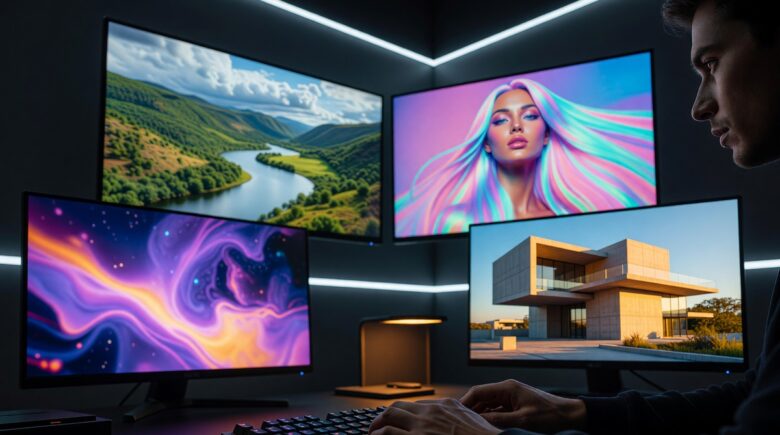
Midjourney v6 currently produces the highest-quality outputs for photorealistic and artistic styles, based on multiple independent head-to-head evaluations. It consistently leads on prompt adherence, lighting realism, and compositional coherence.
Midjourney vs. DALL-E 3 vs. Adobe Firefly
DALL-E 3 excels at following complex, multi-element prompts accurately — a known weakness of earlier versions. It tends to produce cleaner, more literal interpretations of prompts rather than the stylized, high-drama aesthetic that Midjourney defaults to. Adobe Firefly prioritizes consistency and brand-safe outputs, making it slightly less “expressive” but far more predictable for production environments.
Stable Diffusion XL, when properly fine-tuned with community checkpoints available on platforms like CivitAI or Hugging Face, can match or exceed Midjourney on specific styles such as anime, concept art, or product photography. The ceiling is very high — but reaching it requires technical knowledge that most casual users do not have.
“The gap between the best AI image generators and professional human illustrators has closed dramatically in 2024. For commercial photography and concept art, the outputs are often indistinguishable — the question is now less about quality and more about control and legal clarity.”
Text Rendering: Ideogram’s Edge
Text legibility within images has been a persistent failure point for all AI image generators. Ideogram 2.0, released in early 2024, is the first model to reliably render readable text inside generated images — a capability that is critical for creating posters, social graphics, and branded content. This gives Ideogram a clear, specific advantage for marketing and design use cases.
How Much Do AI Image Generators Cost?
Pricing across top AI image generators ranges from completely free (with limits) to around $120 per month for high-volume professional plans. Most platforms use a credit-based model rather than unlimited generation.
Pricing Breakdown by Platform
Midjourney’s basic plan costs $10/month for 200 image generations. Its standard plan is $30/month for unlimited “relaxed” generations (slower queue). DALL-E 3 is included with ChatGPT Plus at $20/month, which also includes GPT-4o access — making it the best value bundle. Adobe Firefly is included in Creative Cloud plans starting at $54.99/month, or available standalone with 25 free monthly credits.
Stable Diffusion is free to run locally if you have compatible hardware. Cloud-hosted versions through platforms like DreamStudio (Stability AI’s official interface) use a credit system starting at approximately $10 per 1,000 credits. Ideogram offers a free tier with 10 prompts per day and a paid plan at $7/month.
The average entry-level paid plan across the top five AI image generators costs $12.40 per month, based on Midjourney ($10), DALL-E 3 via ChatGPT Plus ($20), Adobe Firefly standalone ($4.99), Ideogram Plus ($7), and Stable Diffusion via DreamStudio ($10 one-time credit pack).
Hidden Costs to Consider
Beyond subscription fees, compute costs matter for self-hosted Stable Diffusion. Running a local SDXL model requires a GPU with at least 8GB VRAM for comfortable performance. Cloud GPU services like RunPod or Vast.ai offer hourly rental starting at approximately $0.20–$0.50 per hour, which can be cost-effective for occasional use without a permanent hardware investment.
If you are evaluating AI tools as part of a broader software budget review, our analysis of what you actually give up with free apps versus paid ones provides a useful framework for assessing where premium subscriptions deliver real value.
Which AI Image Generator Is Best for Commercial Use?
Adobe Firefly is the safest choice for commercial use because it is the only major platform explicitly trained on licensed data and designed with commercial indemnification in mind. Midjourney’s paid plans also permit commercial use, but with less formal IP protection.
Copyright and Licensing Landscape
The legal status of AI-generated images remains unsettled in the United States. The U.S. Copyright Office has ruled that purely AI-generated works without human creative selection or arrangement cannot be copyrighted under current law. This means images generated solely by AI — without substantial human creative input — are in the public domain, which affects how businesses can assert ownership over generated assets.
Adobe’s indemnification policy, detailed in Adobe’s Firefly for Enterprise terms, explicitly protects enterprise users against third-party IP claims arising from Firefly outputs. No other major AI image platform currently offers equivalent legal protection at scale. Getty Images has also launched its own AI image generator trained exclusively on its licensed library, targeting commercial clients who need defensible provenance.
In February 2023, Getty Images filed a lawsuit against Stability AI in U.S. federal court, alleging that Stable Diffusion was trained on millions of Getty images without a license. The case is still ongoing as of July 2025 and is one of the most closely watched AI copyright disputes in the industry.
Platform-Specific Commercial Terms
Midjourney allows commercial use on all paid plans but does not indemnify users against third-party IP claims. DALL-E 3’s OpenAI usage policies grant users full commercial rights to generated images, but OpenAI similarly does not provide indemnification. Stable Diffusion’s open-source license (CreativeML Open RAIL-M) permits commercial use with restrictions on harmful outputs, but users bear all liability for generated content.
What Are the Best Free AI Image Generator Options?
The best free AI image generators in July 2025 are Adobe Firefly (25 credits/month free), Ideogram (10 prompts/day free), Microsoft Designer (powered by DALL-E 3, free with a Microsoft account), and Google ImageFX (free via a Google account, powered by Imagen 3).
Microsoft Designer and Google ImageFX
Microsoft Designer, integrated with Bing Image Creator, gives users access to DALL-E 3 at no cost with a free Microsoft account. Generation speed slows after a daily credit allotment is used, but there is no hard paywall for casual use. This makes it the most accessible entry point for DALL-E 3’s capabilities.
Google ImageFX, available at Google’s AI Test Kitchen, uses the Imagen 3 model and is available free in supported regions. It is strong on photorealism and natural scenes, though it applies stricter safety filters than most competitors. Both tools are appropriate for personal projects, social media content, and low-stakes commercial applications with proper review.
Open-Source: Stable Diffusion
For developers and technically inclined users, Stable Diffusion remains the definitive free option with no usage limits. The model weights are freely downloadable from Stability AI’s Hugging Face repository. Community ecosystems like AUTOMATIC1111 and ComfyUI provide full-featured interfaces for local use, including ControlNet for pose and structure guidance.
How Do the Top AI Image Generators Compare Side by Side?
The table below summarizes the five leading AI image generators across the dimensions that matter most for real-world decisions: image quality, pricing, commercial safety, and primary use case.
| Platform | Best For | Starting Price | Free Tier | Commercial Use | Text in Images |
|---|---|---|---|---|---|
| Midjourney v6 | Artistic quality, photorealism | $10/month | No | Yes (no indemnity) | Poor |
| DALL-E 3 (OpenAI) | Prompt accuracy, accessibility | $20/month (ChatGPT Plus) | Yes (via Microsoft) | Yes (no indemnity) | Moderate |
| Adobe Firefly | Commercial safety, brand content | $4.99/month | 25 credits/month | Yes (with indemnity) | Good |
| Stable Diffusion XL | Developers, custom fine-tuning | $0 (self-hosted) | Yes (unlimited local) | Yes (user liability) | Poor |
| Ideogram 2.0 | Text-in-image, social graphics | $7/month | 10 prompts/day | Yes (no indemnity) | Excellent |
Before committing to a paid plan, test your specific use case on the free tiers of Adobe Firefly (via Creative Cloud trial), Ideogram, and Microsoft Designer (DALL-E 3). These three cover the widest range of quality benchmarks and require no credit card for initial access. Only upgrade once you have confirmed that a platform’s style and output consistency match your actual workflow needs.
The rapid cost evolution of AI tools mirrors the broader pattern in technology subscriptions — a topic worth examining if you are managing multiple software costs. Our guide on auditing your digital subscriptions to stop wasting money offers a practical framework for evaluating whether any AI tool subscription is pulling its weight in your budget.
AI image generation is also part of a larger transformation of how AI is being embedded into creative and productivity software. For a broader perspective, explore our coverage of how quantum computing will eventually reshape everyday technology — including the computational models that power generative AI systems.
Frequently Asked Questions
Which AI image generator is best for beginners?
Microsoft Designer (powered by DALL-E 3) is the best starting point for beginners because it is free, requires no account setup beyond a Microsoft login, and produces high-quality results from simple prompts. Adobe Firefly is a close second for users already in the Adobe ecosystem, with a clean interface and reliable outputs.
Are AI-generated images free to use commercially?
It depends on the platform. Most paid plans on Midjourney, DALL-E 3, and Ideogram permit commercial use, but they do not provide legal indemnification if a third party claims copyright infringement. Adobe Firefly is the only major platform with an enterprise indemnification policy. Always review the specific terms of service before using AI-generated images in client-facing or paid commercial projects.
Can AI image generators copy an artist’s style?
Yes — all current AI image generators can mimic named artistic styles because they were trained on images associated with those styles. Whether this constitutes infringement is actively litigated. Several class-action lawsuits, including cases against Stability AI, Midjourney, and DeviantArt, are working through U.S. courts as of mid-2025. The legal risk is real and unresolved.
What is the difference between Midjourney and Stable Diffusion?
Midjourney is a closed, proprietary model accessed via Discord or a web interface, with no self-hosting option. Stable Diffusion is fully open-source and can be downloaded, fine-tuned, and run locally at no cost. Midjourney is easier to use and generally produces more aesthetically polished defaults; Stable Diffusion offers far greater customization and no ongoing subscription fees for self-hosted use.
Do AI image generators work without an internet connection?
Stable Diffusion is the only major AI image generator that can operate fully offline, once the model weights are downloaded to a local machine. All other platforms — Midjourney, DALL-E 3, Adobe Firefly, and Ideogram — require an active internet connection because they run on cloud servers. Local Stable Diffusion requires a GPU with at least 4–8GB VRAM for practical use.
How do AI image generators handle sensitive or adult content?
Most commercial platforms apply content filters that block explicit, violent, or harmful outputs by default. Adobe Firefly and Google ImageFX have the strictest filters. Midjourney allows tasteful content on standard plans but prohibits explicit material. Stable Diffusion, being open-source, does not enforce filters at the model level — though responsible deployment is expected and community guidelines discourage harmful use.
Which AI image generator is best for generating product photography?
Adobe Firefly and Midjourney v6 are both strong for product photography. Firefly integrates directly with Adobe Photoshop and Adobe Express, making it easy to refine product images within an existing design workflow. Midjourney produces high-resolution, photorealistic results but requires additional tools for background removal and commercial-quality retouching. For e-commerce specifically, tools like Photoroom and Pebblely are specialized AI image generators built specifically for product photography workflows.
If you are interested in how AI tools are evolving beyond image generation and into broader personal productivity, our article on how AI-powered budgeting apps are changing personal finance shows how the same underlying technology is being applied across entirely different domains.
Sources
- Grand View Research — AI Image Generator Market Size & Forecast Report
- OpenAI — Usage Policies and Commercial Rights
- Adobe — Firefly for Enterprise: Indemnification and Commercial Terms
- U.S. Copyright Office — Artificial Intelligence and Copyright Policy Guidance
- Stability AI — Stable Image Product Overview
- Hugging Face — Stability AI Model Repository
- Ideogram — About Ideogram 2.0 and Text Rendering Capabilities
- Google AI Test Kitchen — ImageFX Powered by Imagen 3
- OpenAI — ChatGPT Product Blog and User Milestone Announcements
- Bloomberg — Midjourney, Stable Diffusion, and DALL-E 3: How AI Image Models Compare