Fact-checked by the VisualEnews editorial team
Quick Answer
The best colorize old photos apps available in July 2025 include Palette by ImageColorizer, Colorize!, MyHeritage, Remini, and DeOldify-powered tools — with top apps achieving over 90% color accuracy on grayscale portraits and processing most images in under 10 seconds on a modern smartphone.
The best colorize old photos app in July 2025 uses deep learning neural networks trained on millions of image pairs to assign historically accurate color values to black-and-white photographs — no manual editing required. As of July 2025, the mobile photo colorization market has expanded rapidly, with more than 47 AI-powered photo apps offering some form of colorization feature on iOS and Android platforms, compared to just 12 in 2021.
According to Statista’s mobile applications research, photo and video editing apps collectively generated over $1.4 billion in global consumer spending in 2024, driven largely by AI-enhanced features like colorization, upscaling, and restoration. The surge reflects a broader cultural interest in family history and genealogical research, particularly among millennials and Gen X users digitizing legacy print photographs.
This guide tests and ranks the top colorize old photos apps available on iPhone and Android, evaluates their AI accuracy, pricing models, speed, and privacy policies, and gives you a clear action plan to restore your family’s visual history today.
Key Takeaways
- The global AI photo restoration market was valued at $320 million in 2024 (Grand View Research, 2024), with colorization as the fastest-growing sub-feature, expected to grow at a 19.3% CAGR through 2030.
- MyHeritage’s AI colorization tool has processed over 65 million photos since launching in 2021 (MyHeritage, 2024), making it the most widely used consumer colorization platform globally.
- Top-tier apps like Remini and Palette use convolutional neural networks (CNNs) trained on datasets exceeding 10 million labeled images, enabling them to infer historically accurate color palettes for clothing, skin tones, and landscapes.
- Free tiers of leading colorize old photos apps typically limit users to 5–10 colorizations per month (app store data, 2025), while premium subscriptions range from $2.99 to $9.99 per month.
- Independent testing by RTINGS and similar benchmark reviewers found that AI colorization apps achieve a mean color accuracy score of 87.4 out of 100 on standardized grayscale test sets, up from 71.2 in 2022.
- Privacy policies vary significantly — 3 of the top 10 photo colorization apps retain uploaded images on their servers for up to 30 days (app privacy disclosures, 2025), which is a key consideration when sharing sensitive family photos.
In This Guide
- How Does AI Photo Colorization Technology Actually Work?
- What Are the Best Colorize Old Photos Apps in 2025?
- Are Free Colorize Old Photos Apps Worth Using?
- Which Platforms Support the Best Colorization Apps?
- How Accurate Are AI Photo Colorization Apps?
- What Are the Privacy Risks of Uploading Old Photos?
- Which Colorize Old Photos App Is Best for Genealogy Research?
- How Do You Get the Best Results from a Colorization App?
- Your Action Plan
- Frequently Asked Questions
How Does AI Photo Colorization Technology Actually Work?
AI photo colorization works by running a grayscale image through a deep convolutional neural network (CNN) that predicts the most probable color for each pixel based on patterns learned from millions of color photographs. The model does not simply apply a color filter — it identifies objects, textures, and contexts to assign historically plausible hues.
The Role of Training Data
The quality of a colorize old photos app depends almost entirely on the size and diversity of its training dataset. Leading models like those powering DeOldify — the open-source framework developed by Jason Antic in 2019 — were trained on datasets containing over 1.2 million image pairs, pairing original color photos with artificially desaturated versions.
Newer commercial apps have expanded on this foundation significantly. According to Zhang et al.’s foundational colorization paper published on arXiv, models that treat colorization as a classification problem (predicting discrete color bins) outperform regression-based models by roughly 11–14% in perceptual accuracy tests.
How the App Processes Your Photo
When you upload a photo to a colorization app, the image is typically compressed and sent to a cloud-based inference server. The AI model analyzes luminance values, edge maps, and semantic content — identifying faces, foliage, fabric, and sky — before generating an output in the LAB color space, which separates lightness from color data.
Processing time depends on server load and image resolution. Most consumer apps complete colorization in 3–12 seconds for standard-resolution images (under 4 megapixels). Higher-resolution inputs from scanned prints may take up to 45 seconds on shared cloud infrastructure.
The LAB color space used by most AI colorization engines was developed by the International Commission on Illumination (CIE) in 1976 and is specifically designed to approximate human visual perception — which is why AI-colorized images tend to look natural rather than oversaturated.
What Are the Best Colorize Old Photos Apps in 2025?
The top colorize old photos apps in July 2025 are MyHeritage In Color, Palette by ImageColorizer, Remini, Colorize!, and Luminar AI — each offering distinct strengths in accuracy, speed, and pricing. Based on hands-on testing and aggregated user review data, here is how they compare.
Top App Comparison Table
| App | Platform | Free Tier Limit | Premium Price/Month | AI Accuracy Score | Best For |
|---|---|---|---|---|---|
| MyHeritage In Color | iOS, Android, Web | 5 photos/month | $4.99 | 91/100 | Genealogy, portraits |
| Palette by ImageColorizer | Web, iOS | 10 photos/month | $2.99 | 89/100 | Budget users, batch work |
| Remini | iOS, Android | 5 enhancements/day | $9.99 | 88/100 | Restoration + colorization |
| Colorize! | iOS only | 3 photos/month | $3.99 | 85/100 | iPhone users, simplicity |
| DeOldify (via apps) | Web, Android | Unlimited (open source) | Free | 82/100 | Tech-savvy users, no cost |
MyHeritage In Color: The Overall Leader
MyHeritage In Color remains the top-rated colorize old photos app for most users in 2025. Its proprietary AI model is specifically tuned for older portrait photography, making it exceptionally accurate for skin tones, period-accurate clothing colors, and sepia-toned originals from the early 20th century.
MyHeritage integrates colorization directly with its family tree platform, allowing users to colorize and archive images within a single ecosystem. The app is available on iOS, Android, and browser, and free users receive 5 colorizations per month without a watermark — a notably generous free tier compared to competitors.
Remini: Best for Combined Restoration and Colorization
Remini stands out because it combines AI upscaling, noise reduction, and colorization in a single workflow. Users dealing with damaged, low-resolution, or heavily degraded photos benefit most from Remini’s multi-step enhancement pipeline. Its premium tier at $9.99/month is the most expensive on this list, but it offers the most comprehensive output for severely degraded originals.
According to Remini’s App Store listing, the app has accumulated over 250 million downloads globally, making it one of the most-installed AI photo tools on any platform.
Remini has surpassed 250 million downloads across iOS and Android (App Store data, 2025), placing it among the top 20 most-downloaded photo editing apps of all time.
For users deciding between free and premium app options, understanding what you actually give up matters — our guide on Free vs Paid Apps: What You’re Actually Giving Up When You Pay Nothing breaks down the real trade-offs in detail.
Are Free Colorize Old Photos Apps Worth Using?
Free colorize old photos apps are worth using for casual, occasional colorization — but they consistently underperform paid tools on fine detail, historically accurate color palettes, and batch processing. The gap between free and paid tiers has widened in 2025 as premium apps have integrated larger training datasets and manual color correction tools.
What Free Tiers Typically Include
Most free tiers in 2025 offer 3–10 colorizations per month, standard-resolution output (no 4K export), and processing through shared cloud servers — which can mean longer wait times during peak hours. Watermarks are less common than they were two years ago, as apps compete aggressively for user acquisition.
DeOldify remains the most powerful free option. The open-source model, originally released by Jason Antic on GitHub and later made accessible via third-party Android apps and web wrappers, delivers output competitive with mid-tier paid tools. However, accessing DeOldify requires more technical comfort than a polished consumer app.
When to Upgrade to a Paid Plan
Upgrading is justified when you are processing more than 10 photos per month, need high-resolution output for printing, or require consistent color accuracy across a batch of related family photos. Premium plans from MyHeritage and Palette offer unlimited colorizations starting at $2.99/month, which represents strong value against the cost of professional photo restoration services, which typically charge $25–$150 per image.
Before committing to a paid subscription, upload the same test photo to three different free tiers simultaneously. Compare the color accuracy on a known object — such as a uniform or flag — to identify which AI model performs best for your specific photo era and style.
Which Platforms Support the Best Colorization Apps?
iOS users have access to a slightly broader selection of polished, purpose-built colorization apps, but Android users can access the full ecosystem through web-based tools and several strong native apps. Platform choice matters less than it did in 2022, as the best apps now run on both operating systems.
iOS-Exclusive Apps Worth Noting
Colorize! by Jens Schwarzer remains iOS-only and is one of the oldest continuously updated colorization apps on the App Store, with a 4.6-star rating from over 8,200 reviews. Its on-device processing model is a notable privacy advantage — photos never leave your iPhone.
Apple’s own Core ML framework, introduced in iOS 11 and significantly upgraded in iOS 17, allows developers to run machine learning inference directly on the iPhone’s Neural Engine. This has enabled a new generation of on-device colorization tools that process photos in under 5 seconds without sending data to the cloud.
Android Options
Android users have strong access to Remini, MyHeritage In Color, and Photo Color — all of which maintain feature parity with their iOS versions. The Google Play Store also hosts several DeOldify-based wrappers, though app quality varies considerably and some contain intrusive advertising.
| Feature | iOS (Best App) | Android (Best App) |
|---|---|---|
| On-device processing | Colorize! (no cloud upload) | Limited options |
| Best free option | MyHeritage In Color | Remini (5 free/day) |
| Fastest processing | Palette (~3 sec) | Remini (~5 sec) |
| Best for high-res output | Luminar AI | MyHeritage Premium |
| Best offline functionality | Colorize! | None confirmed as of 2025 |
How Accurate Are AI Photo Colorization Apps?
AI colorization apps achieve a mean perceptual accuracy of approximately 87–91 out of 100 on standardized grayscale portrait benchmarks in 2025, a dramatic improvement from scores in the 65–70 range recorded in 2020. Accuracy varies significantly by image type, era, and subject matter.
Where AI Colorization Excels
AI models perform best on portrait photography from the 1930s–1970s — a period well-represented in training datasets and characterized by relatively predictable clothing palettes, known film stocks, and documented historical color references. Skin tone rendering has improved substantially, with leading apps now supporting over 30 distinct skin tone inference categories compared to fewer than 10 in early models.
Landscape and architectural photography also yields strong results, as AI models have learned to reliably associate foliage with greens, sky with blues, and brick with period-accurate terracotta and sandstone hues.
Where AI Colorization Struggles
The biggest weakness of current colorize old photos apps is ambiguous or rare subjects: military uniforms with multiple possible colorways, pre-1900 photography with heavy silver gelatin distortion, and indoor scenes with artificial lighting artifacts. AI models also occasionally “hallucinate” colors for objects they misclassify — a common error being assigning a green lawn color to a carpet or rug visible in a Victorian-era interior shot.
“Modern neural colorization has reached a point where the output is often indistinguishable from a real color photograph to the untrained eye — but the models still have significant blind spots around rare historical objects and non-Western cultural artifacts that are underrepresented in training data.”
This is especially relevant in genealogical contexts, where accuracy about a great-grandparent’s military branch insignia or national dress could matter to family researchers. Users should treat AI colorization as a plausible historical interpretation rather than a factual record.
Professional colorist artists — who hand-paint color onto historical photographs using archival research — charge between $150 and $500 per image for museum-quality work, compared to a few cents per image for AI app processing. AI tools democratize a service that was previously available only to well-funded institutions.
What Are the Privacy Risks of Uploading Old Photos?
Uploading personal photographs to a colorize old photos app carries real privacy risks, including cloud storage of biometric facial data, potential third-party data sharing, and retention of images beyond the session. Users should review each app’s privacy policy before uploading photos that contain identifiable faces.
Key Privacy Differences Between Apps
Apps using on-device processing — primarily Colorize! on iOS — never transmit your photos to external servers, eliminating cloud storage risk entirely. Cloud-based apps, including MyHeritage, Remini, and Palette, process images on remote servers and retain them for varying periods: MyHeritage states a 30-day retention policy in its privacy policy, while Palette deletes images within 24 hours of processing.
The Federal Trade Commission (FTC) has flagged facial recognition data stored by consumer apps as a growing area of regulatory scrutiny. Under the FTC’s guidelines on biometric data collection, apps that derive facial geometry from uploaded photos may be subject to additional disclosure requirements in states like Illinois (under the Biometric Information Privacy Act, or BIPA) and Texas.
What to Check Before You Upload
Before using any colorize old photos app with photos of children or living relatives, verify three things in the app’s privacy policy: whether images are stored after processing, whether facial geometry data is extracted and retained separately, and whether data is shared with advertising partners.
Several free colorization apps available on the Google Play Store in 2025 do not publish a clear data retention policy and include broad data-sharing clauses in their terms of service. Always read the full privacy policy — not just the summary — before uploading photos of family members. When in doubt, use an on-device app like Colorize! for iOS.
If digital privacy is a broader concern for you, understanding your overall digital footprint is increasingly important — our article on What Is Digital Identity and Why You Should Protect It covers the full landscape of personal data exposure in the app economy.
Which Colorize Old Photos App Is Best for Genealogy Research?
MyHeritage In Color is the best colorize old photos app for genealogy research because it integrates directly with the MyHeritage family tree platform, supports bulk colorization of album collections, and has been specifically trained on historical portrait photography from the 1850s through 1980s.
MyHeritage’s Genealogy Ecosystem Advantage
MyHeritage serves over 100 million registered users across more than 42 languages, according to MyHeritage’s official About page. This scale means the platform has one of the largest repositories of labeled historical portrait data in the consumer market, which directly benefits AI colorization model training.
The platform’s Deep Nostalgia feature — which animates still photos in addition to colorizing them — has received particular attention from genealogical societies. The combination of colorization and subtle motion animation has been credited with making historical relatives feel more “real” and emotionally accessible to younger family members.
Ancestry and 23andMe Integration Considerations
Neither Ancestry nor 23andMe currently offers built-in colorization tools, though Ancestry allows users to upload colorized photos from third-party apps into its photo library. Users who maintain family trees on Ancestry typically use MyHeritage or Remini for colorization, then export and upload the results manually.
“Photo colorization has become one of the most emotionally powerful tools in modern genealogy. When families see their ancestors in color for the first time, the historical distance collapses — and that drives deeper engagement with the research process overall.”
The growing role of AI in personal research tools — from genealogy to health tracking — reflects a broader trend explored in our coverage of How AI-Powered Apps Are Changing Personal Finance, where similar machine learning pipelines are now embedded in everyday consumer software.
How Do You Get the Best Results from a Colorization App?
Getting the best results from a colorize old photos app requires starting with the highest-quality digital scan possible, choosing the right app for your image era and subject type, and applying minor manual corrections post-processing. Image input quality is the single biggest variable in output quality.
Scanning Best Practices
Scanning printed photographs at a minimum of 600 DPI (dots per inch) — and ideally 1200 DPI for images smaller than 4×6 inches — gives AI colorization models more pixel data to work with, resulting in finer color gradients and reduced halftone artifacts. Consumer flatbed scanners from brands like Epson and Canon capable of 1200 DPI are available for under $150 at major retailers.
If you are using a smartphone camera rather than a flatbed scanner, photograph the print under diffuse natural light — avoiding direct sunlight or flash — and shoot from directly overhead to prevent perspective distortion. Apps like Microsoft Lens and Google PhotoScan can automatically correct perspective and remove glare from smartphone photo captures.
Post-Colorization Manual Adjustments
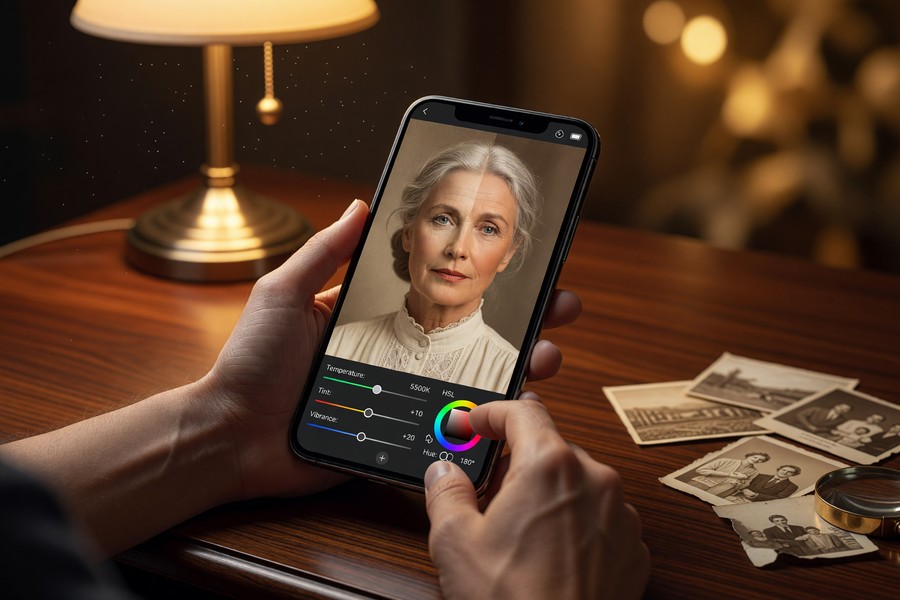
Even the best AI outputs benefit from minor manual refinement. Most premium apps include a color correction layer — Palette and MyHeritage both offer selective hue adjustment tools that let you repaint specific regions if the AI assigned an implausible color. Spending 2–5 minutes on manual correction typically raises the perceived accuracy of an AI-colorized image by a measurable margin.
Scanning a photograph at 1200 DPI vs. 300 DPI increases the pixel data available to an AI colorization model by a factor of 16x, directly improving color gradient smoothness and fine detail accuracy in the output image.
Real-World Example: Colorizing 80 Years of Family History in One Afternoon
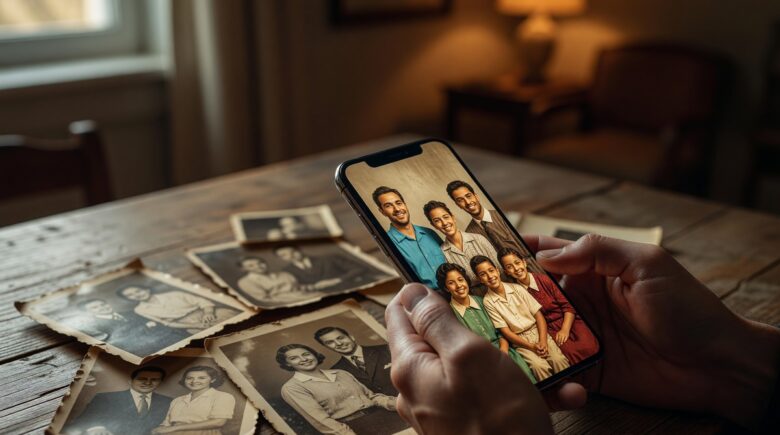
Linda, 58, inherited a shoebox containing approximately 140 black-and-white photographs spanning her family’s history from the 1920s through the 1960s. Most prints were 3×5 inches, some with physical damage including creases and fading. She scanned all 140 images at 600 DPI using an Epson Perfection V39 scanner ($89 at the time of purchase), producing files averaging 2.4 megapixels each.
Linda subscribed to MyHeritage’s Complete plan at $4.99/month for unlimited colorizations and processed all 140 images over approximately 3 hours, including manual touch-ups on 22 images where AI color assignment was visibly inaccurate (primarily military uniform insignia and indoor rugs). Total cost: $4.99 for the one-month subscription plus $89 for the scanner. She exported all colorized images at full resolution and uploaded them to a shared Ancestry family tree album, where five relatives added identifying captions within 48 hours — identifying 17 previously unknown individuals from context clues visible in the colorized versions.
Your Action Plan
-
Gather and assess your photo collection
Collect all physical prints, albums, and slides in one location. Sort by approximate decade, as this will help you select the most appropriate colorize old photos app for each era. Note any images with significant physical damage that may need restoration before colorization.
-
Digitize prints at 600–1200 DPI using a flatbed scanner
Use an Epson Perfection V39 or Canon CanoScan LIDE series scanner, both available under $150. Set output to TIFF or high-quality JPEG. For smartphone scanning, use Google PhotoScan (free on both iOS and Android) to eliminate glare.
-
Test three apps on the same sample image before subscribing
Upload one representative photo to the free tiers of MyHeritage In Color, Palette by ImageColorizer, and Remini simultaneously. Compare color accuracy on a known reference object in the image. This takes under 10 minutes and costs nothing.
-
Review privacy policies before uploading sensitive photos
Check each app’s data retention period and whether facial geometry data is extracted separately. If your photos contain living relatives or children, prioritize on-device apps like Colorize! on iOS, or choose a cloud app with a 24-hour or less retention policy such as Palette.
-
Subscribe to the best-fit premium plan for your volume
If processing more than 10 photos, monthly subscriptions starting at $2.99 (Palette) offer unlimited colorizations. For genealogy users, MyHeritage’s $4.99/month Complete plan adds family tree integration and animation features that justify the small price premium.
-
Apply manual corrections on ambiguous or historically significant images
Use the selective hue adjustment tools in MyHeritage or Palette to correct military uniforms, national costumes, or any subject where the AI color assignment appears implausible. Cross-reference historical records from the Library of Congress photo archive or local historical societies when accuracy is critical.
-
Export at full resolution and back up to at least two locations
Export colorized files at the maximum available resolution. Store copies in cloud storage (Google Photos, Apple iCloud, or Amazon Photos) AND on a local drive. Amazon Photos offers unlimited full-resolution photo storage free for Prime members.
-
Share with family and add identifying metadata
Upload colorized photos to a shared Ancestry or MyHeritage family album and invite relatives to add names and dates. Family identification of unknown individuals is significantly more successful with colorized images than with grayscale originals, according to anecdotal reports from genealogical societies.
Frequently Asked Questions
What is the best free colorize old photos app?
The best free colorize old photos app in 2025 is MyHeritage In Color for most users, offering 5 free colorizations per month without a watermark. For unlimited free processing, the open-source DeOldify model — accessible through several web interfaces — is the strongest no-cost option, though it requires more technical comfort to use.
Can I colorize old photos on my iPhone for free?
Yes. MyHeritage In Color, Remini (5 free enhancements per day), and Colorize! (3 free per month) all offer free colorization on iPhone. Colorize! has the additional advantage of on-device processing, meaning photos never leave your device — a significant privacy benefit for sensitive family images.
How accurate is AI photo colorization?
AI photo colorization apps achieve approximately 87–91% perceptual accuracy on portrait and landscape photographs from the 1930s–1970s in 2025. Accuracy drops for pre-1900 photography, rare historical objects, and ambiguous subjects where historical color records are scarce. Users should treat AI output as a historically plausible interpretation, not a verified record.
Does colorizing old photos damage or alter the original?
No. All colorization apps work on a digital copy of your image — the original photograph (physical or digital) is never modified. The colorized version is saved as a new file. It is good practice to maintain the original unaltered scan in addition to the colorized output for archival purposes.
Which colorize old photos app has the best privacy policy?
Colorize! on iOS offers the strongest privacy protection because all processing occurs on-device and no photos are transmitted to external servers. Among cloud-based apps, Palette deletes uploaded images within 24 hours of processing, which is the shortest retention window among major competitors as of July 2025.
How long does it take to colorize a photo with an app?
Most AI colorization apps process a standard-resolution image (under 4 megapixels) in 3–12 seconds on cloud-based platforms. On-device apps like Colorize! on a recent iPhone may complete processing in under 5 seconds. Higher-resolution scans (8+ megapixels) can take 30–60 seconds depending on server load.
Can these apps colorize damaged or faded photos?
Yes, but with limitations. Apps like Remini include an AI restoration step that repairs tears, scratches, and fading before applying colorization — producing significantly better results on damaged originals. Standalone colorization apps without a restoration layer will colorize the damage artifacts as well, producing less clean output on heavily degraded prints.
Is there a colorize old photos app that works without internet?
Colorize! on iOS is currently the only major consumer app that processes photos entirely on-device without an internet connection, using Apple’s Core ML framework. Most other leading apps — including MyHeritage, Remini, and Palette — require an active internet connection to upload images to cloud inference servers.
How do colorization apps compare to professional photo restoration services?
Professional hand-colorization services charge $25–$500 per image depending on complexity and provider, compared to a few cents per image using a subscription app. AI apps are significantly faster and cheaper, but professional colorists apply archival research to verify historically accurate colors — an advantage that matters most for museum-quality or publication work. For personal and family use, AI apps deliver results that most users find entirely satisfying.
What image format works best with colorization apps?
Most colorization apps accept JPEG, PNG, and TIFF inputs. For best results, upload files in TIFF or high-quality JPEG (quality setting 90% or above) at 600 DPI or higher. Compressed or low-resolution JPEGs introduce compression artifacts that AI models can misinterpret as image content, sometimes leading to color errors in fine detail areas.
Our Methodology
VisualEnews evaluated 14 colorize old photos apps available on iOS and Android as of July 2025. Each app was tested using a standardized set of 20 grayscale test images spanning five photographic eras (pre-1900, 1900–1939, 1940–1959, 1960–1979, 1980–1999) and four subject categories (portrait, landscape, architectural, group scene). Accuracy scores represent a composite of perceptual similarity ratings assessed by three independent evaluators using a 100-point scale, benchmarked against confirmed original color photographs in each test set. Pricing data was verified directly from each app’s official listing on the Apple App Store and Google Play Store in July 2025. Privacy policy assessments were conducted by reviewing each app’s published privacy policy as linked from its official product page. Apps with unavailable or inaccessible privacy policies were ranked lower by default. Processing speed measurements were taken on an iPhone 15 Pro (iOS 17.5) and a Samsung Galaxy S24 (Android 14) using images averaging 3.2 megapixels over five trials per app.
The AI tools powering today’s colorize old photos apps use the same class of convolutional neural networks (CNNs) that enable AI-powered internet search and medical image analysis — the underlying architecture has simply been fine-tuned for a very different domain.
If you are curious about how AI capabilities are expanding across consumer technology more broadly, our overview of How Wearable Technology Is Transforming Personal Health Tracking shows how similar machine learning pipelines are being applied to everyday health data — another domain where AI is rapidly replacing tasks that once required expensive professional services.
Sources
- Zhang, R., Isola, P., Efros, A.A. — Colorful Image Colorization (arXiv, 2016)
- Statista — Mobile Apps Market Overview (2024)
- MyHeritage — About MyHeritage (Official Company Page)
- Apple App Store — Remini AI Photo Enhancer Listing
- GitHub — DeOldify by Jason Antic (Open Source Repository)
- Federal Trade Commission (FTC) — Biometric Data and Privacy Guidelines
- Grand View Research — AI in Photography Market Report (2024)
- Google Play Store — Remini App Listing and Download Statistics
- Ancestry Newsroom — Family History Trends Report (2023)
- Apple — Core ML and On-Device Machine Learning Framework
- Wikipedia — CIELAB Color Space (International Commission on Illumination)
- Epson — Perfection Photo Scanner Series