
Fact-checked by the VisualeNews editorial team
Quick Answer
As of July 2025, the best high-yield savings accounts offer APYs between 4.50% and 5.25% — more than 10 times the national average savings rate of 0.45% (FDIC, 2025). Top picks include SoFi, Marcus by Goldman Sachs, and Ally Bank, all federally insured with no monthly fees.
The best high-yield savings accounts in 2025 are paying rates that were virtually unheard of just three years ago. As of July 2025, online banks and credit unions are offering APYs as high as 5.25% on standard savings accounts — compared to the national average of just 0.45% according to FDIC deposit rate data, meaning the gap between the best and average accounts is now more than 10 percentage points in yield terms.
According to Federal Reserve rate data, the federal funds rate has remained elevated through the first half of 2025, keeping savings yields historically competitive. Bankrate’s 2025 savings survey found that 55% of Americans still hold their primary savings at a traditional bank earning less than 1% APY — leaving billions of dollars in potential interest on the table every year.
This guide compares the top accounts available right now, breaks down what actually matters when choosing a high-yield savings account, and gives you a clear action plan to move your money within a week. You will find rate tables, real-world examples, and expert guidance so you can make a confident, informed decision.
Key Takeaways
- The top high-yield savings accounts currently pay up to 5.25% APY (as of July 2025), compared to the national average of 0.45% (FDIC, 2025) — a difference that adds up to hundreds of dollars annually on a $10,000 balance.
- Online banks dominate the best high-yield savings accounts rankings because they carry 60–70% lower overhead costs than traditional brick-and-mortar banks (FDIC Economic Research, 2024), allowing them to pass savings to depositors.
- All federally insured accounts are protected up to $250,000 per depositor, per institution by the FDIC or NCUA (Federal Deposit Insurance Act), making high-yield savings accounts as safe as a traditional savings account.
- Americans collectively held $1.06 trillion in savings accounts earning less than 1% APY as of Q1 2025 (Federal Reserve Flow of Funds, 2025), representing a major missed opportunity for passive income.
- Compound interest on a $25,000 balance at 5.00% APY generates approximately $1,280 per year — versus just $113 at the national average rate, a difference of over $1,100 annually (FDIC rate calculations, 2025).
- The Consumer Financial Protection Bureau (CFPB) recommends maintaining 3–6 months of essential expenses in a liquid, federally insured savings account — making high-yield options the ideal emergency fund vehicle.
In This Guide
- What Is a High-Yield Savings Account and How Does It Work?
- Which Banks Offer the Best High-Yield Savings Accounts Right Now?
- How Do You Compare High-Yield Savings Accounts Beyond the APY?
- Are Online Banks Safe for High-Yield Savings?
- How Much Money Should You Keep in a High-Yield Savings Account?
- Are High-Yield Savings Account Earnings Taxable?
- What Are the Best Alternatives to High-Yield Savings Accounts?
- What Happens to High-Yield Savings Rates When the Fed Cuts Rates?
- How Do You Open a High-Yield Savings Account?
What Is a High-Yield Savings Account and How Does It Work?
A high-yield savings account (HYSA) is an FDIC- or NCUA-insured deposit account that pays a significantly higher Annual Percentage Yield (APY) than a standard savings account, typically offered by online banks or credit unions with lower operating costs.
Interest compounds daily or monthly and is credited to your account on a regular schedule. Because of compounding, a 5.00% APY account earns slightly more than simple 5% annual interest — the difference grows meaningfully over years.
How APY Differs From APR
APY (Annual Percentage Yield) reflects the total interest earned over one year, including compounding. APR (Annual Percentage Rate) does not account for compounding. For savings accounts, APY is always the more accurate measure of what you will actually earn.
A $10,000 deposit at 5.00% APY compounding daily earns roughly $512.67 after one year — slightly more than a simple 5% rate would suggest. This difference compounds significantly over multiple years.
The term “high-yield” has no official regulatory definition. Any bank can use it — which is why comparing actual APYs and reading account terms carefully matters more than a label.
Regulation D and Withdrawal Limits
Historically, the Federal Reserve’s Regulation D limited savings account withdrawals to six per month. The Fed suspended that rule in April 2020 during the COVID-19 pandemic, but many banks still impose their own six-transaction limits — and may charge fees or convert your account if you exceed them.
Always check a bank’s specific withdrawal policy before opening an account, especially if you plan to use it as a working cash buffer.
Which Banks Offer the Best High-Yield Savings Accounts Right Now?
As of July 2025, the highest-yielding FDIC-insured savings accounts come from online institutions including SoFi Bank, Marcus by Goldman Sachs, Ally Bank, Discover Bank, American Express National Bank, and credit unions like Alliant Credit Union. These consistently rank at the top of independent rate trackers including Bankrate and NerdWallet.
| Bank / Institution | APY (July 2025) | Minimum Balance | Monthly Fee | FDIC / NCUA Insured |
|---|---|---|---|---|
| SoFi Bank | 5.10% APY | $0 | $0 | FDIC (up to $2M via partner banks) |
| Marcus by Goldman Sachs | 4.90% APY | $0 | $0 | FDIC insured |
| Ally Bank | 4.75% APY | $0 | $0 | FDIC insured |
| Discover Bank | 4.65% APY | $0 | $0 | FDIC insured |
| American Express National Bank | 4.60% APY | $0 | $0 | FDIC insured |
| Alliant Credit Union | 5.25% APY | $100 | $0 | NCUA insured |
| Synchrony Bank | 4.85% APY | $0 | $0 | FDIC insured |
Rates are variable and change frequently — always verify directly with the institution before opening an account. The table above reflects publicly available rates as of early July 2025.
A $20,000 balance at 5.10% APY earns approximately $1,044 per year — compared to just $90 at the national average of 0.45% (FDIC, 2025). That is a difference of $954 annually from the same deposit.
What Makes SoFi Stand Out
SoFi Bank offers one of the highest standard APYs available, currently 5.10%, with no minimum balance and no monthly fees. Its savings accounts are eligible for expanded FDIC insurance up to $2 million through its SoFi Insured Deposit Program, which spreads funds across a network of partner banks.
SoFi also bundles savings with a checking account in its SoFi Money product, allowing seamless transfers and direct deposit setup within a single app interface.
Why Alliant Credit Union Leads on Rate
Alliant Credit Union offers the top rate in this comparison at 5.25% APY, but requires a $100 minimum daily balance to earn interest and $5 minimum opening deposit. As a credit union, it is insured by the National Credit Union Administration (NCUA) — the credit union equivalent of FDIC, covering up to $250,000 per depositor.

How Do You Compare High-Yield Savings Accounts Beyond the APY?
APY is the most important factor, but it is not the only one. The best high-yield savings accounts also score well on fees, minimum balance requirements, access to funds, customer service quality, and integration with other financial tools.
A seemingly high APY can be negated by monthly maintenance fees. For example, a 5.00% APY account with a $10 monthly fee costs $120 per year — which on a $5,000 balance wipes out more than half the interest earned.
Key Factors to Evaluate
- Fee structure: Look for $0 monthly maintenance fees and no minimum balance requirements to earn the stated APY.
- Transfer speed: Most online banks process ACH transfers in 1–3 business days. Some, like Ally, offer faster transfers for eligible customers.
- Mobile app quality: Check app store ratings and reviews — this matters if you manage finances primarily from a smartphone.
- Customer service: Online-only banks vary widely. Look for 24/7 phone or chat support, especially for fraud resolution.
- Rate consistency: Some banks offer promotional “bonus” rates that expire. Always check whether the advertised APY is the standard ongoing rate.
“The APY is your starting point, not your ending point. Savers should also look at rate history — a bank that dropped its rate sharply the moment the Fed paused is not as depositor-friendly as one that held rates steady. Loyalty to your depositors matters in this market.”
Promotional Rates vs. Standard Rates
Some institutions advertise elevated rates only for new customers or for a limited promotional window (often 90–180 days). After the promotion ends, the rate drops — sometimes dramatically. Read the fine print before opening any account promoted as having a “bonus” or “introductory” APY.
Accounts included in the comparison table above all offer their stated APY as the ongoing standard rate with no expiration condition, based on publicly available terms as of July 2025.
Are Online Banks Safe for High-Yield Savings?
Yes — online banks offering the best high-yield savings accounts are as safe as traditional banks, provided they carry FDIC insurance. The FDIC guarantees deposits up to $250,000 per depositor, per insured bank, per ownership category regardless of whether the bank has physical branches.
The FDIC has insured deposits since 1933 and has never failed to pay an insured depositor. According to FDIC deposit insurance guidelines, even if a bank fails, insured funds are typically accessible within one to two business days.
You can hold accounts at multiple FDIC-insured banks and receive separate $250,000 coverage at each institution. A couple with joint accounts can insure up to $1 million across two banks using standard ownership category rules.
How to Verify FDIC Coverage
Before opening any account, confirm the institution’s FDIC status using the FDIC BankFind tool. Enter the bank’s name to see its charter number, insurance status, and financial condition data. This takes less than two minutes and confirms your protection is real.
For credit unions, use the NCUA’s Credit Union Locator at MyCreditUnion.gov to verify NCUA insurance status before depositing funds.
What Happened During the 2023 Bank Failures
The 2023 failures of Silicon Valley Bank and Signature Bank rattled public confidence in bank safety. However, both situations ultimately resulted in full depositor recovery — including amounts above the FDIC limit — due to regulatory intervention. Standard FDIC-insured deposits at any bank are protected regardless of market conditions.
How Much Money Should You Keep in a High-Yield Savings Account?
Financial planners generally recommend keeping 3 to 6 months of essential living expenses in a high-yield savings account as an emergency fund, plus any near-term savings goals with a timeline under three years. Money needed in longer than three years may be better served by investment accounts.
The CFPB and most certified financial planners align on this framework: savings accounts are for liquid, low-risk money — not long-term wealth building. For most Americans, that means holding between $10,000 and $40,000 in a HYSA depending on their monthly expenses.
Use a “savings bucket” strategy: maintain one HYSA for your emergency fund (untouched) and a second for short-term goals like a car purchase or vacation. Many banks — including Ally and Marcus — allow multiple savings “buckets” or sub-accounts within a single login.
When Your Balance Exceeds $250,000
If your savings exceed the FDIC’s $250,000 single-depositor limit, consider spreading funds across multiple FDIC-insured institutions, using a joint account structure (which doubles the coverage), or exploring Treasury bills and money market funds for amounts above insurance limits.
Building a solid financial foundation — including knowing where your emergency fund lives and why — is central to the kind of complete financial stability that protects you from life’s unexpected shocks.
Are High-Yield Savings Account Earnings Taxable?
Yes — interest earned in a high-yield savings account is taxable as ordinary income in the year it is credited, regardless of whether you withdraw it. The IRS treats savings account interest the same as wages or salary for federal income tax purposes.
Banks and credit unions will send a Form 1099-INT to any depositor who earns more than $10 in interest during a calendar year. You must report this income on your federal tax return even if you do not receive the form.
How Much Will You Owe?
The tax owed depends on your marginal income tax bracket. At a 22% federal tax rate — the rate for single filers earning $47,151–$100,525 in 2025 — a depositor earning $1,000 in HYSA interest owes approximately $220 in federal taxes, leaving a net after-tax yield of roughly 3.90% on a nominal 5.00% APY account.
State income taxes may also apply. High-income earners in states like California or New York should factor in combined marginal rates exceeding 50% when calculating true net yield.
A depositor in the 22% federal tax bracket earning $1,250 in HYSA interest on a $25,000 balance (at 5.00% APY) would owe approximately $275 in federal income tax — leaving a net gain of $975 for the year, still far ahead of what a traditional savings account would earn (FDIC rate data, 2025).
Tax-Advantaged Alternatives
If tax drag on savings interest is a concern, consider whether a portion of your liquid savings could be held in a Health Savings Account (HSA) or Roth IRA — both of which offer tax-free growth under qualifying conditions. These require meeting eligibility rules and have annual contribution limits set by the IRS.
What Are the Best Alternatives to High-Yield Savings Accounts?
The best high-yield savings accounts compete directly with several other low-risk, liquid vehicles — including money market accounts, Certificates of Deposit (CDs), Treasury bills, and money market mutual funds. Each has trade-offs in liquidity, yield, and risk profile.
| Product | Typical Yield (July 2025) | Liquidity | FDIC / Government Protected | Best For |
|---|---|---|---|---|
| High-Yield Savings Account | 4.50%–5.25% APY | High (withdraw anytime) | FDIC up to $250K | Emergency funds, short-term goals |
| Money Market Account (MMA) | 4.25%–5.00% APY | High (check-writing may be available) | FDIC up to $250K | Those who want check access |
| 1-Year CD | 4.75%–5.40% APY | Low (penalty for early withdrawal) | FDIC up to $250K | Savings you will not need for 1 year |
| 3-Month Treasury Bill | 4.80%–5.30% yield | Medium (held to maturity) | U.S. Government backed | State-tax-free income |
| Money Market Mutual Fund | 4.70%–5.20% yield | High (T+1 settlement) | NOT FDIC insured | Investors with brokerage accounts |
Treasury bills offer one compelling advantage over HYSAs: T-bill interest is exempt from state and local income taxes, making them more attractive in high-tax states. You can purchase them directly at TreasuryDirect.gov with no brokerage account required.
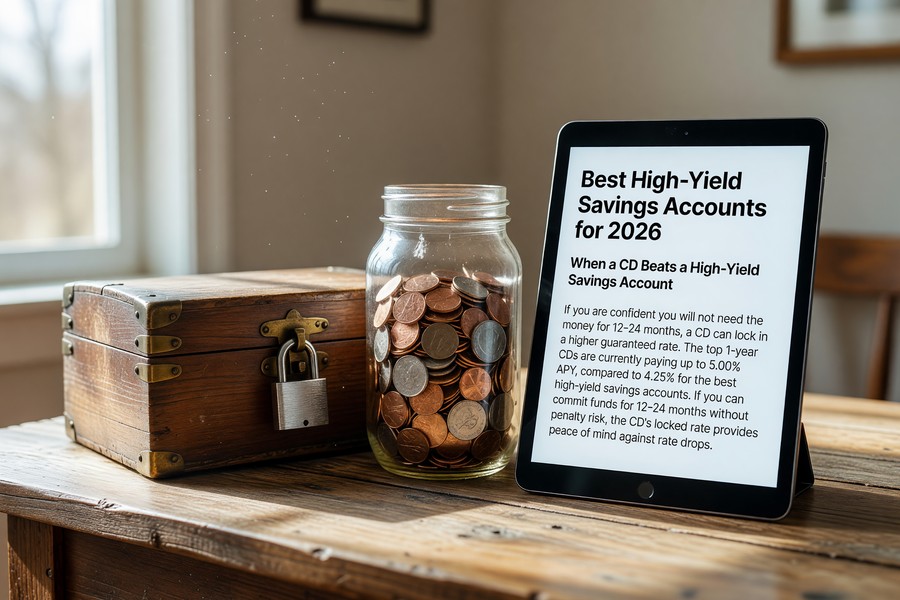
When a CD Beats a High-Yield Savings Account
If you are confident you will not need the money for 12–24 months, a CD can lock in a higher guaranteed rate. The top 1-year CDs are currently paying up to 5.40% APY — above most standard HYSA rates — but come with early withdrawal penalties, typically 90 to 180 days of interest.
This trade-off matters most when rates are expected to fall. If the Federal Reserve cuts rates, your HYSA yield will drop automatically — but a CD locks in today’s rate for the full term.
What Happens to High-Yield Savings Rates When the Fed Cuts Rates?
High-yield savings account rates are directly tied to the federal funds rate set by the Federal Open Market Committee (FOMC). When the Fed cuts rates, banks typically reduce HYSA APYs within weeks — sometimes within days. When the Fed raises rates, yields follow upward, often more slowly.
The Fed held rates steady in its June 2025 meeting, according to the Federal Reserve’s FOMC calendar and statements, but markets are pricing in one to two rate cuts before year-end 2025. If cuts materialize, HYSA rates could fall to the 4.00%–4.50% range by early 2026.
Some banks slash HYSA rates faster than others when the Fed cuts. If you notice your rate drop sharply after a Fed announcement, compare current offerings and do not hesitate to move your money. There is no penalty for switching between savings accounts.
What Rate History Tells Us
In 2020–2021, when the federal funds rate was near 0%, most HYSAs offered APYs of just 0.50% or less — down from nearly 2.50% in late 2018. The 2022–2023 rate hike cycle pushed rates to their current highs. This history confirms that HYSA yields are cyclical, not permanent.
Locking a portion of savings into a longer-term CD now — while rates remain elevated — is a reasonable hedge against future Fed cuts, as long as you can tolerate the liquidity constraint.
“Savers who benefited from the rate hike cycle should not assume today’s yields are the new normal. If the Fed pivots to cuts, HYSA rates will follow quickly. A laddered CD strategy combined with a high-yield savings account gives you both flexibility and rate protection going into 2026.”
How Do You Open a High-Yield Savings Account?
Opening a high-yield savings account typically takes 10–15 minutes online. Most banks require only a government-issued ID, Social Security Number, and an initial deposit linked to an existing bank account. There is no credit check for a standard savings account.
The process is straightforward: choose a bank, complete the online application, verify your identity, link an external account for your initial deposit, and transfer funds. Most accounts are active within one to two business days.
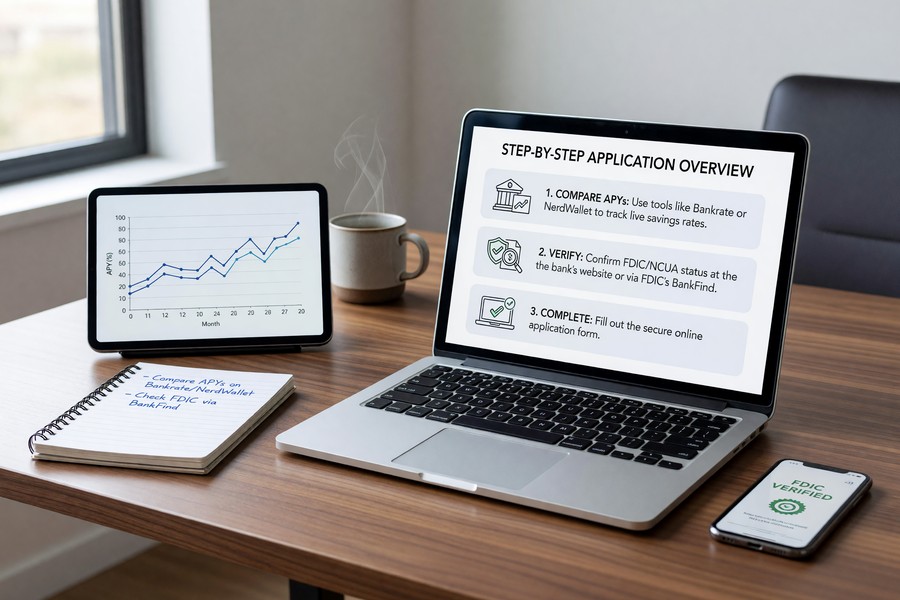
Step-by-Step Application Overview
- Compare current APYs using Bankrate or NerdWallet’s live savings rate trackers.
- Confirm FDIC or NCUA status at the institution’s website or via BankFind.
- Complete the online application — typically 10–15 questions covering personal information and beneficiary designation.
- Link your current bank account via routing and account numbers for the initial deposit transfer.
- Set up direct deposit or automatic recurring transfers to build the balance consistently.
Understanding how to build and protect your savings is part of managing money effectively in real life — and switching to a higher-yield account is one of the most impactful low-effort moves available to most households.
Opening a high-yield savings account does NOT trigger a hard inquiry on your credit report. Banks use identity verification, not credit checks, for savings account applications — so your FICO Score is not affected.
Real-World Example: From Big-Bank Savings to a 5% HYSA
Daniel, 38, had kept $32,000 in a savings account at a major national bank earning 0.01% APY — a rate that generated just $3.20 per year. After reading about high-yield savings accounts in early 2025, he opened an account with Marcus by Goldman Sachs at 4.90% APY. The transfer took four days to complete, required no minimum balance, and cost him nothing in fees. In his first 12 months, Daniel earned approximately $1,568 in interest — compared to $3.20 at his old bank. His total savings effort: about 20 minutes of form-filling and one phone call to verify his external account. Daniel used the interest earned to fully fund his annual Roth IRA contribution, putting his windfall to additional tax-advantaged use. His net worth increased by over $1,500 with no change to his savings behavior, risk tolerance, or financial discipline.
Your Action Plan
-
Check your current savings rate today
Log into your existing bank account and find the APY on your savings account. If it is below 4.00%, you are almost certainly underearning. Use the FDIC’s national rate table to benchmark where your current rate stands relative to the national average.
-
Compare top rates using an independent aggregator
Visit Bankrate’s savings rate comparison tool or NerdWallet’s high-yield savings page to see current APYs across dozens of institutions. Filter for accounts with $0 minimum balance and $0 monthly fees to get a clean comparison. Rates change weekly — always check the date of any list you find.
-
Verify FDIC or NCUA insurance status
Before opening any account, confirm deposit insurance using the FDIC BankFind Suite. Enter the institution’s name and confirm its active insured status. For credit unions, use the NCUA Credit Union Locator at MyCreditUnion.gov.
-
Open your chosen high-yield savings account online
Complete the application at the institution’s official website — not through a third-party aggregator. Have your government-issued ID, Social Security Number, and current bank account routing and account numbers ready. The full process takes 10–15 minutes.
-
Transfer your emergency fund first
Move your emergency fund — typically 3–6 months of essential expenses — to the new HYSA as the priority transfer. Keep a small operational cushion (1–2 months of expenses) in your existing checking account to avoid overdrafts during the transition period.
-
Set up automatic recurring deposits
Schedule a recurring weekly or monthly transfer from your checking account to your new HYSA. Even $100 per month adds to compound growth. Most online banks allow you to set recurring transfers directly in the mobile app or website dashboard. If you are working toward building momentum through small money wins, automating your savings is one of the highest-leverage habits available.
-
Set a calendar reminder to rate-check quarterly
HYSA rates change frequently. Set a quarterly calendar reminder to compare your current rate against the top offers. Switching accounts when a significantly better rate is available is free, simple, and carries no credit impact. Loyalty to an underperforming bank costs you real money.
-
Report your interest income at tax time
Watch for Form 1099-INT from your bank each January. Interest earned in a HYSA is reportable ordinary income — add it to your federal and state tax returns. Use IRS.gov’s free filing tools or a service like TurboTax to ensure accurate reporting and avoid penalties.
Frequently Asked Questions
What is the highest APY available on a savings account right now?
As of July 2025, the highest publicly available APY on an FDIC- or NCUA-insured savings account is 5.25% at Alliant Credit Union, with SoFi Bank close behind at 5.10%. Rates change frequently — always verify directly with the institution before applying.
Are the best high-yield savings accounts only available online?
Predominantly, yes. Online-only banks account for the vast majority of top-yielding savings accounts because they carry significantly lower overhead than traditional banks with physical branches. A few regional credit unions and community banks offer competitive rates, but major national brick-and-mortar banks consistently rank near the bottom for savings APYs.
Is my money safe in an online bank?
Yes, provided the bank is FDIC-insured. FDIC coverage protects deposits up to $250,000 per depositor, per insured institution, regardless of whether the bank has physical branches. Verify coverage using the FDIC BankFind tool before depositing.
How often do high-yield savings account rates change?
HYSA rates are variable and can change at any time, but typically shift in response to Federal Reserve rate decisions. Banks usually adjust rates within days to weeks of a Fed action. Some banks are more aggressive than others in passing rate changes — both upward and downward — to customers.
Can I have more than one high-yield savings account?
Yes. There is no legal limit on the number of savings accounts you can hold across different institutions. In fact, holding accounts at multiple FDIC-insured banks extends your deposit insurance coverage beyond the single-bank $250,000 limit. Many savers maintain separate accounts for different goals — emergency fund, vacation, home down payment.
Do high-yield savings accounts hurt my credit score?
No. Opening a savings account does not trigger a hard credit inquiry and is not reported to credit bureaus. Your FICO Score and credit report are unaffected by savings account activity. If you are actively working on building your credit history, a HYSA is a complementary tool that does not interfere with that process.
What is the minimum deposit to open a high-yield savings account?
Many of the best high-yield savings accounts — including those from SoFi, Marcus, Ally, and Discover — require no minimum opening deposit and no minimum balance to earn the advertised APY. A few institutions like Alliant Credit Union require a modest minimum, typically $100. Always check the specific terms before applying.
How does a high-yield savings account differ from a money market account?
Both are FDIC-insured, variable-rate deposit accounts, but money market accounts (MMAs) sometimes offer check-writing privileges or a debit card, which a standard HYSA typically does not. In practice, APYs are similar. The primary difference is access method — HYSAs are generally transfer-only, while MMAs may offer direct payment capabilities.
What happens to my savings if a bank fails?
If an FDIC-insured bank fails, the FDIC steps in and guarantees all insured deposits up to $250,000 per depositor. According to the FDIC, insured depositors have never lost a single cent of covered deposits since the agency was founded in 1933. Access to funds is typically restored within one to two business days through a successor bank or direct FDIC payment.
Should I move all my savings to a high-yield savings account?
For most people, the answer is yes for liquid emergency savings and near-term goals. Money you will not need for three or more years may be better served by diversified investments with higher long-term return potential. A well-structured financial plan typically uses a HYSA for short-term liquidity while investing long-term savings in tax-advantaged accounts like a 401(k) or IRA. Understanding your relationship with money can help you make this decision with clarity — resources like this guide to your relationship with money offer useful frameworks for thinking through it.
Our Methodology
VisualeNews evaluated savings accounts from more than 40 banks and credit unions to identify the best high-yield savings accounts for 2025. Institutions were assessed on the following criteria: Annual Percentage Yield (APY) as of July 1, 2025; minimum opening deposit and minimum balance to earn the stated APY; monthly maintenance fees; FDIC or NCUA insurance status (verified via BankFind or NCUA Locator); availability to nationwide applicants; mobile app availability and customer service options; and rate history over the prior 12 months to identify rate stability.
Only institutions offering accounts available to customers in all 50 U.S. states were considered. APYs were confirmed directly from each institution’s official product page. Rates are variable and may have changed since publication. This article is reviewed and updated quarterly. VisualeNews does not receive compensation from any financial institution mentioned in this article — all rankings are editorially independent.
Sources
- FDIC — National Rates and Rate Caps (2025)
- Federal Reserve — Selected Interest Rates (H.15 Release, 2025)
- FDIC — Your Insured Deposits (Deposit Insurance Overview)
- FDIC — BankFind Suite: Institution Search
- Federal Reserve — FOMC Meeting Calendar and Statements (2025)
- TreasuryDirect.gov — Treasury Bills Overview
- Consumer Financial Protection Bureau (CFPB) — Savings and Emergency Funds
- IRS — Topic No. 403: Interest Received (Tax Treatment of Savings Interest)
- Bankrate — Best High-Yield Savings Account Rates (2025)
- NerdWallet — Best High-Yield Online Savings Accounts (2025)
- MyCreditUnion.gov — NCUA Share Insurance and Credit Union Safety
- Federal Reserve — Survey of Consumer Finances (2023, published 2024)