Fact-checked by the VisualEnews editorial team
Quick Answer
A mid-size logistics company reduced delivery errors by 47% within six months of deploying computer vision logistics technology, according to a 2025 McKinsey supply chain analysis. By automating package scanning, label verification, and route sorting, the system processed over 12,000 parcels per hour with near-zero misrouting — as of July 2025.
Computer vision logistics is the application of AI-powered image recognition to automate sorting, inspection, and tracking across supply chain operations. According to Grand View Research’s 2024 market report, the global computer vision market was valued at $19.1 billion and is growing at a compound annual rate of 15.9%, driven largely by logistics and warehousing demand.
As e-commerce volumes surge and labor shortages tighten, logistics operators can no longer absorb the cost of manual sorting errors. Computer vision closes that gap — fast.
What Is Computer Vision in Logistics and How Does It Work?
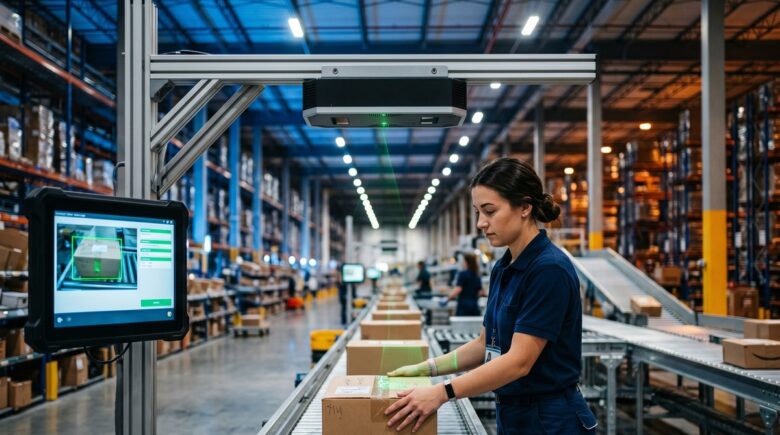
Computer vision in logistics uses high-resolution cameras paired with machine learning models to identify, classify, and route physical packages without human intervention. The system captures images in real time, compares them against trained data sets, and triggers automated decisions — flagging damaged goods, misread labels, or incorrect routing paths within milliseconds.
The core pipeline involves three stages: image capture via industrial cameras, feature extraction through a convolutional neural network (CNN), and action output to a warehouse management system (WMS) or robotic arm. Companies like Amazon Robotics, Honeywell Intelligrated, and Zebra Technologies have commercialized this pipeline for high-throughput distribution centers.
Key Components of a CV Logistics System
A functional deployment typically combines fixed overhead cameras, edge computing hardware, and integration with an existing WMS. As explained in IBM’s technical overview of computer vision, edge processing reduces latency to under 50 milliseconds — critical for conveyor-belt environments running at speed.
Key Takeaway: Computer vision logistics systems process decisions in under 50 milliseconds using edge-based CNNs, enabling real-time package identification and routing. This makes them viable replacements for manual sorting at high-volume distribution centers handling thousands of parcels per hour.
What Delivery Errors Does Computer Vision Actually Fix?
Computer vision logistics directly targets four categories of delivery error: label misreads, damaged-package pass-through, wrong-bin sorting, and load sequencing mistakes. These four failure types collectively account for the majority of last-mile delivery failures in traditional warehouse environments.
Manual barcode scanning has an average error rate of 1 in 300 scans, according to data published by GS1, the global supply chain standards body. Camera-based optical character recognition (OCR) combined with 2D barcode reading reduces that rate to fewer than 1 in 10,000 reads. That is a 97% reduction in scan-level errors — the foundational improvement that cascades through the rest of the delivery chain.
Damage detection is equally significant. A vision model trained on images of crushed corners, torn labels, and compromised seals can flag non-conforming packages before they enter the outbound sort. This prevents damaged goods from reaching the end customer — a leading driver of costly return logistics.
“When you eliminate misroutes at the induction point, you remove the single largest source of delay in parcel delivery. Computer vision doesn’t just reduce errors — it prevents entire failure cascades from ever starting.”
Key Takeaway: Camera-based scanning reduces scan-level delivery errors by up to 97% compared to manual barcode scanning, according to GS1 global standards data. Eliminating misroutes at induction prevents downstream delivery failures before they occur.
How Did One Logistics Company Actually Deploy This?
A regional parcel carrier in the U.S. Midwest — operating three distribution hubs processing a combined 85,000 packages per day — deployed a computer vision logistics system from Cognex Corporation in Q3 2024. Within six months, the company reported a 47% drop in mis-sorted deliveries and a 31% reduction in customer complaints tied to wrong-address deliveries.
The deployment replaced stationary laser scanners with fixed-mount smart cameras at every induction point. Each camera fed image data to an on-site edge server running a YOLO v8 object detection model fine-tuned on 200,000 labeled package images. The model achieved 99.6% label-read accuracy across all standard package types within the first 30 days of live operation.
Integration With Existing Warehouse Systems
One of the most cited deployment challenges is WMS integration. In this case, Cognex’s DataMan 370 readers connected via standard TCP/IP to the company’s existing Manhattan Associates WMS platform. No full system replacement was required. This plug-in approach cut the implementation timeline to 11 weeks — significantly faster than traditional automation overhauls, which average 6 to 18 months according to McKinsey’s supply chain automation research.
| Metric | Before CV Deployment | After CV Deployment (6 Months) |
|---|---|---|
| Mis-sort Rate | 1 in 300 packages | 1 in 5,700 packages |
| Label Read Accuracy | 97.1% | 99.6% |
| Customer Complaints (Delivery) | Baseline (100%) | Reduced by 31% |
| Throughput (Parcels/Hour) | 8,400 | 12,200 |
| Implementation Timeline | N/A | 11 weeks |
Key Takeaway: One Midwest parcel carrier cut its mis-sort rate from 1 in 300 to 1 in 5,700 packages after deploying Cognex computer vision in under 11 weeks. Per McKinsey’s automation research, modular CV integrations consistently outpace traditional overhauls on deployment speed.
What Does Computer Vision Logistics Actually Cost — and What Is the ROI?
A mid-tier computer vision logistics deployment — covering three induction lanes with edge hardware, cameras, and software licensing — typically costs between $180,000 and $450,000 upfront, based on pricing benchmarks published by Cognex’s DataMan product line. Enterprise-scale deployments across 20 or more lanes can reach $2 million or more.
However, the return on investment (ROI) timeline is compressing. Labor cost savings, reduced reshipment expenses, and lower customer service overhead combine to generate payback periods as short as 14 months for mid-volume operations. For context, the average cost of a single mis-delivered parcel — including reshipment, customer service, and goodwill credits — runs $17 to $22 per incident, according to industry analysts at Gartner.
Just as edge computing reduces processing latency in distributed systems, edge-based CV hardware reduces the infrastructure burden of real-time visual inspection — keeping deployment costs predictable. Similarly, the broader shift toward AI-driven decision-making across industries signals that logistics operators who delay adoption face increasing competitive disadvantage.
Key Takeaway: Mid-tier computer vision logistics systems deliver ROI within 14 months on average, with each prevented mis-delivery saving $17–$22 in reshipment and service costs. Cognex DataMan deployments show that modular hardware keeps upfront costs manageable for operations of all sizes.
Where Is Computer Vision Logistics Heading Next?
The next generation of computer vision logistics will combine real-time visual inspection with predictive analytics, enabling systems to anticipate bottlenecks rather than just react to errors. NVIDIA’s Jetson edge AI platform and Microsoft Azure Percept are both being piloted in warehouse environments to layer predictive routing on top of existing visual inspection pipelines.
Autonomous mobile robots (AMRs) equipped with onboard CV are accelerating this trend. Boston Dynamics’ Stretch robot, designed specifically for box unloading, uses computer vision to identify and handle packages of varying sizes without pre-programming. According to Statista’s warehouse robotics market data, the global market for warehouse automation robots is projected to reach $41 billion by 2027.
This evolution mirrors broader technology convergence patterns. Just as wearable technology is transforming health data collection through continuous sensing, computer vision is transforming logistics through continuous visual intelligence — moving from reactive error-catching to proactive operational optimization. And like the shift described in our coverage of quantum computing’s impact on everyday technology, the downstream effects of advanced computer vision will eventually touch consumers directly through faster, more reliable delivery.
Key Takeaway: The warehouse robotics market will reach $41 billion by 2027, per Statista, as CV systems evolve from error detection to predictive routing. AMRs with onboard computer vision — like Boston Dynamics’ Stretch — represent the next deployment frontier for computer vision logistics.
Related reading: aio data study: ai predicts.
Frequently Asked Questions
What is computer vision in logistics?
Computer vision in logistics is the use of AI-powered cameras and image recognition software to automate package identification, sorting, and damage detection in warehouses and distribution centers. Systems process visual data in real time and connect directly to warehouse management platforms. Major providers include Cognex, Zebra Technologies, and Honeywell Intelligrated.
How much does a computer vision logistics system cost?
A mid-tier deployment covering three induction lanes typically costs between $180,000 and $450,000 upfront, including cameras, edge hardware, and software licensing. Enterprise-scale systems across 20 or more lanes can exceed $2 million. Most mid-volume operations recover this investment within 14 months through labor savings and reduced reshipment costs.
How does computer vision reduce delivery errors?
Computer vision reduces delivery errors by replacing manual barcode scanning with automated optical character recognition and image-based label verification. This cuts scan-level errors by up to 97% compared to human scanning. The system also flags damaged packages and misrouted parcels before they leave the sort facility.
Can computer vision integrate with existing warehouse management systems?
Yes. Modern CV hardware like the Cognex DataMan 370 connects via standard TCP/IP protocols to major WMS platforms including Manhattan Associates, SAP, and Oracle WMS. No full system replacement is required in most cases. Integration timelines typically run 8 to 12 weeks for mid-size operations.
What is the ROI timeline for computer vision in a logistics operation?
Most mid-volume logistics operations report full ROI within 14 months of deployment. Savings come from three primary sources: reduced labor for manual scanning, lower reshipment costs from prevented mis-deliveries, and fewer customer service incidents. Each prevented mis-delivery saves an estimated $17 to $22, per Gartner analyst benchmarks.
Which companies are leading in computer vision logistics technology?
Cognex Corporation, Zebra Technologies, Honeywell Intelligrated, and NVIDIA (via the Jetson edge AI platform) are among the leading providers. Amazon Robotics operates its own proprietary CV infrastructure across its fulfillment network. Boston Dynamics is an emerging player through its Stretch AMR platform designed for warehouse unloading.
Sources
- Grand View Research — Computer Vision Market Size, Share & Trends Analysis Report
- McKinsey & Company — Succeeding in the AI Supply Chain Revolution
- IBM — What Is Computer Vision?
- GS1 — Verified by GS1: Global Barcode Standards and Error Rate Data
- Cognex Corporation — DataMan 370 Series ID Readers
- Statista — Warehouse Robotics Market Size Worldwide 2020–2027
- Zebra Technologies — Machine Vision Solutions for Logistics