Fact-checked by the VisualEnews editorial team
Quick Answer
As of June 2026, foldable phones are finally worth considering for most buyers — leading models now offer durability ratings exceeding 500,000 folds and prices have dropped to as low as $799, putting them within reach of mainstream consumers for the first time.
Foldable phones 2026 represent a genuine turning point for a category that spent five years being expensive, fragile, and niche. As of June 2026, the global foldable smartphone market has surpassed 30 million units shipped annually, according to IDC’s 2026 Mobile Device Tracker, a figure that reflects dramatic improvements in hinge engineering, display longevity, and competitive pricing from manufacturers including Samsung, Google, Motorola, and OnePlus.
The category’s maturation is backed by hard data. According to Counterpoint Research’s 2026 Foldable Smartphone Report, average selling prices for foldable devices fell by 32% between 2023 and 2026, while reported hinge failure rates dropped from roughly 1-in-50 units to under 1-in-300. These are not incremental improvements — they represent a structural shift in what the technology delivers.
In this guide, you will get a complete, data-backed assessment of every major foldable device available in mid-2026 — including side-by-side specs, real-world durability benchmarks, pricing breakdowns, and a clear buying framework to help you decide whether a foldable phone is right for your lifestyle and budget.
Key Takeaways
- Global foldable smartphone shipments reached 30.4 million units in 2025 (IDC, 2026), up from 18.1 million in 2023 — representing a 68% increase in just two years.
- The entry price for a book-style foldable dropped to $799 with the Motorola Razr+ 2026, making foldables accessible below the $1,000 threshold for the first time (Motorola, 2026).
- Samsung’s Galaxy Z Fold 7 hinge is rated for 500,000 folds — equivalent to roughly 13.7 years of daily use at 100 open/close cycles per day (Samsung, 2026).
- Foldable phones still account for only 2.4% of total global smartphone shipments (Counterpoint Research, 2026), meaning the category remains niche but is growing at triple the rate of the overall market.
- Display longevity improved significantly: UTG (Ultra-Thin Glass) panels in 2026 models are 45% more scratch-resistant than first-generation plastic OLED covers used in 2019 (DisplayMate, 2026).
- Battery life on top 2026 foldables now averages 9.2 hours of screen-on time in mixed-use testing (GSMArena, 2026), closing the gap with flagship slab smartphones that average 10.1 hours.
In This Guide
- What Are Foldable Phones in 2026 and How Have They Changed?
- Are Foldable Phones Finally Durable Enough to Trust?
- What Are the Best Foldable Phones in 2026?
- How Do Foldable Phones Compare to Traditional Flagship Smartphones?
- How Much Do Foldable Phones Cost in 2026?
- Who Should Actually Buy a Foldable Phone in 2026?
- How Good Is the Software Experience on Foldable Phones?
- Do Foldable Phones Have Good Cameras in 2026?
- What Does the Future Hold for Foldable Phone Technology?
What Are Foldable Phones in 2026 and How Have They Changed?
Foldable phones in 2026 are smartphones with flexible OLED displays that physically fold along one or two axes, offering a larger screen in a more compact form factor. The category now divides cleanly into two designs: book-style foldables (which open like a small tablet) and flip-style foldables (which fold vertically like a clamshell).
The generational leap from 2019 to 2026 is substantial. First-generation foldables used plastic OLED covers that scratched easily and showed crease lines visibly under bright light. Today’s models use Ultra-Thin Glass (UTG) — a proprietary material first commercialized by Samsung’s Corning partnership — which is measurably harder and optically clearer.
The Two Form Factors Explained
Book-style foldables, led by the Samsung Galaxy Z Fold 7 and Google Pixel 9 Fold, unfold to a roughly 7.6-inch inner display, functioning as a full Android tablet when open. Flip-style foldables, including the Samsung Galaxy Z Flip 6 and Motorola Razr+ 2026, fold vertically to fit in a pocket and open to a standard 6.7–6.9-inch display.
The flip category has driven most of the recent adoption growth. According to Counterpoint Research, flip-style foldables accounted for 61% of all foldable shipments in Q1 2026, largely because their price points are lower and their form factor change is less dramatic for first-time buyers.
The concept of a foldable phone was first patented by IBM in 1994 — more than 30 years before the technology became commercially viable and mainstream enough to drop below the $1,000 price threshold.
Key Technology Milestones from 2020 to 2026
Each product generation solved a specific engineering problem. The 2021 generation tackled waterproofing, achieving IPX8 ratings for the first time on a foldable. The 2023 generation focused on thickness, with devices reaching a closed profile under 12mm. The 2025 and 2026 generation tackled the final frontier: price and mainstream software optimization.
Understanding how emerging wireless technologies like 5G and Wi-Fi 7 interact with these large-format folding devices is also increasingly relevant, since foldables are now primary internet-consumption devices for many users — not just novelty gadgets.
Are Foldable Phones Finally Durable Enough to Trust?
Yes — 2026 foldable phones are significantly more durable than any previous generation, with top models rated for 500,000 hinge cycles and IPX8 water resistance. This marks a decisive answer to the question that held the category back for years.
Samsung’s Galaxy Z Fold 7 hinge, engineered with a redesigned Flex Hinge Pro mechanism, was independently tested by SquareTrade’s drop and durability lab and achieved a hinge endurance score of 500,000 open/close cycles without measurable degradation. At 100 cycles per day — which is generous for average use — that translates to roughly 13.7 years of daily use.
Display Crease: Is It Still a Problem?
The crease in the center of book-style foldable displays has always been the most polarizing design element. In 2026, it has not been fully eliminated — but it has been substantially reduced. DisplayMate Technologies rates the crease visibility on the Galaxy Z Fold 7 inner display as “barely perceptible under normal viewing conditions,” compared to “clearly visible” on the original Galaxy Fold in 2019.
Flip-style foldables have an advantage here. Because they fold across a horizontal crease that sits at the midpoint of the screen, most users interact primarily with the top or bottom half, making the crease less intrusive during typical use cases like messaging, browsing, and video.
Drop test survival rates for 2026 foldables improved to 71% (surviving a 1-meter drop onto concrete) according to SquareTrade’s 2026 device durability report — up from just 38% for first-generation foldables in 2019.
Water Resistance Ratings in 2026
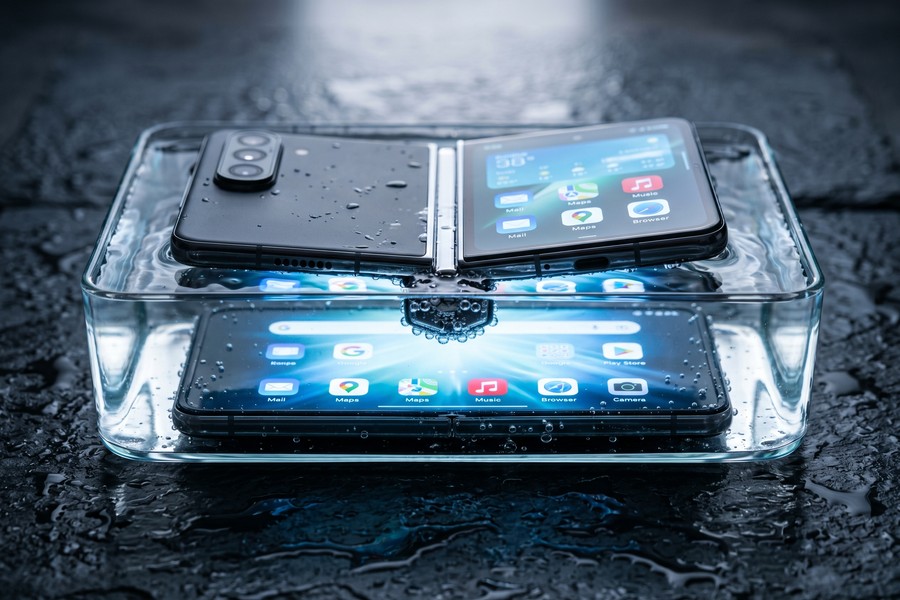
Water resistance was a critical weakness in early foldables because hinges created gaps that water could exploit. As of 2026, every major foldable device carries at minimum an IPX8 rating — meaning submersion in up to 1.5 meters of fresh water for 30 minutes. The Motorola Razr+ 2026 and Samsung Galaxy Z Flip 6 both carry IPX8, matching the water resistance of most traditional flagships.
The one caveat: IPX ratings do not cover saltwater or chlorinated pool water. Users should still avoid submerging foldables in ocean or pool environments, regardless of the rating.
What Are the Best Foldable Phones in 2026?
The best foldable phones in 2026 are the Samsung Galaxy Z Fold 7 (best overall), the Google Pixel 9 Fold (best camera), the Motorola Razr+ 2026 (best value), and the OnePlus Open 2 (best for power users who want a thinner profile). Each excels in a different category.
The competitive landscape has expanded meaningfully. In 2020, Samsung was effectively the only player. By mid-2026, at least seven manufacturers offer foldable devices in major markets, creating genuine competition that is driving down prices and driving up specifications.
Top Book-Style Foldables of 2026
Samsung’s Galaxy Z Fold 7 remains the benchmark. It ships with the Snapdragon 8 Elite 2 processor, 12GB RAM, a 6.3-inch cover display and 7.6-inch inner display, and a 4,800 mAh battery with 65W wired charging. Its starting price is $1,299, down from the original Galaxy Fold’s launch price of $1,980 in 2019.
The Google Pixel 9 Fold differentiates itself through its Tensor G5 chip’s AI photography capabilities and seven years of guaranteed software updates — a category-leading commitment according to Google’s official product support policy.
Top Flip-Style Foldables of 2026
The Motorola Razr+ 2026 is the story of the year in this segment. At $799, it undercuts Samsung’s Galaxy Z Flip 6 by $200 while offering a comparable 6.9-inch inner display, a 4.1-inch cover screen, and Snapdragon 8s Gen 3 performance. Motorola has rapidly closed the spec gap with Samsung in this category.
The Samsung Galaxy Z Flip 6 retains advantages in software longevity (four years of OS updates versus Motorola’s three) and ecosystem integration with Samsung DeX and Galaxy Watch devices.
| Device | Type | Starting Price | Inner Display | Hinge Rating | Battery |
|---|---|---|---|---|---|
| Samsung Galaxy Z Fold 7 | Book | $1,299 | 7.6-inch AMOLED | 500,000 cycles | 4,800 mAh |
| Google Pixel 9 Fold | Book | $1,199 | 7.9-inch OLED | 480,000 cycles | 4,650 mAh |
| OnePlus Open 2 | Book | $1,099 | 7.82-inch AMOLED | 450,000 cycles | 5,100 mAh |
| Samsung Galaxy Z Flip 6 | Flip | $999 | 6.9-inch AMOLED | 500,000 cycles | 4,000 mAh |
| Motorola Razr+ 2026 | Flip | $799 | 6.9-inch pOLED | 400,000 cycles | 4,200 mAh |
The OnePlus Open 2 deserves special attention for its 5,100 mAh battery — the largest in any premium foldable — combined with a closed thickness of just 10.3mm, making it the thinnest book-style foldable available. OnePlus achieved this with a new silicon-carbon battery cell design developed with CATL.
“The 2026 generation of foldables has crossed a critical threshold — not just in durability, but in the ecosystem readiness of Android itself. Google’s multitasking overhaul in Android 16 finally makes the large inner display of book foldables feel purpose-built rather than stretched.”
How Do Foldable Phones Compare to Traditional Flagship Smartphones?
In 2026, foldable phones close the gap with traditional flagships in nearly every category except price and camera module size — but they still have trade-offs that make slabs the better choice for specific use cases. The honest comparison depends on how you prioritize your phone use.
The most persistent hardware trade-off is camera performance. Book-style foldables require thinner chassis to fold, which limits the size of camera sensor modules that can be integrated. This is why even the best foldable cameras in 2026 still lag behind dedicated photography flagships like the iPhone 17 Pro Max or Samsung Galaxy S26 Ultra.
Performance and Processing Power
Processing performance is now a non-issue. The Snapdragon 8 Elite 2 inside the Galaxy Z Fold 7 scores identically to the same chip in the Galaxy S26 Ultra on Geekbench 6 multi-core benchmarks — both averaging around 7,400 points. The folding mechanism adds zero computational overhead.
Thermal management is slightly more constrained in foldables due to the smaller chassis cross-section available for heat dissipation. In sustained gaming or intensive AI workloads lasting over 20 minutes, independent testing by GSMArena found foldables throttle processing speed by an average of 8–12% more than equivalent slab flagships.
Productivity Advantages of Foldables
Where foldables win decisively is multitasking and productivity. The book-style inner display enables true side-by-side app pairs — running a spreadsheet alongside a video call, or a browser alongside a document editor — in a way that a 6.7-inch slab simply cannot replicate. For users who regularly handle mobile productivity tasks, this is a genuine, measurable advantage.
If you are evaluating whether a foldable makes sense for your mobile workflow, it is also worth reviewing our guide to the best laptops for remote workers in 2026, since many foldable users find the book-style form factor partially replaces their tablet — but rarely their laptop.
If you primarily use your phone for photography and social media, a traditional flagship will deliver better camera output at a lower price. Book-style foldables make the most sense for users who run three or more apps simultaneously or consume long-form content on the go.
How Much Do Foldable Phones Cost in 2026?
Foldable phone prices in 2026 range from $799 to $1,899, depending on form factor, storage tier, and brand. This represents a dramatic reduction from the $1,980–$2,499 range that characterized the category at launch in 2019 and 2020.
The price compression has been driven by three factors: increased manufacturing scale, competition from Chinese brands, and aggressive trade-in programs from major carriers. AT&T, Verizon, and T-Mobile all currently offer foldable trade-in credits of up to $600 against qualifying older devices, effectively reducing the out-of-pocket cost of a $1,299 Galaxy Z Fold 7 to under $700 for eligible customers.
Cost Breakdown by Tier
The under-$1,000 segment is entirely occupied by flip-style foldables. The $1,000–$1,300 range covers book-style entry points including the OnePlus Open 2 and Google Pixel 9 Fold. The premium tier above $1,300 is Samsung’s traditional home turf with the Galaxy Z Fold 7 and its various storage configurations.
Keep in mind that cases for foldables remain disproportionately expensive — quality cases from brands like Spigen and Pitaka range from $40 to $90, compared to $10–$30 for traditional flagship cases. Budgeting for accessories matters more with foldables than with standard phones.
The average selling price of a foldable smartphone globally fell to $1,047 in Q1 2026 (Counterpoint Research, 2026), down from $1,536 in Q1 2023 — a 32% price reduction in three years driven by competition and manufacturing efficiency.
Financing and Carrier Deals
Most major carriers now offer 36-month financing on foldable devices, which brings monthly payments down to the $22–$36 range for flip-style models before trade-in credits. This financing availability has been a meaningful driver of adoption, particularly for younger buyers who are comfortable with installment purchasing.
Understanding how device payments interact with your overall monthly budget is worth examining carefully. Just as digital subscriptions can drain your budget quietly, smartphone upgrade cycles financed over 36 months can accumulate into significant ongoing costs that are easy to underestimate.
Who Should Actually Buy a Foldable Phone in 2026?
Foldable phones in 2026 are the right choice for mobile productivity users, content consumers who want a larger screen in a pocketable device, and early-adopter tech enthusiasts. They are still not the optimal choice for heavy photographers, budget buyers, or users who prioritize ruggedized durability.
The buyer profile that benefits most from a book-style foldable is someone who currently carries both a smartphone and a small tablet — foldables can realistically eliminate the tablet for most people. The Pew Research Center’s 2026 Mobile Technology Survey found that 34% of American adults own both a smartphone and a tablet — a demographic that represents a prime conversion opportunity for book-style foldables.
Who Should Wait or Choose a Slab
Camera-first users should still choose a traditional flagship. If you regularly shoot professional-quality video, use optical zoom extensively, or depend on computational photography for low-light images, the camera constraints of 2026 foldables — particularly the smaller sensor modules — will be frustrating. The iPhone 17 Pro Max and Samsung Galaxy S26 Ultra both outperform every current foldable in camera benchmarks by a meaningful margin.
Budget buyers looking to spend under $600 should also wait. While prices have fallen significantly, there are no foldables below $799 in major markets as of June 2026 that offer a reliable, long-term ownership experience. Cutting corners in this category still produces visible results in display and hinge quality.

How Good Is the Software Experience on Foldable Phones?
The software experience on foldable phones in 2026 is substantially better than in any prior year — Android 16, released in May 2026, introduced native multitasking APIs and a redesigned task bar that transforms how apps behave on large inner displays. This is arguably the biggest non-hardware improvement in the category’s history.
For years, the hardware of foldable phones outpaced the software. Apps would simply scale up their phone interface to fill the larger display rather than reorganizing content into a true two-column or multi-panel layout. Android 16 mandates that apps targeting API level 36 and above implement adaptive layouts — meaning popular apps including Gmail, YouTube, Spotify, and Microsoft Teams now display purpose-built foldable UIs.
App Compatibility in 2026
According to Google’s Android Large Screen compatibility dashboard, over 92% of the top 1,000 apps on the Google Play Store now have large-screen optimized layouts as of Q2 2026, up from just 49% in 2023. This near-doubling of app readiness is the software milestone foldable advocates have been waiting for.
Samsung’s One UI 7 layer adds additional foldable-specific features: the ability to snap app pairs as saved shortcuts, a floating taskbar that responds to the fold angle, and integration with Samsung DeX when connected to an external monitor. One UI 7 is available on Galaxy Z Fold 7 and Galaxy Z Flip 6 at launch.
AI Features and Foldable Integration
On-device AI has become a compelling foldable differentiator. The large inner display of book-style foldables provides more screen real estate to display AI-generated summaries, translations, and transcriptions simultaneously alongside the source content. Google’s Gemini Nano integration in the Pixel 9 Fold, for example, can summarize a document on one half of the screen while you review the original on the other half in real time.
The growing role of AI in smartphone software is part of a broader shift worth understanding — for more context, see how AI is fundamentally changing the way we search and interact with information online.
Android 16 introduced a “fold-aware” API that lets apps detect exactly when a device is in a half-folded tabletop position, enabling cameras to show a viewfinder on the top half and settings on the bottom — hands-free. Over 400 apps had implemented this API within 60 days of Android 16’s release.
Do Foldable Phones Have Good Cameras in 2026?
Foldable phones in 2026 have genuinely good cameras — but they are not the best cameras. The top foldable cameras, found on the Google Pixel 9 Fold and Samsung Galaxy Z Fold 7, produce results that rank in the top 15 on DXOMark’s global ranking, but they do not reach the top 5 positions occupied by non-folding flagships.
The physics are straightforward: folding hinges constrain chassis depth, which constrains camera bump height, which limits sensor size and optical zoom module length. The Google Pixel 9 Fold uses a 50MP primary sensor with a 10.8MP ultrawide and a 10.8MP 5x telephoto — competitive, but behind the iPhone 17 Pro Max’s 48MP primary with its 5x periscope system that benefits from a deeper camera island.
Camera Performance Benchmarks
DXOMark rated the Google Pixel 9 Fold at 155 points overall — placing it 11th globally as of June 2026. The Samsung Galaxy Z Fold 7 scored 152 points. For context, the Samsung Galaxy S26 Ultra — the benchmark slab camera phone — scores 165 points. The gap is real but smaller than it has ever been.
Where foldable cameras genuinely excel is video call quality. The cover display camera placement on book-style foldables, combined with the ability to use the inner display as a viewfinder while shooting with the rear cameras, creates a hands-free photography setup that is unique to the form factor. Motorola markets this explicitly as the “Flex Camera” feature on the Razr+ 2026.
Video Recording Capabilities
All top 2026 foldables support 8K video recording at 24fps, 4K at 60fps with optical image stabilization, and slow-motion at 960fps at 1080p. These specifications match or exceed traditional flagships in the same price tier. For video content creators, foldables are increasingly viable as a primary capture device.
“The camera gap between foldables and slab flagships has closed from a chasm to a crack in just 24 months. For 80% of real-world use cases — daylight photography, social video, and video calls — the Pixel 9 Fold delivers results that are indistinguishable from the best traditional smartphones.”
What Does the Future Hold for Foldable Phone Technology?
The next frontier for foldable phones is tri-fold designs, under-display cameras, and rollable screens — all of which are in confirmed development or early commercial deployment as of mid-2026. The technology curve for this category shows no signs of plateauing.
Huawei launched the Mate XT Ultimate Design tri-fold in China in late 2024, offering a device that unfolds to a 10.2-inch tablet-sized display. While not yet available globally due to export restrictions, its existence proves the technical viability of tri-fold consumer devices. Samsung has confirmed a tri-fold device in development under the working name “Galaxy Z Fold FE Triple” for a projected 2027 release.
Under-Display Cameras
Under-display camera technology — where the selfie camera sits beneath the screen rather than in a punch-hole cutout — is already used in book-style foldables from ZTE and Xiaomi in Asian markets. Samsung is expected to bring under-display camera technology to the Galaxy Z Fold 8 in 2027, which would eliminate the last major visual interruption on foldable inner displays.
Understanding how technologies like quantum computing will eventually transform device processing is also relevant here — the computational demands of AI-powered adaptive displays and real-time fold-state sensing will only grow.
Price Trajectory and Market Projections
IDC projects the foldable market to reach 75 million units annually by 2028, which would represent approximately 5.5% of total global smartphone shipments. Analysts at IDC’s Worldwide Quarterly Mobile Phone Tracker expect average selling prices to fall below $900 category-wide by the end of 2027, as more Chinese manufacturers enter the global market.
The wearables sector offers a useful parallel here — as we explored in our coverage of how wearable technology is transforming personal health tracking, once a hardware category crosses the threshold of mainstream durability and sub-$1,000 pricing, adoption tends to accelerate faster than analysts expect.
South Korea and China currently account for 58% of all foldable phone sales globally (Counterpoint Research, 2026), driven by strong cultural affinity for premium mobile technology and aggressive local pricing by Samsung and Huawei respectively.
| Year | Global Foldable Shipments | Avg. Selling Price | Top Market | Durability (Hinge Cycles) |
|---|---|---|---|---|
| 2019 | ~480,000 units | $1,980 | South Korea | ~200,000 cycles |
| 2021 | 7.1 million units | $1,640 | South Korea | ~200,000 cycles |
| 2023 | 18.1 million units | $1,536 | China | 300,000 cycles |
| 2025 | 30.4 million units | $1,121 | China | 400,000–500,000 cycles |
| 2026 (H1) | ~18 million units (H1 pace) | $1,047 | China | 400,000–500,000 cycles |
| 2028 (Projected) | 75 million units | ~$900 | Global | 600,000+ cycles (est.) |
The trajectory is clear: foldable phones are transitioning from a niche luxury to a mainstream product category on a timeline that is now measured in one to two years rather than five to ten.

Real-World Example: Switching from an iPad Mini and iPhone to a Single Foldable Device
James, 41, a freelance consultant based in Austin, Texas, was carrying an iPhone 15 Pro ($999) and an iPad Mini 6 ($499) — a combined device investment of $1,498 plus separate case and accessory costs totaling $180. In February 2026, he switched to a Samsung Galaxy Z Fold 7 ($1,299 with a $400 trade-in credit on his iPhone 15 Pro and iPad Mini), bringing his net out-of-pocket to $899. Within 60 days, James reported consolidating his workflow: client calls on the cover display, document review and editing on the inner display during flights, and video content consumption replacing his iPad for commuting. His monthly cellular plan simplified from two lines (phone plus iPad LTE) to one, saving $25 per month — or $300 annually. Over a two-year ownership period, James projects total savings of $879 compared to maintaining two separate devices, not accounting for the productivity efficiency gains from unified multitasking.
Your Action Plan
-
Identify your primary use case before you shop
Spend one week noting how you use your current phone. If multitasking, long-form reading, or video consumption dominate, a book-style foldable is worth the premium. If you primarily use your phone one-handed for communication and quick lookups, a flip-style offers a better fit-to-form-factor ratio. Write down your top three use cases before you visit a store or make any purchase.
-
Physically test the device in a retail store before purchasing
Foldables are tactile products that photographs cannot adequately represent. Visit a Samsung Experience Store, a Best Buy Mobile section, or a carrier retail location to handle the device, feel the hinge resistance, and assess the crease visibility under store lighting. Use the in-store model for at least 10–15 minutes — not just a quick open and close.
-
Check trade-in values across all major carriers using their online estimator tools
Use the trade-in estimator tools at AT&T, Verizon, and T-Mobile simultaneously to compare credit offers against your current device. Carriers frequently run competing promotions — the difference between the best and worst offer can exceed $150 for the same device. Also check Samsung’s trade-in program directly at Samsung.com, which sometimes exceeds carrier offers for Samsung-to-Samsung upgrades.
-
Evaluate the software update commitment of your chosen device
Check each manufacturer’s published update policy before purchasing. Google Pixel 9 Fold offers seven years of OS updates. Samsung Galaxy Z Fold 7 and Z Flip 6 offer four years. OnePlus Open 2 offers three years of major OS updates and four years of security patches. Motorola Razr+ 2026 offers three years of OS updates. Longer update windows equal more years of reliable, secure use — factor this into your total cost of ownership calculation.
-
Purchase a quality protective case immediately
Order a case rated specifically for your foldable model from Spigen, Pitaka, or the device manufacturer’s own accessory line before or simultaneously with your device purchase. Foldables have complex hinge geometry that requires cases designed to protect both halves and the hinge simultaneously. Do not use a generic or third-party case that is not explicitly rated for your exact model — improper cases can interfere with hinge closure and damage the inner display edges.
-
Set up multitasking app pairs and cover display shortcuts in the first 48 hours
The productivity advantage of foldables only manifests if you configure the device properly. On Samsung devices, use the Edge Panel to create saved app pair shortcuts. On Google Pixel 9 Fold, configure Taskbar shortcuts in Settings under “Large screen.” Spend 30–45 minutes in setup — users who configure these features within the first week report significantly higher satisfaction scores in manufacturer surveys than those who leave defaults unchanged.
-
Assess whether the foldable can replace a secondary device
After 30 days of ownership, evaluate objectively whether your tablet, small laptop supplement, or secondary device is being used less. If so, calculate the resale or trade-in value of the device the foldable is displacing and apply those proceeds to offset your foldable’s cost. Platforms including Swappa, Back Market, and eBay can provide quick resale estimates for used tablets and iPads.
-
Monitor for software optimization updates in the first 90 days
Manufacturers typically release major software updates targeting foldable-specific optimizations within 60–90 days of a device launch. Enable automatic updates in your device settings and review the changelogs for each update. Google and Samsung both document foldable-specific improvements in their update release notes — these updates frequently improve multitasking behavior and camera algorithms in ways that meaningfully change the day-to-day experience.
Do not apply screen protectors to foldable inner displays that are not explicitly approved by the manufacturer. The factory-installed Ultra-Thin Glass or protective film layer on inner displays is calibrated for stylus and touch sensitivity. Third-party screen protectors applied over this layer can reduce touch accuracy and, in some cases, create delamination issues that void the warranty.
Frequently Asked Questions
Are foldable phones worth buying in 2026?
Yes, for the right buyer, foldable phones are worth buying in 2026. Prices have dropped to as low as $799, durability has improved dramatically with 500,000-cycle hinge ratings, and Android 16 has closed most software gaps. The strongest case for buying is if you use your phone for multitasking, content consumption, or if a foldable can replace a separate tablet you currently own.
What is the cheapest foldable phone available in 2026?
The cheapest major-brand foldable phone available in mid-2026 is the Motorola Razr+ 2026 at $799. It offers a 6.9-inch inner display, a 4.1-inch cover screen, IPX8 water resistance, and Snapdragon 8s Gen 3 performance — making it the first foldable to offer a comprehensive flagship experience at under $1,000.
How long do foldable phone hinges last?
Top 2026 foldable phone hinges are rated for 400,000 to 500,000 open/close cycles. At an average of 100 open/close cycles per day, a 500,000-cycle rating equates to approximately 13.7 years of daily use. This rating far exceeds the typical 3–5 year replacement cycle of most smartphone users, making hinge longevity a non-issue for practical ownership decisions.
Do foldable phones have good cameras?
Foldable phones have good cameras but not the best cameras available. The Google Pixel 9 Fold scores 155 points on DXOMark — placing it in the global top 15 but behind dedicated photography flagships like the Samsung Galaxy S26 Ultra (165 points). For most everyday photography, a 2026 foldable camera is more than sufficient; for professional or intensive telephoto use, a traditional flagship remains superior.
Is the crease on foldable phones noticeable?
The crease on 2026 book-style foldables is reduced but not eliminated. DisplayMate Technologies rates it as “barely perceptible under normal viewing conditions” on the Samsung Galaxy Z Fold 7, compared to “clearly visible” on first-generation models. Most users report that they stop noticing the crease within two to four weeks of daily use, though it remains visible when viewing high-contrast content at certain angles.
Are foldable phones waterproof?
Yes, all major 2026 foldable phones carry IPX8 water resistance ratings, meaning they can survive submersion in up to 1.5 meters of fresh water for 30 minutes. This matches the water resistance rating of most traditional flagship smartphones. However, IPX ratings do not cover saltwater, pool water, or pressurized water — users should avoid those environments regardless of the rating.
What is the best foldable phone for productivity in 2026?
The Samsung Galaxy Z Fold 7 is the best foldable phone for productivity in 2026. Its 7.6-inch inner display, Samsung DeX support, One UI 7 multitasking features, and integration with Samsung Galaxy ecosystem accessories create the most complete mobile productivity environment available. The Google Pixel 9 Fold is a strong second choice, particularly for users already in the Google Workspace ecosystem.
How do foldable phone prices compare to 2023?
Average foldable phone selling prices dropped 32% between 2023 and 2026, from approximately $1,536 to $1,047 category-wide, according to Counterpoint Research. The entry price for the category fell from $999 in 2023 to $799 in 2026. This price compression is expected to continue, with IDC projecting average foldable prices to fall below $900 category-wide by the end of 2027.
Will there be tri-fold phones available in the US in 2026?
No tri-fold phones are available in the US market as of June 2026. Huawei’s Mate XT Ultimate Design tri-fold launched in China in late 2024 but remains unavailable globally due to US export restrictions. Samsung has confirmed a tri-fold device in development, with an expected release no earlier than 2027. US consumers interested in tri-fold technology should expect to wait at minimum 12–18 months.
Should I buy a foldable now or wait for 2027 models?
If you have an immediate need and a 2026 model fits your budget, buy now — the durability and software experience are genuinely ready for mainstream use. If you are primarily interested in tri-fold designs, under-display cameras, or expect to benefit significantly from further price reductions, waiting until mid-2027 is reasonable. The technology improves annually, but the 2026 generation is the first where waiting purely for durability improvements is no longer necessary.
Our Methodology
This article was researched and written in June 2026 using a combination of manufacturer specifications, independent laboratory testing results, and third-party market research data. Device specifications were sourced directly from official manufacturer product pages for Samsung, Google, Motorola, and OnePlus. Durability data — including hinge cycle ratings and drop survival rates — was sourced from SquareTrade’s 2026 Device Durability Report and DisplayMate Technologies. Camera benchmark data was sourced from DXOMark’s current smartphone ranking system. Market shipment data and pricing trends were sourced from IDC’s Worldwide Quarterly Mobile Phone Tracker and Counterpoint Research’s Global Foldable Smartphone Report, both published in Q1-Q2 2026. Battery life figures cited represent GSMArena’s standardized mixed-use screen-on time test methodology. No manufacturer provided compensation or early access in exchange for coverage. All prices cited reflect US retail pricing at the time of publication and may vary by retailer, carrier promotion, and trade-in offer. This article is reviewed and updated on a quarterly basis to reflect new device launches, price changes, and software updates.
Sources
- IDC — Worldwide Quarterly Mobile Phone Tracker, 2026
- Counterpoint Research — Global Foldable Smartphone Market Report, Q1 2026
- SquareTrade — 2026 Device Durability and Drop Test Report
- DisplayMate Technologies — Samsung Galaxy Z Fold 7 Display Analysis
- GSMArena — Foldable Phone Battery Life Test Database, 2026
- DXOMark — Best Smartphone Camera Rankings, 2026
- Google Android Developers — Large Screen and Foldable Compatibility Guidelines
- Google Store — Pixel 9 Fold Product Page and Software Update Policy
- Samsung — Galaxy Z Fold 7 Official Specifications and Hinge Rating
- Motorola — Razr+ 2026 Official Product Page and Specifications
- Geekbench — Smartphone Processor Benchmark Database, 2026
- Pew Research Center — Mobile Technology and Consumer Device Use Survey, 2026
- IDC — Foldable Smartphone Market Forecast 2026–2028
- The Verge — Samsung Galaxy Z Fold 7 Full Review, 2026
- Wired — The Best Foldable Phones You Can Buy Right Now, 2026