
Fact-checked by the VisualeNews editorial team
Quick Answer
Credit scores work by weighing five factors: payment history (35%), amounts owed (30%), length of credit history (15%), credit mix (10%), and new credit (10%). FICO scores range from 300–850. As of July 2025, the average U.S. FICO score is 717, placing most Americans in the “good” tier.
Understanding how credit scores work starts with one fact: a three-digit number, calculated by FICO or VantageScore, summarizes your entire borrowing history into a single risk rating lenders use to make decisions. According to the Consumer Financial Protection Bureau, this score influences whether you qualify for a mortgage, car loan, credit card, and even some apartment rentals.
If your score is working against you — or you simply don’t know what drives it — this guide explains every factor, how much each one weighs, and what you can realistically do to improve your position. We’ll cover the scoring models, the five core components, and the most common mistakes that quietly drag scores down.
Key Takeaways
- Payment history accounts for 35% of your FICO score — a single missed payment can lower a good score by 60–110 points (myFICO Credit Education).
- Your credit utilization ratio makes up 30% of your score; keeping it below 30% is the standard guidance, but below 10% produces the best results (Experian).
- The average U.S. FICO score reached 717 in 2023, up from 688 a decade earlier, according to FICO’s latest data.
- Hard inquiries from new credit applications stay on your credit report for 2 years and can reduce your score by up to 10 points each (Equifax).
- Approximately 26 million Americans are “credit invisible” — they have no credit file at all — making it impossible to generate a score without intervention (CFPB Report).
In This Guide
What Exactly Is a Credit Score?
A credit score is a numerical summary — ranging from 300 to 850 — that represents your creditworthiness based on data in your credit report. Lenders use it to predict the likelihood you’ll repay a debt on time.
The two dominant scoring models are FICO (developed by Fair Isaac Corporation) and VantageScore (created jointly by the three major credit bureaus: Equifax, Experian, and TransUnion). FICO scores are used in over 90% of U.S. lending decisions, according to FICO’s official product page.
Where Does Score Data Come From?
Your score is generated from data inside your credit report — not from your income, job title, or bank balance. Each of the three bureaus maintains its own file, which is why your score can vary slightly depending on which bureau a lender pulls from.
You can access your credit reports from all three bureaus for free once per week at AnnualCreditReport.com, the only federally authorized source. Reviewing your reports regularly also helps you catch errors that can drag your score down without your knowledge.
Credit scores did not become widely used in mortgage lending until 1995, when Freddie Mac recommended that lenders begin using FICO scores in underwriting decisions.
What Are the Five Factors That Determine Your Score?
Understanding how credit scores work requires knowing the exact weight each factor carries. FICO’s scoring model uses five components, and two of them alone account for 65% of your total score.
| Factor | Weight | What It Measures |
|---|---|---|
| Payment History | 35% | On-time vs. missed payments across all accounts |
| Amounts Owed | 30% | Credit utilization ratio and total balances |
| Length of Credit History | 15% | Age of oldest, newest, and average accounts |
| Credit Mix | 10% | Variety of account types (cards, loans, mortgage) |
| New Credit | 10% | Recent applications and hard inquiries |
Payment History: The Single Biggest Driver
Payment history carries more weight than any other factor. Every on-time payment builds positive history; every late or missed payment creates a derogatory mark. A payment 30 or more days late is typically reported to the bureaus and can remain on your report for seven years.
The damage is not equal across score ranges. According to myFICO’s credit education resources, a single 30-day late payment can drop a score of 780 by up to 110 points, while the same event drops a score of 680 by roughly 60–80 points.
Credit Utilization: The Most Controllable Factor
Credit utilization — the ratio of your revolving balances to your total credit limits — is both highly impactful and highly responsive to quick changes. Paying down a balance today can raise your score within one billing cycle.
Most scoring guidance recommends staying below 30% utilization, but data from Experian consistently shows that people with scores above 800 maintain utilization below 7%. This is also one area where those looking to build credit from scratch — as detailed in our guide to building credit from nothing — have the most direct leverage early on.

What Do Credit Score Ranges Actually Mean?
Credit score ranges translate raw numbers into risk tiers that lenders use to set rates and approval thresholds. The higher your score, the lower the interest rate you’ll typically qualify for — and the difference in cost over a loan’s lifetime can be substantial.
A borrower with an Exceptional score (800+) may qualify for a mortgage rate nearly 1.5 percentage points lower than a borrower in the Fair range (580–669), which on a $300,000 loan translates to tens of thousands of dollars in extra interest paid over 30 years.
Standard FICO Score Tiers
- Exceptional: 800–850 — Best available rates, easiest approvals
- Very Good: 740–799 — Near-best rates, broad approval
- Good: 670–739 — Standard rates, most approvals
- Fair: 580–669 — Higher rates, some denials
- Poor: 300–579 — Difficulty qualifying; secured products often required
As of 2023, 57% of Americans have a FICO score of 700 or higher, while roughly 16% have a score below 580, according to FICO’s scoring distribution data.
What Hurts Your Credit Score the Most?
The most damaging events — in descending order of harm — are bankruptcy, foreclosure, collections accounts, and missed payments. Most derogatory marks stay on your report for seven years; Chapter 7 bankruptcy stays for ten years.
Understanding these risks is especially relevant if you’re navigating debt or tight finances. Many of the same pressures that lead to paying bills becoming a monthly crisis are also the ones most likely to cause the missed payments that damage your score the most.
Errors on Your Credit Report
Credit report errors are more common than most people realize. The Federal Trade Commission (FTC) found that 1 in 5 consumers had an error on at least one of their three credit reports. These errors — such as incorrect account statuses or fraudulent accounts — can suppress your score even when your actual behavior is sound.
Disputing errors is a legal right under the Fair Credit Reporting Act (FCRA). You can file disputes directly with each bureau online through Equifax, Experian, and TransUnion. Bureaus are required to investigate and respond within 30 days.
“Your payment history is the single most important factor in your credit score. Even one missed payment can have a significant negative impact, particularly if your score was high to begin with.”
How Do FICO and VantageScore Differ?
Both FICO and VantageScore use the same 300–850 range and broadly similar factors, but their weighting and calculation methods differ in ways that can produce meaningfully different scores from the same credit file.
VantageScore 4.0 places greater emphasis on trending data — how your balances are moving over time — rather than a single-point snapshot. This can benefit borrowers who have been actively paying down debt, even if their current balances are still elevated.
Key Differences at a Glance
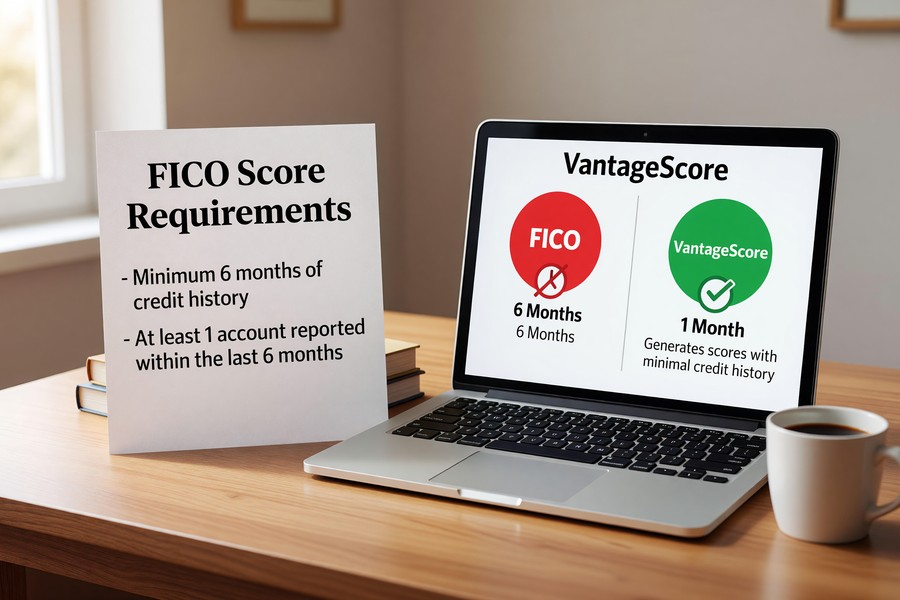
- FICO requires at least six months of credit history and one account reported within the last six months to generate a score.
- VantageScore can generate a score with as little as one month of history and one account reported within the last 24 months.
- FICO has multiple industry-specific versions (auto, mortgage, card); VantageScore uses a single general model with periodic version updates.
For people who are just starting out, VantageScore’s lower data threshold matters. If you’re working through the early stages of establishing credit, our article on practical money management systems covers how credit fits into a broader financial strategy.
VantageScore was used in over 27 billion scoring instances in 2022, according to the company’s own usage reports — making it one of the most widely referenced alternative scoring models in the U.S. financial system.
How Can You Improve Your Credit Score?
Improving your credit score is entirely achievable through consistent, targeted behavior — but it requires understanding which actions produce the fastest results versus long-term gains. The two highest-impact moves are paying on time, every time, and reducing revolving balances.
Knowing how credit scores work also means recognizing that some factors improve only with time. You cannot accelerate the length-of-credit-history component — a six-year-old account will not become eight years old any faster. Focus your energy on the factors you can control today.
Fastest Score Improvements
- Pay down credit card balances to reduce utilization — this can raise your score within 30–45 days (one billing cycle).
- Become an authorized user on a family member’s long-standing, low-utilization account to inherit their positive history.
- Set up autopay for the minimum payment on every account to eliminate the risk of accidental missed payments.
- Request a credit limit increase without spending more — this immediately lowers your utilization ratio.
Long-Term Credit Building Strategies
For those working to establish or rebuild credit, secured credit cards and credit-builder loans (offered by many credit unions and online lenders like Self Financial) are structured specifically to generate positive payment history. These tools are especially relevant for the 26 million credit-invisible Americans who lack enough data for a score.
It’s also worth knowing that cosigning on someone else’s loan creates a two-way credit relationship. Before agreeing, read our breakdown of what to know before cosigning a loan — because the other person’s payment behavior will directly affect your credit file. Additionally, the CFPB’s free resources at consumerfinance.gov provide step-by-step guidance on disputing errors, understanding your report, and tracking improvement progress.
Space out any new credit applications by at least 6 months. Multiple hard inquiries in a short window signal risk to lenders and can compound score damage beyond what a single inquiry would cause on its own.
“The best thing consumers can do is focus on the basics: pay your bills on time, keep your balances low, and don’t open new accounts unless you need them. These actions account for the vast majority of your score.”
Building healthy credit habits also reinforces broader financial stability. If you’re working toward long-term financial security, our guide to what financial stability means and where to start puts credit in context alongside savings, income, and debt management.
Frequently Asked Questions
How long does it take to build a good credit score from scratch?
It typically takes 6–12 months of responsible credit use to generate a scoreable FICO file and reach a “Good” range (670+). Using a secured card with on-time payments and low utilization is the fastest documented path for someone starting from zero.
Does checking your own credit score hurt it?
No. Checking your own score is a soft inquiry and has no effect on your score whatsoever. Only hard inquiries — generated when a lender checks your credit after an application — can reduce your score, typically by up to 10 points.
How do credit scores work when you apply for a mortgage?
Mortgage lenders typically pull scores from all three bureaus and use the middle score for qualification. Most conventional loans require a minimum score of 620, while FHA loans allow scores as low as 500 with a larger down payment, per HUD’s mortgage lending guidelines.
Can closing a credit card hurt your score?
Yes, in two ways. Closing a card reduces your total available credit, which raises your utilization ratio. It also shortens your average account age if the card is one of your older accounts. Keeping old accounts open with zero or minimal balances is generally the better strategy.
How often is a credit score updated?
Credit scores are recalculated each time a lender requests them, based on whatever data is in your credit file at that moment. Most creditors report account activity to the bureaus once per month, so your score can change monthly as new data is reported.
Does income affect your credit score?
No. Income is not a factor in any FICO or VantageScore calculation. Your score is based entirely on credit behavior data — payment history, balances, account ages, and applications — not on how much you earn.
How do credit scores work after a bankruptcy?
A Chapter 7 bankruptcy stays on your credit report for 10 years; Chapter 13 for 7 years. Scores can begin recovering within 12–24 months if you establish new positive credit accounts, because recent behavior is weighted more heavily than older negative events as time passes.
Sources
- Consumer Financial Protection Bureau — Credit Reports and Scores
- myFICO — What’s in Your Credit Score
- FICO — Average U.S. FICO Score Data
- Experian — What Is a Good Credit Utilization Rate?
- Equifax — How Do Hard Inquiries Affect Your Credit Score?
- CFPB — Report: 26 Million Consumers Are Credit Invisible
- AnnualCreditReport.com — Official Free Credit Report Access
- Federal Trade Commission — Study: One in Five Consumers Had Errors on Credit Reports
- U.S. Department of Housing and Urban Development — Mortgage Loan Information
- FICO — The FICO Score Product Overview