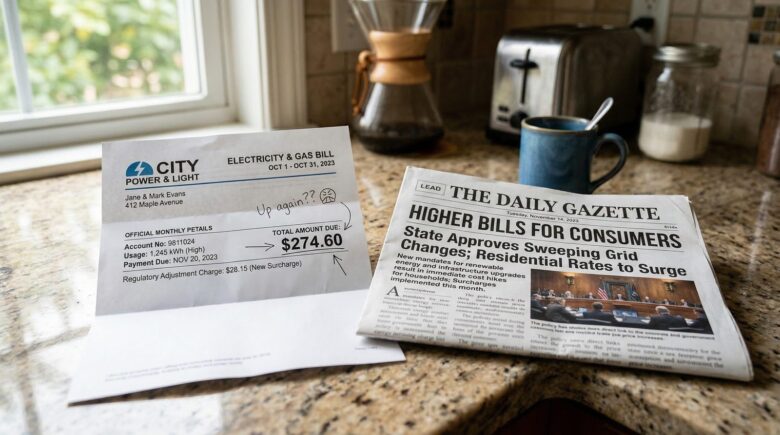
How Policy Decisions Show Up in Monthly Bills
Every month, you open your email or check your mailbox and find bills from your utility company, internet provider, insurance carrier, and bank. The numbers seem to inch upward year after year, and you might assume it’s inflation — just the general cost of everything going up. But look more closely and a different story emerges.
Many of the specific charges on your monthly bills are direct consequences of government policy decisions. Not background noise from the economy — specific choices made by legislators, regulators, and agencies at the federal, state, and local level that ripple forward to your bank account. Understanding those connections doesn’t just explain your bills. It helps you anticipate costs, make smarter financial decisions, and engage with policy debates with real stakes rather than abstract ones.
📌 For a comprehensive overview of available programs and how to access them, check out our complete guide to government assistance programs.
How Energy Policy Shows Up in Your Electricity Bill
Your electricity and gas bills reflect policy decisions made at multiple levels of government simultaneously. When states mandate renewable energy portfolios — requiring utilities to source a percentage of their power from solar, wind, or other clean sources — utilities must invest in new infrastructure to comply. Those infrastructure costs get passed to consumers through rate increases approved by state public utility commissions.
California’s aggressive clean energy targets, for example, have contributed to the state having some of the highest residential electricity rates in the nation. The policy goal is to reduce carbon emissions and address climate change — a legitimate public objective. But the financial cost arrives as line items on monthly bills, often without explanation. You’re paying for a policy transition whether or not you voted for it, understand it, or have the income to comfortably absorb it.
Federal regulations shape costs as well. The Environmental Protection Agency sets emission standards for power plants. Upgrading equipment to meet those standards requires capital investment, which utilities recover through rate increases. If your state’s utility is in the middle of a compliance upgrade cycle, that’s likely reflected in what you’re paying right now.
Deregulated Energy Markets: Choice With Complexity
Some states have deregulated their energy markets, allowing consumers to choose their electricity supplier rather than relying on a single regulated utility. This competition can lower prices — but it introduces complexity that many households aren’t equipped to navigate. Policy decisions about market structure directly determine whether you have options and what those options actually cost.
In deregulated states, many consumers stay with the default provider and pay more than they need to. Others sign promotional contracts that revert to higher rates after an introductory period. The policy designed to create savings only delivers savings if you actively manage your choices — and not everyone has the time or bandwidth to do that.
For a broader look at how systemic financial complexity tends to disadvantage people with less time and money, see Why Assistance Rules Feel Punishing on Purpose.
Telecommunications Policy and What You Pay for Internet
Your internet bill reflects decades of regulatory decisions about how telecommunications infrastructure is built, owned, and governed. The Federal Communications Commission’s net neutrality rules — enacted, repealed, and debated multiple times — influence how providers are permitted to charge for service. When the FCC reclassified broadband in 2017, it fundamentally changed the regulatory framework governing your internet access. These aren’t abstract policy debates. They determine whether providers can throttle certain content, prioritize their own services over competitors, or charge different rates for different service tiers.
Infrastructure requirements also shape your bill. When municipalities require internet providers to expand service to underserved areas, companies often raise rates in profitable zones to subsidize the expansion. The Universal Service Fund — which appears as an explicit line item on many phone bills — directly funds programs bringing connectivity to remote areas and low-income households. You may be subsidizing rural broadband even if you’ve never thought about it.
The 2021 Infrastructure Investment and Jobs Act earmarked $65 billion for broadband expansion. As providers upgrade networks to meet new deployment standards, expect those investments to surface in your monthly charges over time. The timeline between a policy authorization and a rate adjustment on your bill can span years — which is why these connections often go unnoticed. By the time a charge appears, the policy that caused it may be years old.
Health Insurance Premiums and the Policy Behind the Price
Health insurance premiums are perhaps the most direct example of government policy showing up as a monthly bill. The Affordable Care Act introduced essential health benefits that all plans must cover — preventive care, mental health services, prescription drugs, and more. This expanded coverage increased premiums for some people while making insurance accessible for others who previously couldn’t qualify. Which side of that equation you fell on depended heavily on your income, age, and health status.
State-level decisions matter as much as federal ones. States that expanded Medicaid under the ACA created different insurance market dynamics than those that didn’t. Insurance companies price their plans based on the risk pool in each state — and the composition of that risk pool is directly shaped by which populations have public coverage and which are left to find private plans. When healthy people exit the market due to a policy change, premiums rise for those who stay. Your premium isn’t just a function of your own health. It reflects the health and participation of your entire state’s insurance market, which in turn reflects the policy choices your state has made.
Prescription drug pricing is another area where policy decisions directly affect what you pay. Medicare’s new authority to negotiate drug prices — granted through the Inflation Reduction Act — aims to reduce costs for Medicare recipients. Pharmaceutical companies respond to these policies by adjusting their pricing strategies in other market segments. The interplay between regulation and market response makes predicting your out-of-pocket drug costs genuinely difficult. Staying informed about these shifts is one way to anticipate costs before they hit.
Your monthly insurance premium is not just a price set by your insurer. It’s a number that emerges from a web of federal mandates, state regulatory choices, market dynamics, and legislative decisions that may have been made years ago.
Banking Fees and the Regulations That Create Them
Banking regulations affect the fees you encounter in ways that are often invisible until you start looking. The Durbin Amendment, part of the 2010 Dodd-Frank Act, capped the interchange fees that banks charge merchants when customers use debit cards. The stated intent was to benefit consumers through lower prices at the register. But banks responded by eliminating free checking accounts, introducing new monthly maintenance fees, and raising minimum balance requirements. Consumer protection legislation for merchants translated into higher costs for checking account holders — a classic example of how regulatory changes produce unintended consequences.
The Consumer Financial Protection Bureau influences fees across most consumer financial products through its oversight authority. Rules about overdraft charges, late payment fees, and credit card practices all emerge from CFPB actions. Recent guidance limiting overdraft fees could save consumers billions annually — and you’ll notice those changes in your account terms and fee schedules as banks adapt. When the CFPB acts, your bank changes its business model. Sometimes that benefits you directly. Sometimes it produces tradeoffs that are harder to see.
For context on how financial systems and regulations tend to affect lower-income households differently than others, see Why Being Bad With Money Is Often a Systems Problem.
Fintech and the Cost of Compliance
Digital payment platforms face evolving regulatory requirements that affect your user experience. When Venmo or Cash App implements identity verification procedures in response to IRS reporting requirements, some platforms introduce fees or adjust limits to manage compliance costs. The convenience that made these services attractive comes with regulatory overhead that eventually reaches your transaction costs in some form.
Tax Policy and Take-Home Pay
Tax policy doesn’t appear as a line item on your utility or insurance bills, but it determines how much money you have available to pay all of them. Federal tax brackets, standard deductions, child tax credits, and payroll tax rates all affect your take-home pay. When Congress passes tax legislation, your paycheck changes within weeks. The 2017 Tax Cuts and Jobs Act altered withholding tables immediately, affecting how much money hit workers’ accounts each pay period. For people living paycheck to paycheck, that kind of change — positive or negative — matters enormously.
State and local tax policies add complexity. Property taxes fund schools and municipal services, but they also represent a major household expense — particularly for renters, since landlords factor property tax costs into rent. When a city council approves a school bond or a county passes a new levy, those costs flow through to residents in ways that aren’t always direct or visible. States without income tax frequently compensate with higher sales taxes or property taxes, shifting the burden differently across income levels. Understanding your total tax burden across all levels of government helps you budget more accurately and evaluate financial decisions — like moving to a different city or state — with realistic numbers.
Payroll taxes deserve particular attention for gig workers and freelancers. Social Security and Medicare taxes that employees share with employers fall entirely on the self-employed. Self-employment tax represents a substantial cost that many people don’t fully account for when calculating income from freelance work. Recent proposals to modify Social Security tax rates or the income cap subject to payroll taxes could significantly affect monthly cash flow depending on your employment structure. These are policy conversations worth following — they’re not abstract.
Why Your Bills Tell a Story About Political Priorities
The connection between policy and bills runs in both directions. Policy shapes what you pay — but what voters and consumers demand also shapes policy over time. When utility customers organized against rate increases in certain states, public utility commissions changed how they evaluated rate applications. When consumer advocates documented the impact of overdraft fees, legislative pressure built until regulatory action followed. Your bills are a record of past political decisions, but they’re also stakes in future ones.
This doesn’t mean every policy outcome is in your control, or that individual action is sufficient to address systemic problems. But being informed about these connections changes how you engage with decisions about your own finances. When you understand why your electricity rate went up, you can evaluate whether shopping for a different supplier makes sense. When you understand why your insurance premium changed, you can make more informed choices during open enrollment.
For more on how living with tight financial margins makes all of these policy impacts land harder, see When Paying Bills Becomes a Monthly Crisis and The Difference Between Getting By and Getting Ahead.
How to Use This Knowledge in Your Financial Planning
Understanding the policy roots of your monthly bills isn’t just an intellectual exercise — it has practical financial applications.
- Anticipate rather than react. When you know that your state is in the middle of a utility infrastructure upgrade, or that a new insurance regulation is taking effect, you can model those costs into your budget before they arrive on a bill.
- Ask the right questions. When a bill goes up, contact the provider and ask specifically what changed and why. Rate increases on utility bills often come with public explanations filed with your state’s public utility commission — those filings are available to you.
- Evaluate your options with context. If you live in a deregulated energy market, understanding the policy structure helps you comparison shop intelligently. If your employer offers health insurance, understanding the policy environment helps you evaluate whether marketplace alternatives might be worth exploring.
- Vote with financial stakes in mind. State legislators vote on utility regulation, Medicaid expansion, insurance market rules, and local tax policy. These aren’t distant abstractions. They show up as numbers in your budget every single month.
According to the U.S. Energy Information Administration, electricity prices vary by more than 100% between the highest and lowest-cost states — a gap driven primarily by regulatory structure and state energy policy, not by raw differences in generation costs. That range represents hundreds of dollars per year for households in high-cost states, all traceable to policy decisions.
Related Reading
- Why Assistance Rules Feel Punishing on Purpose
- What Happens After Benefits End
- Government Assistance Programs You May Already Qualify For
Frequently Asked Questions
Why do utility bills vary so much from state to state?
State energy policy is the primary driver. States with aggressive renewable energy mandates often have higher electricity rates due to infrastructure transition costs. States with deregulated energy markets may have lower baseline rates but more pricing variability. The fuel mix a state uses for generation, the age of its infrastructure, and the level of regulatory oversight all reflect policy decisions made over decades. The U.S. Energy Information Administration publishes average residential electricity rates by state — a useful reference if you’re considering relocating or want to understand your state’s position.
Does the Universal Service Fund really add to my phone bill?
Yes. The Universal Service Fund is a federal program administered by the FCC that funds phone and broadband access for schools, libraries, rural areas, and low-income households. Telecommunications providers are required to contribute, and most pass that cost directly to consumers as an explicit line item. It’s typically a small percentage of your monthly bill. The fund supports programs like Lifeline, which provides discounted phone service to low-income households, and E-Rate, which funds school and library internet access.
How does Medicaid expansion affect my private insurance premium?
Medicaid expansion affects the risk pool in your state’s private insurance market. States that expanded Medicaid moved lower-income, higher-health-risk individuals into public coverage, which generally improved the risk balance for private insurers and put downward pressure on premiums. States that didn’t expand Medicaid tend to have more of those individuals in private market plans — or uninsured — which affects how insurers price their products. The connection isn’t immediate or simple, but multiple studies have found that expansion states experienced slower premium growth in individual market plans compared to non-expansion states.
What can I actually do if a rate increase feels unjustified?
More than most people realize. Utility rate increases must be approved by your state’s public utility commission, and those proceedings are public. You can review the justification for a proposed rate increase, and in many states, you can submit written comments or attend public hearings. Consumer advocacy organizations often monitor these proceedings and can alert you to upcoming cases. For insurance premium changes, your state’s insurance commissioner’s office handles complaints and regulates rate filings. Banking fee changes are subject to CFPB oversight. None of these channels are fast, but they exist — and when enough consumers engage, outcomes change.
Sonia Reyes is a benefits access advocate and policy researcher who has guided thousands of individuals through government assistance applications. She writes about the systems that shape everyday financial life — and how to navigate them without losing your mind. She works out of Albuquerque, NM.