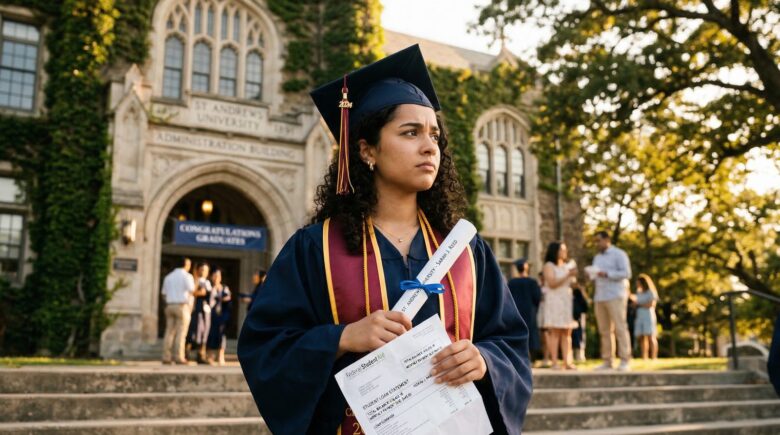
Is Education Still “Worth It”? A Financial Reality Check
For decades, higher education was treated as a near-automatic path to financial security. The message was simple and repeated everywhere: get a degree, land a better job, build a better life. For a long time, that equation held up well enough that few people questioned it.
But the math has shifted dramatically. Tuition costs have exploded. Wages for many college graduates have stagnated. Student debt has become one of the defining financial burdens of an entire generation. And the job market has quietly opened alternative pathways that did not exist a generation ago. Today, asking whether a college education is still worth it is not pessimistic or anti-intellectual. It is one of the most important financial questions a young person — or anyone considering returning to school — can ask.
📌 For a broader look at building long-term security, see our complete guide to financial stability.
The answer is not a simple yes or no. It depends enormously on what you study, where you study, how much you borrow, and what you plan to do with it. This article breaks down the real financial calculus so you can make a decision based on evidence rather than assumption.
The Rising Cost of College vs. What Graduates Actually Earn
The price of a college degree has increased faster than almost any other major expense in the American economy. According to data from the Education Data Initiative, tuition at public four-year institutions has increased by more than 179% since 1980, even after adjusting for inflation. Private university costs have followed a similar — and in many cases steeper — trajectory.
Meanwhile, wage growth for most workers has not kept pace. The Federal Reserve reports that real wages for young workers have grown only modestly during the same period, with significant variation by field. The result is a widening gap between what education costs and what it pays back, at least in the early years after graduation.
The average borrower now graduates with approximately $37,000 in student loan debt, according to Education Data Initiative figures. Professional programs push that number far higher — medical school graduates frequently carry debt exceeding $200,000, and many law school graduates are not far behind. These are not abstract numbers. A $37,000 loan at a standard interest rate translates to roughly $370 per month for ten years. That is money that cannot go toward rent, an emergency fund, retirement savings, or anything else.
The Hidden Cost: Opportunity Cost
The financial cost of college extends beyond tuition and loan payments. Four years spent in school represents four years of foregone income and four years of delayed retirement contributions during the period when compound growth is most powerful. For many graduates, their early 20s became a financial lost decade — accumulating debt rather than assets during the years that compound interest would have worked hardest for them.
None of this means college is the wrong choice. It means the decision deserves the same serious financial analysis you would apply to any major long-term investment.
The Degree Premium Is Real — But Complicated
Despite rising costs, college graduates do still earn more on average than workers with only a high school diploma. The Bureau of Labor Statistics reports that bachelor’s degree holders earn a median weekly income of roughly $1,432, compared to approximately $853 for high school graduates. Over a 40-year career, that gap can add up to close to $1 million in additional cumulative earnings.
That number sounds compelling. But aggregate statistics hide enormous variation that matters a great deal for any individual decision.
Your Major Matters More Than Your School
Engineering, computer science, nursing, and accounting graduates typically see strong, relatively quick returns on their educational investment. Liberal arts, fine arts, and humanities graduates often spend years — sometimes a decade or more — before their earnings justify what they borrowed. That is not a criticism of those fields. It is a financial reality that should factor into how much you choose to borrow and how you structure your career trajectory.
Geography also shapes the math. The same credential that launches a $90,000 starting salary in San Francisco may generate $52,000 in a mid-sized Midwest market. If you plan to stay close to home, calibrate your expectations — and your borrowing — accordingly.
Underemployment Is More Common Than the Data Suggests
The degree premium also fails to account for underemployment. Research from the Federal Reserve Bank of New York found that roughly 40% of recent college graduates work in jobs that do not require a bachelor’s degree. These graduates are servicing degree-level debt while earning wages that reflect high-school-level credential requirements. That combination is financially devastating for long-term wealth building. It reflects a job market where degree inflation has pushed requirements up for jobs that were previously accessible without them — meaning many graduates carry the full cost of the investment without capturing the expected return.
Alternative Pathways That Can Lead to Middle-Class Incomes
The traditional college-or-nothing mentality has softened significantly in recent years — and for good reason. The digital economy and a tightening skilled trades market have created genuine alternative pathways to stable, well-paying careers that do not require a four-year degree.
Skilled Trades
Electricians, plumbers, HVAC technicians, and welders are in high demand across most of the country, and that demand is growing as an older generation of tradespeople retires. Bureau of Labor Statistics data shows median annual wages for electricians around $61,000, with experienced tradespeople in high-demand markets earning substantially more. Apprenticeship programs typically take 2–5 years, cost little to nothing, and pay a wage while you train. The result: zero debt, an in-demand skill, and a career path with genuine upward mobility.
Coding Bootcamps and Tech Certifications
The technology sector has been the most visible arena for alternative credentialing. Coding bootcamps offer intensive 12–24 week programs at a fraction of traditional tuition costs. Several major tech companies have publicly dropped degree requirements in favor of skills assessments. Certifications from Google, AWS, CompTIA, and similar providers carry real weight in hiring. These paths are not right for everyone, and outcomes vary — but they represent a genuine alternative for people with the right aptitude and motivation.
Community College as a Strategic Launchpad
Community colleges are one of the most underrated options in American higher education. Starting at a two-year institution and transferring to a four-year school can cut total education costs by 30–50% or more, depending on the schools involved. Many community colleges have strengthened direct transfer agreements with state universities and built employer partnerships that create pathways to jobs. For someone who does want a bachelor’s degree, starting at a community college is often the financially intelligent way to get there.
Online education has also matured significantly. Platforms like Coursera and edX offer accredited certificates from well-regarded universities at a fraction of traditional tuition costs. These credentials are not equivalent to a full degree in every employer’s eyes — but they can supplement existing education, demonstrate specific skills, and open doors that a resume gap would otherwise close.
When Student Debt Outweighs Career Returns
Financial advisors who work with young adults commonly use a simple rule of thumb: your total student debt at graduation should not exceed your expected first-year salary. Someone expecting to earn $50,000 in their first job should aim to borrow no more than $50,000 total. It is a rough guide, not a law — but it reflects the real constraint that monthly loan payments impose on everything else in your financial life.
A $40,000 debt at 5% interest requires roughly $425 per month for 10 years. That is money that cannot go toward a down payment on a home, an emergency fund, or retirement. The Federal Reserve Bank of New York has found that student debt significantly delays homeownership — borrowers purchase homes an average of seven years later than non-borrowers with similar incomes. Seven years of delayed equity building, delayed wealth accumulation, and delayed stability. That is a real and quantifiable cost.
Graduate Degrees Deserve Extra Scrutiny
Graduate programs are particularly worth examining carefully before committing. A master’s degree in many fields provides only a marginal earnings boost over a bachelor’s — often not enough to justify the additional debt and the two or more years of foregone income. There are exceptions: MBA programs at highly-ranked schools with strong recruiting pipelines, specialized degrees in fields with clear salary bumps (speech-language pathology, physician assistant, nurse practitioner), and a handful of others. But the general assumption that more education always equals more earning power is not supported by the data across most fields.
Law school deserves special mention. A JD from a well-regarded school with strong recruiting outcomes can be an excellent financial investment. A JD from a lower-ranked school with poor employment outcomes and high tuition is one of the most expensive financial mistakes a person can make. Before applying, research bar passage rates, employment outcomes at graduation, and median starting salary. Those numbers tell the real story.
For-profit colleges warrant serious skepticism. These institutions have historically charged premium tuition while delivering below-average outcomes, and their graduates default on loans at significantly higher rates than graduates of traditional colleges.
A Framework for Making the Decision Strategically
Treating an educational investment like the major financial decision it is means running the numbers before you commit. Here is a practical framework:
- Research your target career’s salary range. Look at entry-level salaries in the specific field and geographic area where you plan to work. The Bureau of Labor Statistics Occupational Outlook Handbook is a reliable starting point.
- Apply the debt-to-income rule. Aim to borrow no more than your expected first-year salary. If the math does not work at your target school, explore less expensive paths to the same credential.
- Exhaust free money before borrowing. Fill out the FAFSA even if you doubt you will qualify. Apply for every scholarship and grant you can find. Work during school if it is feasible. Every dollar you do not borrow saves you roughly $1.50 over the life of the loan once you factor in interest.
- Consider alternatives honestly. Could you reach your career goal through a community college, a certification program, an apprenticeship, or a less expensive state school? The credential at the end matters; the institution that issued it matters much less in most fields than reputation suggests.
- Think about the full timeline. A four-year degree that costs $80,000 in debt and takes 10 years to pay off is not just a financial decision — it is a decade of your financial life shaped by that choice. Make sure the career it leads to justifies that commitment on both levels.
If you want to understand what financial stability actually looks like for people navigating these choices, it is not about being rich — it is about having margin. That margin is harder to build when a large portion of your income goes to loan payments every month.
Reframing the Question
The question is not really whether education is worth it. Education — in most forms — has value. The question is whether a specific educational investment justifies its specific cost for your particular situation, goals, and career path.
For many people, a four-year college degree remains the right answer. For others, a trade certification, a community college associate degree, or an employer-sponsored training program is a smarter financial path to the same destination. The worst outcome is defaulting to college without analysis — and spending years managing debt that reflects an unexamined assumption, not a genuine investment.
We now have more educational options than at any point in American history. Community colleges, trade schools, bootcamps, and apprenticeships all offer real pathways to stable incomes. The students who navigate this landscape most successfully ask hard questions before they sign the loan paperwork — not after. If you are working on building long-term stability on a tight budget, it is worth understanding what getting ahead actually requires versus just getting by.
Education can still be worth it. It just is no longer automatically worth it. And knowing the difference is one of the most financially important things you can understand.
Related Reading
- What Financial Stability Actually Looks Like
- When Financial Progress Feels Invisible
- Why Being Bad With Money Is Often a Systems Problem
Frequently Asked Questions
Is it still worth going to college if I’m not sure what I want to study?
Going to college undecided is not inherently a mistake, but it raises your financial risk. If you spend one or two years switching majors and taking unneeded credits, you add cost without adding value. If you are genuinely uncertain, consider starting at a community college — where you can explore for far less money — before committing to four-year tuition. Alternatively, taking a gap year to gain work experience and clarify your direction can prevent expensive trial-and-error at full tuition rates.
How do I know if the debt I’m taking on is too much?
The most practical rule is to keep total borrowing below your expected starting salary in your chosen field. If you expect to earn $45,000 in your first job, try not to graduate with more than $45,000 in debt. You can research typical starting salaries using the Bureau of Labor Statistics Occupational Outlook Handbook or salary sites like Glassdoor and LinkedIn. If the debt-to-income ratio looks problematic, it is a signal to explore less expensive paths to the same credential.
Are trade and vocational careers really as financially viable as college careers?
For many trades, yes — and in some cases, the financial math is better. Electricians, plumbers, HVAC technicians, and similar skilled tradespeople are in genuine shortage across the country, which drives wages up. Many apprentices earn a wage while training, emerge with zero debt, and qualify for union jobs with benefits, retirement plans, and strong income stability. The social stigma around trades careers has been fading as wages and job security in white-collar fields have become less certain. The question is always which path aligns with your actual skills, interests, and long-term goals.
What if I already have a degree and regret the debt I took on?
You have more options than you may realize. Income-driven repayment plans cap federal loan payments at a percentage of your discretionary income, which can make payments manageable even when your salary feels mismatched with your debt. Public Service Loan Forgiveness (PSLF) erases remaining federal loan balances after 10 years of payments for people working in qualifying public sector or nonprofit jobs. Refinancing is an option for private loans if your credit and income qualify, though it can remove federal protections, so it requires careful consideration. The debt does not define your entire financial future — it is a constraint to manage strategically, not a permanent sentence. Understanding why debt is a math problem, not a moral failure, is a useful starting point for approaching it clearly.
James Achebe is a certified financial planner and financial literacy instructor who focuses on long-term stability for middle- and lower-income households. His work bridges the gap between textbook advice and the reality of living on a tight budget. He’s based in Washington, D.C.