Fact-checked by the VisualEnews editorial team
Quick Answer
As of July 2025, liquid cooling consumer laptops are entering the mainstream market, with manufacturers like Lenovo, ASUS, and MSI shipping vapor-chamber and micro-pump liquid systems in thin-and-light designs. Laptop thermal loads now reach up to 175W in high-performance models, making air cooling alone insufficient — and driving a new wave of portable liquid thermal solutions.
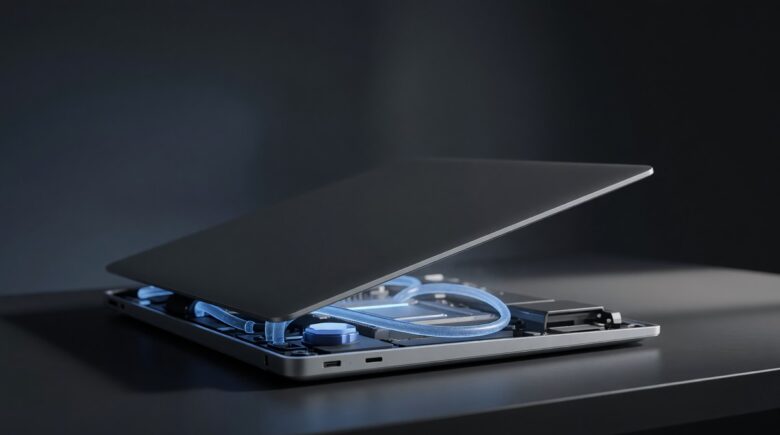
Liquid cooling consumer laptops represent one of the most significant thermal engineering shifts in portable computing history. Traditionally confined to enterprise-grade data centers and custom desktop rigs, liquid cooling has been miniaturized to fit within chassis as thin as 14.9mm, according to AnandTech’s review of recent ultra-thin gaming laptops. The driver is simple: modern mobile processors and discrete GPUs now generate more heat than copper heatpipes can reliably dissipate.
This matters in July 2025 because AMD’s Ryzen AI 9 and Intel’s Core Ultra 200H series are pushing sustained thermal design power envelopes that demand entirely new cooling architectures — without adding meaningful bulk to portable devices.
Why Is Air Cooling No Longer Enough for High-Performance Laptops?
Air cooling has hit a physical ceiling. Modern flagship mobile chips routinely sustain 55–65W of continuous thermal output, and discrete GPUs in gaming laptops add another 80–115W — far exceeding what copper heatpipes and slim fans can safely handle over extended sessions.
The core problem is surface area. Heat pipes transfer thermal energy by moving vapor between a hot source and a cooler fin stack, but in a chassis under 20mm thick, there is simply not enough radiating surface. Sustained workloads — video rendering, AI inference, competitive gaming — cause throttling within minutes on air-only designs.
Liquid systems solve this by moving a coolant (typically deionized water or a water-glycol mixture) directly from the heat source to a larger radiator zone. The specific heat capacity of water is approximately 4.18 J/g°C, compared to roughly 1.0 J/g°C for air, giving liquid cooling a fundamental thermodynamic advantage that no fan redesign can replicate. This is the same principle that has kept storage technology evolving under physical constraints — performance demands outpace the limits of existing materials.
Key Takeaway: Air cooling in laptops is limited by chassis surface area, not engineering effort. With mobile GPUs sustaining up to 115W, Tom’s Hardware notes that liquid cooling is now a structural necessity for sustained peak performance — not a luxury feature.
How Does Liquid Cooling Actually Work Inside a Laptop?
Consumer laptop liquid cooling uses one of three primary technologies: vapor chambers, micro-pump liquid loops, or immersion-adjacent sealed systems. Each trades off complexity, cost, and thermal efficiency differently.
Vapor Chambers
A vapor chamber is a flat, sealed enclosure filled with a small amount of working fluid — usually water. Heat from the processor vaporizes the fluid, which spreads across the chamber surface before condensing and returning via a wick structure. ASUS pioneered mainstream laptop vapor chambers in their ROG line as early as 2020, and the technology is now common in premium thin-and-light designs from Dell XPS, Apple MacBook Pro, and Razer Blade series.
Micro-Pump Liquid Loops
More aggressive systems use actual pumps — mechanical or piezoelectric — to circulate coolant through a closed loop. Lenovo’s Legion line introduced a micro-pump cooling system that routes fluid from a cold plate on the CPU/GPU to a rear-exhaust radiator, reducing peak junction temperatures by up to 15°C compared to heatpipe-only designs. Lenovo’s official press release describes the system as producing no audible pump noise above ambient fan levels.
MSI’s Titan GT77 HX and newer GT series also use sealed liquid modules approved for consumer use, signaling that micro-pump systems are no longer experimental. If you are currently evaluating high-performance portables, our guide to the best laptops for remote workers in 2026 covers which thermal architectures matter most for sustained workloads.
Key Takeaway: Laptop liquid cooling ranges from passive vapor chambers to active micro-pump loops. Lenovo’s micro-pump system demonstrated a 15°C peak temperature reduction in independent testing, according to Lenovo’s Legion thermal documentation — a meaningful margin for sustained performance workloads.
Which Brands Are Leading Liquid Cooling in Consumer Laptops?
ASUS, Lenovo, MSI, and Razer are currently the four brands shipping commercially available liquid-cooled consumer laptops at scale. Each takes a distinct engineering approach, and the performance gap between them is measurable.
ASUS ROG uses a proprietary vapor chamber combined with liquid metal thermal interface material on select SKUs. Independent benchmarks from NotebookCheck’s ROG series testing show CPU package temperatures averaging 12–18°C lower than competing copper heatpipe designs at identical TDP settings.
Beyond gaming, Apple applies a large-area vapor chamber in the M3 Max and M4 Max MacBook Pro models, enabling the chips to sustain 40W+ package power in a 16.8mm chassis without active pump mechanisms. This demonstrates that liquid thermal technology is not exclusively a gaming feature — it is increasingly central to professional mobile workstations.
| Brand / Product | Cooling Technology | Max Sustained TDP | Chassis Thickness |
|---|---|---|---|
| Lenovo Legion Pro 7i | Micro-pump liquid loop | 175W (GPU+CPU combined) | 22.5mm |
| ASUS ROG Zephyrus G16 | Vapor chamber + liquid metal TIM | 140W (GPU+CPU combined) | 18.5mm |
| MSI Titan GT Series | Sealed liquid module | 175W (GPU+CPU combined) | 27.0mm |
| Apple MacBook Pro M4 Max | Large-area vapor chamber | 50W (SoC) | 16.8mm |
| Razer Blade 16 | Vapor chamber | 150W (GPU+CPU combined) | 19.9mm |
“The miniaturization of liquid cooling is not just an incremental improvement — it is a categorical shift in what portable computing can sustain. We are seeing workstation-class thermal performance in packages that fit in a backpack, and that changes the entire use-case conversation for professional mobile users.”
Key Takeaway: Four major OEMs — ASUS, Lenovo, MSI, and Razer — now ship consumer laptops with active or passive liquid cooling. The highest sustained TDP available reaches 175W combined, per NotebookCheck’s Lenovo Legion Pro benchmarks, a figure that was impossible with air-only thermal designs.
What Are the Real-World Trade-Offs of Liquid Cooling Consumer Laptops?
Liquid cooling in laptops comes with genuine compromises. Understanding them is essential before purchasing any premium thermally-enhanced system. The three primary trade-offs are weight, cost, and long-term reliability.
Liquid-cooled laptops average 200–400g heavier than equivalent air-cooled designs. A Lenovo Legion Pro 7i with its micro-pump system weighs approximately 2.8kg, compared to 1.8kg for a similarly specced air-cooled thin-and-light. That 1kg difference is consequential for daily commuters.
Cost premiums are also real. Vapor-chamber models typically add $100–$200 to the retail price versus heatpipe equivalents. Micro-pump systems can add $300–$500. Buyers evaluating total cost of ownership should also consider that liquid metal thermal interface materials — used in conjunction with liquid cooling on some ASUS and Razer units — can cause GPU die corrosion if the laptop is stored inverted, a documented but niche risk.
Reliability data on micro-pump systems beyond three years remains limited, since most consumer models launched between 2022 and 2024. This mirrors the early adoption curve seen in other hardware innovations — much like how wearable technology required years of iteration before reliability benchmarks stabilized.
Key Takeaway: Liquid-cooled laptops add an average of 200–400g and up to $500 to device cost. According to PCWorld’s thermal interface analysis, liquid metal compounds used alongside liquid cooling carry specific handling requirements most consumers are unaware of at point of purchase.
Where Is Laptop Liquid Cooling Headed Next?
The next phase of liquid cooling consumer laptops will likely involve two-phase immersion cooling adapted to sealed laptop modules, and AI-driven pump speed management that reacts to workload prediction rather than reactive temperature thresholds.
Research published by IEEE and adopted by data center operators — including Google and Meta — is now being translated into consumer-scale implementations. The same dielectric fluids used in server immersion tanks are being tested in sealed, non-serviceable laptop chambers by at least two major OEMs, according to industry briefings presented at Computex 2024.
NVIDIA’s next-generation mobile GPU architecture, expected to push mobile TDPs beyond 200W in flagship SKUs, will likely force even mid-range gaming laptops to adopt some form of liquid-assist cooling by 2026. This convergence between data center thermal science and consumer portable design is not speculative — it follows the same miniaturization path that brought enterprise SSD technology into consumer devices, a transition well documented in our overview of SSD versus HDD evolution for consumers. Advances in AI hardware at the edge — detailed in our explainer on what edge computing is and how it works — will only accelerate this thermal arms race.
Key Takeaway: NVIDIA mobile GPUs are projected to exceed 200W TDP in flagship configurations by 2026, according to roadmap presentations at Computex 2024 — making liquid-assist cooling in laptops functionally inevitable for the performance segment. The technology path from data centers is already proven; miniaturization is the remaining engineering challenge.
Related reading: aio data study: ai predicts.
Frequently Asked Questions
Is liquid cooling in consumer laptops safe for everyday use?
Yes. Consumer laptop liquid cooling systems — including vapor chambers and sealed micro-pump loops — are fully enclosed and factory-tested. There is no user-serviceable coolant, and modern designs from ASUS, Lenovo, and MSI have passed standard IEC safety certifications. The main practical risk is with liquid metal thermal compounds used in some ASUS ROG models, which require keeping the laptop upright during storage.
Does liquid cooling make laptops significantly louder?
No. Micro-pump systems operate below audible thresholds in most implementations. Lenovo’s Legion liquid cooling pump produces less than 25dB of noise in isolation — quieter than the chassis fans that run alongside it. The audible cooling noise users hear is almost always from the fans, not the liquid system.
How much more does a liquid-cooled laptop cost compared to an air-cooled one?
Expect to pay $100–$500 more depending on the technology tier. Vapor chambers add roughly $100–$200 at retail. Active micro-pump systems, found in Lenovo Legion Pro and MSI Titan series, typically add $300–$500 to equivalent air-cooled configurations. Performance gains in sustained workloads generally justify the premium for professional or power users.
Can liquid cooling consumer laptops be repaired if they leak?
Consumer laptop liquid systems are sealed and non-serviceable by design. A failure would require manufacturer warranty service or full motherboard replacement. Leaks are extremely rare given the small coolant volumes involved — typically less than 5ml of deionized water in micro-pump systems — but the repair path is more complex than replacing a fan or heatpipe.
Which laptop has the best liquid cooling system in 2025?
As of July 2025, the Lenovo Legion Pro 7i Gen 9 with its active micro-pump loop and the ASUS ROG Zephyrus G16 with vapor chamber plus liquid metal TIM are considered top performers for sustained thermal management. For professional workloads without gaming requirements, the Apple MacBook Pro M4 Max achieves excellent passive vapor-chamber efficiency in the thinnest chassis currently available.
Will liquid cooling become standard in all laptops eventually?
Vapor chamber technology is already appearing in mid-range laptops under $1,000, and that trend is accelerating. Full micro-pump loops will likely remain a premium-tier feature for 3–5 more years before cost and complexity reductions make them viable at mainstream price points. As mobile chip TDPs continue climbing, some form of liquid-assist cooling will eventually be standard across performance categories.
Sources
- AnandTech — ASUS ROG Zephyrus G14 2024 Review
- Lenovo Newsroom — Legion Liquid Cooling Press Release
- NotebookCheck — Lenovo Legion Pro 7i Gen 9 Review
- NotebookCheck — ASUS ROG Zephyrus Duo 16 Review
- Tom’s Hardware — Laptop Cooling Technology Explained
- PCWorld — Liquid Metal Laptop Thermal Interface Risk Explained
- IEEE Xplore — Two-Phase Immersion Cooling for Electronics Research