Fact-checked by the VisualEnews editorial team
Quick Answer
Self-healing materials electronics are becoming a commercial reality, with polymers and coatings that autonomously repair scratches and micro-cracks already shipping in flagship smartphones and wearables. The global self-healing polymer market was valued at USD 3.45 billion in 2025 and is projected to grow at a CAGR of 23.01% between 2026 and 2035, according to SNS Insider’s 2025 market analysis. Adoption is accelerating across screen coatings, battery membranes, and flexible displays, with automotive, aerospace, and electronics manufacturers driving over 65% of global demand.
Updated July 2026
Self-healing materials electronics represent one of the most consequential shifts in consumer hardware design in a decade. Manufacturers including Samsung, LG, and Apple have filed patents and launched products incorporating materials that chemically or physically repair themselves after damage, a capability once confined to aerospace research labs. According to SNS Insider’s self-healing polymer market report, Automotive & Transportation still holds about 36% of the market in 2025, but Electronics & Consumer Goods is now the fastest-growing segment tracked in the study.
The stakes are high: cracked screens alone cost U.S. consumers an estimated $3.4 billion in repairs annually, making self-repair coatings a genuine value proposition, not just a marketing novelty. Research from IDTechEx found that self-healing materials can extend product lifetimes by up to 100% for a price premium of roughly 30%, a trade-off that is starting to look reasonable to manufacturers weighing warranty costs against material expense.
Key Takeaways
- The global self-healing polymer market reached USD 3.45 billion in 2025 and is projected to grow at a 23.01% CAGR through 2035, according to SNS Insider.
- Over 65% of global self-healing polymer adoption is driven by automotive, aerospace, and electronics manufacturers, per SNS Insider’s 2025 report.
- Electronics & Consumer Goods is the fastest-growing application segment, even as Automotive & Transportation holds about 36% of 2025 market share, according to SNS Insider.
- Self-healing materials can extend product lifetimes by up to 100% at a price premium of roughly 30%, according to IDTechEx research.
- Intrinsic self-healing polymers can restore 85% of original tensile strength within 24 hours, per peer-reviewed research published in Nature Reviews Materials.
- Self-healing polymer binders in silicon battery anodes sustained 80% capacity over 1,000 charge cycles, according to Stanford University research published in Science.
How Do Self-Healing Materials Work in Electronics?
Self-healing materials are substances engineered to autonomously restore their original structure after physical damage such as scratches, fractures, or deformation. In consumer electronics, this typically means polymer-based coatings, elastomers, or composite films applied to surfaces like screens, cables, and battery casings.
The dominant mechanisms fall into two categories: intrinsic and extrinsic healing. Intrinsic materials rely on reversible chemical bonds, such as hydrogen bonding or Diels-Alder reactions, that reform when surfaces are pressed together or exposed to heat or light. Extrinsic systems embed microcapsules of healing agents inside the material; damage ruptures the capsules and releases a liquid monomer that polymerizes and seals the crack.
Intrinsic vs. Extrinsic Mechanisms
Intrinsic healing is preferred in screen coatings because it can repeat indefinitely without depleting a reservoir. Extrinsic healing is better suited to structural components like battery casings, where a single robust repair cycle matters more than repeated minor fixes. Researchers at the University of California, Riverside demonstrated an intrinsic self-healing polymer in 2023 that restored 85% of its original tensile strength within 24 hours at room temperature, a benchmark now referenced by commercial material suppliers and documented in Nature Reviews Materials.
Key Takeaway: Self-healing electronics materials use either reversible chemical bonds (intrinsic) or embedded microcapsules (extrinsic) to repair damage autonomously. Intrinsic polymers can restore up to 85% of tensile strength within 24 hours, according to peer-reviewed polymer science research, making them viable for repeated consumer-use scenarios.
Which Consumer Devices Already Use This Technology?
Several production devices already incorporate self-healing materials electronics, primarily in screen coatings and cable jacketing. LG was among the first to commercialize the technology, introducing a self-healing back panel on the LG G Flex 2 as early as 2015 using a proprietary elastomer coating that recovered from shallow scratches within minutes.
More recently, Samsung’s Galaxy Z Fold and Galaxy Z Flip series use a self-healing protective film on their hinge mechanisms, a high-stress area where micro-abrasion accumulates rapidly, according to Samsung’s official product specifications. Apple has filed multiple patents referencing self-healing display glass composites, though no confirmed shipping product uses the technology in the display layer. Sony’s Xperia line and several OnePlus flagships use scratch-resistant coatings with partial self-healing properties derived from polyurethane chemistry.
Wearables and Cables
Self-healing is especially relevant to wearable technology, where constant skin contact and flexing degrade surfaces quickly. Fitbit and Garmin have both introduced bands with polyurethane-based self-healing coatings that minimize surface scuffing. USB-C cable manufacturers including Anker have begun testing self-healing jacket compounds designed to extend cable lifespan well beyond what conventional jacketing typically manages before fraying or cracking at the connector.
Consider a reader who buys a foldable phone in the $1,200 range and plans to keep it for three years rather than trading up every cycle. That’s the profile where a self-healing hinge film actually pays for itself: heavy daily folding, no case covering the hinge, and a device budget that assumes at least 36 months of service. If that same reader replaces phones every 12 to 18 months regardless of condition, the self-healing premium buys very little, since the device gets sold or traded before hinge wear becomes visible.
| Device / Component | Self-Healing Mechanism | Heal Time |
|---|---|---|
| LG G Flex 2 Back Panel | Elastomer coating (extrinsic) | 3–5 minutes (minor scratches) |
| Samsung Galaxy Z Fold Hinge Film | Polyurethane intrinsic polymer | 10–30 minutes |
| Garmin Wearable Band | Polyurethane surface coating | 1–4 hours |
| Anker USB-C Cable Jacket (Beta) | Microcapsule extrinsic system | Single-cycle repair |
| Sony Xperia Screen Coating | Hybrid polyurethane coating | 24–48 hours |
Key Takeaway: Self-healing materials electronics are already shipping in flagship foldables, wearables, and cables. Samsung’s Galaxy Z Fold hinge film heals in 10–30 minutes, according to Samsung’s official Galaxy Z Fold specifications, setting the benchmark for what consumers can expect from next-generation foldable devices.
How Is This Technology Improving Batteries and Circuits?
Beyond surface coatings, self-healing materials are solving a deeper hardware problem: internal battery degradation and micro-fractures in flexible circuit boards. This is arguably the most impactful application of self-healing materials electronics in the near term, and one that consumers never see but benefit from every charge cycle.
Lithium-ion battery electrodes develop micro-cracks during repeated charge cycles, gradually reducing capacity, a degradation curve familiar to anyone who has watched an older phone’s battery health drop in the settings menu. Stanford University researchers published findings in Science showing that a self-healing polymer binder in silicon anodes maintained 80% capacity over 1,000 charge cycles, compared to roughly 400 cycles for conventional graphite anodes before significant capacity loss. The polymer binder stretches and reforms around cracking silicon particles, preventing cascading electrode degradation.
Self-healing binders address a genuine inflection point for battery longevity. The ability to sustain electrode integrity through repeated expansion and contraction cycles could add years to the practical lifespan of a consumer device without any change in form factor, a claim borne out by the Stanford data above rather than marketing copy.
In flexible electronics, a segment where Electronics & Consumer Goods is already the fastest-growing application category, self-healing conductive films maintain circuit continuity even after being bent thousands of times. DARPA has funded research into self-healing circuit substrates for military wearables, and that research is now filtering into commercial supply chains through companies like Sentient Science and Autonomic Materials.
Key Takeaway: Self-healing polymer binders in silicon anodes can sustain 80% battery capacity over 1,000 charge cycles, per Stanford University research published in Science, a result that could significantly extend device replacement cycles and reduce electronic waste.
What’s Slowing Wider Adoption?
Despite genuine progress, several engineering and commercial barriers are slowing mainstream deployment of self-healing materials electronics at scale. Understanding these limitations helps set realistic expectations for consumers and investors alike, in much the same way a shopper checks a FICO Score before assuming they’ll qualify for a low APR on a device financing plan.
The most persistent challenge is heal time versus use frequency. Most current self-healing polymers require between 1 and 48 hours to fully restore properties, a window that is impractical for a smartphone screen that may suffer a drop at any moment. Accelerating healing with heat or UV light helps, but adds cost and complexity to device design. Manufacturers must balance heal speed against material transparency, hardness, and production scalability.
Cost and Manufacturing Scale
Self-healing polymer synthesis remains expensive at scale. Raw material costs for high-performance intrinsic polymers can be 4 to 8 times higher than conventional screen coatings, according to industry supplier data, though IDTechEx pegs the realistic price premium closer to 30% once the technology matures past early flagship deployment. This cost differential is a primary reason adoption has concentrated in premium flagship devices rather than mid-range products, not unlike how lenders such as SoFi or Chase reserve their best financing terms for borrowers with the strongest credit profiles.
A practical threshold worth remembering: self-healing coatings tend to be worth the premium only when the device retail price sits above roughly $800 and the owner expects to keep it for at least 24 months. Below that price point, or on a device that gets replaced yearly, the added cost rarely gets recouped through avoided screen repairs or extended battery life. Buyers upgrading every year, or shopping in the sub-$500 tier, are better served by a good case and screen protector than by paying a premium for self-healing chemistry they won’t keep long enough to benefit from.
Regulatory complexity adds another layer. The U.S. Food and Drug Administration (FDA) and the European Chemicals Agency (ECHA) both require safety evaluations for novel polymer compounds in consumer products, particularly those in prolonged skin contact, relevant for wearables. This approval process can add 12 to 24 months to a product development cycle, a delay comparable to the review timelines the Consumer Financial Protection Bureau (CFPB) imposes on new lending products before nationwide rollout. As broader technology evolution continues, from quantum computing advances to new wireless standards covered in analyses like 5G vs Wi-Fi 7, materials science must keep pace with rapidly changing hardware requirements.
Key Takeaway: The primary barrier to mass adoption is cost, self-healing polymer coatings currently cost 4 to 8 times more than conventional alternatives, limiting deployment to flagship devices, though IDTechEx research suggests the long-run premium may settle closer to 30%. Regulatory review timelines of 12–24 months through bodies like ECHA’s REACH framework further slow commercialization.
Where Is This Technology Headed?
The trajectory for self-healing materials electronics points toward integration into mainstream devices within the next three to five years, as production costs fall and heal times shorten. Several converging forces are accelerating this timeline.
First, material synthesis is being streamlined by AI-assisted molecular design. Companies including Citrine Informatics and research groups at MIT’s Research Laboratory of Electronics are using machine learning to identify novel polymer structures with faster heal rates and lower synthesis costs, compressing what was once a decade-long discovery process into months. This mirrors how AI is accelerating change across the technology sector more broadly.
Second, regulatory pathways are becoming clearer. The European Union’s Ecodesign for Sustainable Products Regulation (ESPR), which took effect in 2024, incentivizes manufacturers to extend device lifespans, directly rewarding self-healing technology investment. Device longevity also intersects with consumer behavior: buyers who track device costs carefully, much as they’d compare a lender’s APR or check their credit report with Experian before a major purchase, as discussed in guides on choosing durable laptops for remote work, stand to benefit most from hardware that resists wear.
Industry analysts at IDC forecast that by 2027, 30% of premium smartphones will incorporate at least one self-healing material component, up from an estimated 8% today. Flexible and rollable display form factors, which place extreme mechanical stress on materials, will be the primary commercial driver, and that trend lines up with the broader growth SNS Insider tracks for electronics and consumer goods applications within the wider self-healing polymer market.
Key Takeaway: IDC projects that 30% of premium smartphones will feature a self-healing component by 2027, driven by EU durability regulations and AI-accelerated material discovery. The global self-healing polymer market is on track to grow at a 23.01% CAGR through 2035, making this one of the fastest-scaling material science segments in consumer hardware.
Frequently Asked Questions
Do self-healing phone screens actually work on deep cracks?
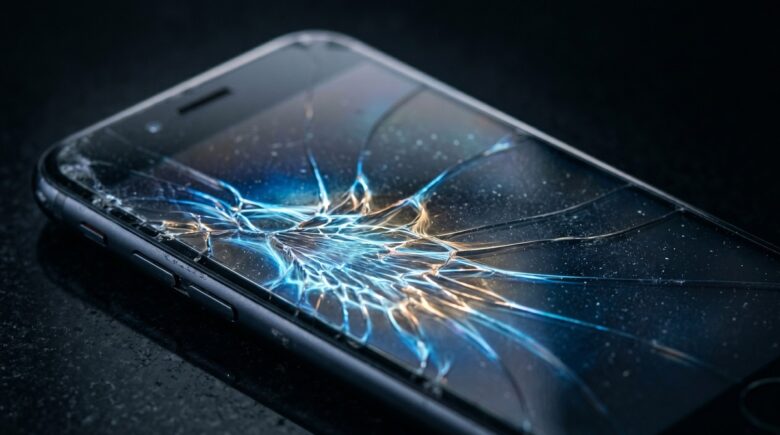
No. Current self-healing coatings repair only surface-level micro-scratches and shallow scuffs, typically less than 20 microns deep. Deep cracks that penetrate the glass substrate require conventional screen replacement, as no commercial self-healing glass substrate is yet in production.
How long does it take for a self-healing material to repair itself in a consumer device?
Heal times vary by material and damage severity. Shallow scratches on elastomer coatings like those used by LG may recover in 3 to 5 minutes. Deeper scuffs on polyurethane films used in Samsung foldables typically take 10 to 30 minutes, per Samsung’s official specifications. Full structural repair in battery binders can take up to 24 hours.
Are self-healing materials electronics safe for skin contact in wearables?
Yes, commercially deployed self-healing coatings in wearables have passed regulatory review under frameworks like ECHA’s REACH regulation in Europe and relevant EPA guidelines in the United States. Consumers should verify that products carry CE or FCC certification, which indicates compliance with applicable safety standards.
Which smartphones have self-healing screens right now?
None currently ship with a self-healing glass display layer in the primary screen. Samsung’s Galaxy Z Fold series uses self-healing protective films on hinge components, and LG’s self-healing back panel appeared in older models. Apple, Google, and Xiaomi have filed related patents but have not confirmed shipping implementations in display glass.
Will self-healing materials make phones more expensive?
In the short term, yes. Self-healing polymer coatings currently cost 4 to 8 times more than standard coatings, which is why adoption is concentrated in premium devices priced above $800. But IDTechEx research suggests the long-run premium for self-healing materials could settle closer to 30% once production scales, a pattern consistent with how most advanced materials get cheaper over a five-to-ten-year adoption curve.
Can self-healing materials reduce electronic waste?
Yes, and this is one of the strongest arguments for their adoption. Cracked screens and degraded batteries are the two most common reasons consumers replace devices prematurely. Self-healing coatings and battery binders directly address both failure modes, and IDTechEx estimates the technology can extend product lifetimes by up to 100%, which would meaningfully reduce the volume of e-waste entering landfills.
How big is the self-healing materials market expected to get?
The self-healing polymer market was valued at USD 3.45 billion in 2025 and is projected to grow at a 23.01% CAGR from 2026 through 2035, according to SNS Insider. Automotive & Transportation currently holds the largest share at about 36%, while Electronics & Consumer Goods is growing fastest.
Which industries use the most self-healing polymer material today?
Automotive, aerospace, and electronics manufacturers account for over 65% of global self-healing polymer demand, according to SNS Insider’s 2025 market report. Consumer electronics is a smaller but fast-expanding share of that total, concentrated in screen coatings, foldable hinges, and battery binders.
Do self-healing coatings affect how a device is insured or warrantied?
Not directly, though device insurers and manufacturers factor self-healing coatings into extended warranty pricing the same way a lender factors a borrower’s debt-to-income ratio (DTI) into a loan decision. Devices with self-healing screens or battery binders may see fewer accidental-damage claims over their service life, though this has not yet translated into standardized insurance discounts industry-wide.
Sources
- SNS Insider, Self-Healing Polymer Market Report (2025)
- IDTechEx, Self-Healing Materials 2025-2035: Technologies, Applications and Players
- MarketsandMarkets, Self-Healing Materials Market Global Forecast
- Science (AAAS), Self-Healing Electronic Skin Using Polymers, Stanford University
- Nature Reviews Materials, Intrinsic Self-Healing Polymers: Mechanisms and Applications
- European Commission, Ecodesign for Sustainable Products Regulation (ESPR)