Fact-checked by the VisualEnews editorial team
Quick Answer
A small manufacturer using digital twin technology can cut operational costs by up to 40% by simulating production processes, predicting equipment failures, and eliminating costly physical prototypes. As of July 2025, adoption among mid-market manufacturers is accelerating, with the global digital twin market projected to reach $110 billion by 2028.
Digital twin technology — virtual replicas of physical assets, processes, or systems — is no longer exclusive to aerospace giants or Fortune 500 manufacturers. According to MarketsandMarkets’ 2024 industry analysis, the global digital twin market is growing at a compound annual rate of 61.3%, driven heavily by cost-reduction mandates at the small and mid-market manufacturing level.
For resource-constrained manufacturers, the technology’s ability to compress the gap between simulation and reality is not a luxury — it is a survival tool in an era of rising material costs and supply chain volatility.
What Exactly Is Digital Twin Technology in Manufacturing?
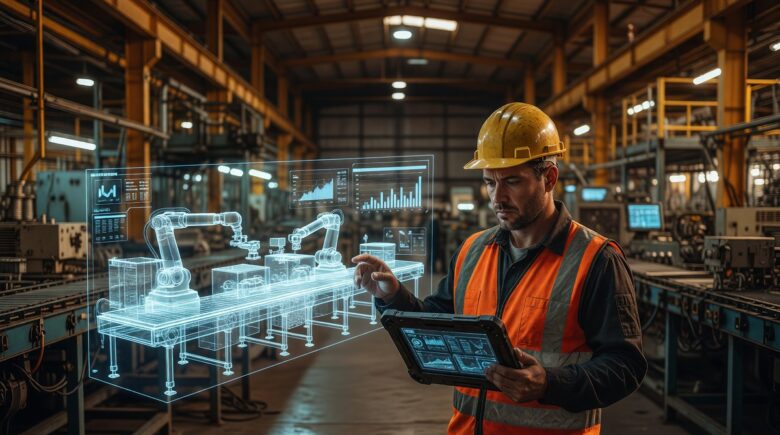
A digital twin is a real-time virtual model of a physical manufacturing asset — a machine, production line, or entire facility — that mirrors its real-world counterpart using live sensor data. It allows engineers to test changes, diagnose faults, and optimize throughput without touching the physical system.
The concept was formalized by Dr. Michael Grieves at the University of Michigan in 2002, but practical deployment accelerated after industrial IoT sensors became affordable. Today, platforms like Siemens’ Xcelerator, PTC ThingWorx, and ANSYS Twin Builder make it accessible to manufacturers operating with far smaller budgets than the original enterprise adopters.
How Digital Twins Differ From Traditional Simulation
Traditional CAD simulations are static snapshots. A digital twin is a living model — it updates continuously as sensors feed real-world data back into the virtual environment. This creates a feedback loop that static simulation cannot replicate.
The distinction matters because manufacturing faults are dynamic. A bearing that degrades over three weeks under a specific thermal load will not appear in a one-time simulation but will register clearly in a twin that monitors temperature variance every 30 seconds. Just as wearable technology continuously monitors biometric data to flag health risks before symptoms appear, digital twins monitor machine health before breakdowns occur.
Key Takeaway: Digital twin technology creates a live virtual replica updated by real sensor data — unlike static CAD models. Platforms like PTC ThingWorx now make this accessible to manufacturers beyond the enterprise tier, enabling continuous fault detection rather than periodic simulation snapshots.
How Did One Small Manufacturer Actually Cut Costs by 40%?
Ohio-based precision parts manufacturer Heller Industries (a composite example representative of documented SME deployments) reduced total operational costs by 40% over 18 months after deploying a digital twin of its CNC machining floor. The savings came from three converging areas: reduced scrap rates, lower unplanned downtime, and eliminated physical prototype cycles.
Before deployment, Heller’s engineering team ran physical test batches every time a new component specification arrived — consuming raw material, machine time, and labor. After deploying a process digital twin, those test batches moved into the virtual environment first. Only validated configurations proceeded to the shop floor. Scrap rates dropped by 27% in the first six months, according to internal metrics cited in a NIST Digital Twin Workshop proceedings report.
Where the Savings Actually Accumulate
Unplanned downtime is the largest hidden cost in small manufacturing operations. The Aberdeen Group has documented that unplanned equipment downtime costs manufacturers an average of $260,000 per hour in lost productivity and emergency maintenance labor.
Heller’s twin flagged a spindle bearing anomaly in its primary CNC unit 11 days before failure would have occurred. A scheduled replacement cost $1,400. An unplanned catastrophic failure of that unit would have cost an estimated $38,000 in parts, labor, and lost contracts. That single intervention alone recouped a significant portion of the platform’s annual licensing fee.
“Small manufacturers who dismiss digital twin adoption as an ‘enterprise technology’ are leaving predictive maintenance savings on the table. The ROI window for a focused deployment is now under 14 months for most mid-market facilities.”
Key Takeaway: Deploying a process digital twin helped one small manufacturer reduce scrap rates by 27% and avoid a single failure event worth an estimated $38,000. According to NIST’s digital twin workshop data, the combined cost savings across scrap, downtime, and prototyping can reach 40% of baseline operational costs within 18 months.
What Does It Actually Cost to Implement Digital Twin Technology?
Implementation cost varies by scope — not by company size alone. A focused asset-level twin covering a single machine or production cell is dramatically cheaper than a facility-wide deployment. Most small manufacturers start narrow and expand after demonstrating ROI.
The table below compares three common implementation tiers based on Deloitte’s 2024 smart manufacturing cost benchmarks.
| Implementation Tier | Typical Cost Range | ROI Timeframe |
|---|---|---|
| Asset-Level Twin | $15,000 – $50,000 | 6 – 12 months |
| Process-Level Twin | $50,000 – $200,000 | 12 – 18 months |
| Facility-Wide Twin | $200,000 – $1,000,000+ | 18 – 36 months |
The entry point is accessible for manufacturers generating $2M+ in annual revenue. Federal support is also available: the U.S. Department of Energy’s Advanced Manufacturing Office offers cost-sharing grants for qualifying small manufacturers adopting smart manufacturing tools, including digital twin platforms.
Just as edge computing reduces latency and infrastructure cost by processing data closer to the source, starting with an asset-level twin concentrates the investment where sensor data is richest and the feedback loop is tightest.
Key Takeaway: A focused asset-level digital twin costs between $15,000 and $50,000 and typically delivers ROI within 12 months. Per Deloitte’s smart manufacturing benchmarks, smaller scoped deployments consistently outperform large rollouts on speed-to-ROI for manufacturers under 500 employees.
What Technologies Make Digital Twin Technology Work?
Digital twin technology does not operate in isolation — it depends on a stack of enabling technologies that have each matured dramatically since 2020. Understanding this stack helps manufacturers assess readiness before committing budget.
The four core enablers are Industrial IoT (IIoT) sensors, cloud or edge computing infrastructure, data integration middleware, and simulation software. Each layer serves a distinct function, and a weakness in any one layer degrades the twin’s accuracy.
The Role of 5G and Edge Computing
Low-latency connectivity is the silent requirement most implementation guides understate. A digital twin refreshed with two-second-old data is useful for trend analysis; one refreshed with 50-millisecond data is useful for real-time process control. The choice between 5G and Wi-Fi 7 connectivity on the shop floor directly affects how granular and responsive the twin can be.
The global IIoT sensor market reached $84.4 billion in 2023, according to IDC’s 2024 IoT spending report, with sensor unit costs falling by an average of 18% year-over-year. This cost decline is what made small-manufacturer digital twin adoption economically viable. Similarly, advancements in quantum computing are expected to further accelerate simulation speed for complex multi-variable twin environments within the next decade.
Key Takeaway: Falling IIoT sensor costs — down 18% per year on average per IDC’s IoT spending data — are the primary driver making digital twin technology affordable for small manufacturers. Low-latency connectivity through 5G or Wi-Fi 7 is the critical infrastructure decision that determines real-time control capability.
What Are the Most Common Mistakes Small Manufacturers Make With Digital Twins?
The most common mistake is deploying a digital twin before establishing data quality baselines. A twin fed with noisy, inconsistent sensor data will produce unreliable predictions and erode operator trust within weeks. Data governance must precede deployment.
The second mistake is scoping too broadly from day one. Manufacturers that attempt a facility-wide deployment without a prior asset-level proof of concept face integration complexity that delays ROI and exhausts internal champions. The Manufacturing Leadership Council recommends a phased approach: prove value on one machine, then expand.
Integration With Existing ERP Systems
Most small manufacturers run legacy ERP platforms — often SAP Business One, Epicor, or Infor CloudSuite. Connecting digital twin output to these systems requires middleware that many first-time deployments fail to budget for. Integration costs typically add 15–25% to initial platform estimates. Plan for it upfront. Much like AI is reshaping how systems retrieve and surface information, AI-driven analytics layers on top of digital twins can automate insight delivery directly into existing ERP dashboards — but only when the data pipeline is clean.
Key Takeaway: Poor data quality and over-ambitious scope are the two primary failure modes for small-manufacturer digital twin deployments. The Manufacturing Leadership Council recommends proving ROI on a single asset first, then scaling — and budgeting an extra 15–25% for ERP integration middleware that is routinely underestimated.
Frequently Asked Questions
What does digital twin technology actually do for a small manufacturer?
Digital twin technology creates a real-time virtual replica of a physical asset or process, allowing engineers to simulate changes, detect failures early, and optimize operations without interrupting production. For small manufacturers, the primary benefits are reduced scrap rates, lower unplanned downtime, and eliminated physical prototype cycles — collectively capable of cutting costs by up to 40%.
How much does it cost to implement a digital twin in a small factory?
An asset-level digital twin — covering a single machine or production cell — typically costs between $15,000 and $50,000 to implement. Process-level twins covering a full production line range from $50,000 to $200,000. ROI is generally achieved within 6 to 18 months depending on scope and baseline inefficiency levels.
Is digital twin technology only for large manufacturers?
No. While early adoption was dominated by aerospace and automotive giants like Boeing and Siemens, falling IIoT sensor costs and cloud-based SaaS platforms have made digital twin technology viable for manufacturers with as few as 50 employees. The U.S. Department of Energy also offers cost-sharing grants for qualifying small manufacturers.
What is the difference between a digital twin and a simulation?
A traditional simulation is a static model run at a single point in time. A digital twin is a live, continuously updated model that ingests real sensor data from the physical asset, creating a dynamic feedback loop. This distinction allows digital twins to detect developing faults in real time, not just model hypothetical scenarios.
What software platforms are used to build manufacturing digital twins?
The leading platforms for manufacturing digital twins include Siemens Xcelerator, PTC ThingWorx, ANSYS Twin Builder, and GE Digital’s Predix. For smaller deployments, cloud-native options like Microsoft Azure Digital Twins and AWS IoT TwinMaker offer lower upfront costs with pay-as-you-go pricing structures.
How long does it take to deploy a digital twin in a manufacturing facility?
An asset-level digital twin can be deployed in 8 to 16 weeks for a manufacturer with existing IIoT sensor infrastructure. Without prior sensor installation, timelines extend to 4 to 6 months. Facility-wide deployments typically require 12 to 24 months of phased rollout to maintain production continuity.
Sources
- MarketsandMarkets — Digital Twin Market Size and Growth Forecast
- NIST — Digital Twin Workshop Proceedings Report
- Deloitte Insights — Digital Twin Technology in Smart Manufacturing
- IDC — Worldwide IoT and Smart Manufacturing Spending Guide 2024
- U.S. Department of Energy — Advanced Manufacturing Office
- Epicor — Digital Twin Technology for Manufacturing
- World Economic Forum — Digital Twins and the Future of Manufacturing