The Order That Actually Makes Sense When Paying Off Debt
When you’re carrying debt across multiple accounts — a credit card at 22%, a car loan at 6%, a student loan at 4.5% — the instinct is often just to throw whatever you can at all of them simultaneously and hope for the best. It feels fair, balanced, and somehow less overwhelming than having to pick. But spreading your extra money across every balance is usually the slowest and most expensive way out of debt.
The order in which you pay off debt matters more than most people realize. The same total amount of extra payments, applied in the right sequence, can save thousands of dollars in interest and cut years off your timeline. The trick is understanding which order actually fits your situation — and then committing to it instead of second-guessing every month.
📌 For more practical strategies on everyday financial decisions, explore our complete guide to managing money in real life.
Why Paying Off Debt in the Right Order Matters
Interest is what makes debt expensive. Every month you carry a balance, your lender charges you a percentage of what you owe. The higher that percentage, the faster the cost grows. When you make minimum payments across the board without a strategic priority, the most expensive debt just keeps accumulating interest while you make slow, broad progress everywhere.
Here’s a concrete example. Say you have two debts: a $3,000 credit card balance at 22% APR and a $6,000 personal loan at 8% APR. If you have $200 extra each month to apply beyond minimums, spreading it equally means you’re reducing the cost of the 8% loan about as aggressively as the 22% loan. But every dollar applied to the credit card saves you 22 cents per year in interest. Every dollar applied to the personal loan saves you 8 cents. The math strongly favors attacking the higher-rate debt first.
This isn’t just theory. A study published by NerdWallet found that borrowers who followed an intentional payoff sequence saved an average of 15% more in interest compared to those who made random or equal extra payments. The difference adds up quickly, especially when credit card rates are in the high teens or above 20%.
The Two Core Strategies: Avalanche and Snowball
Most structured debt payoff advice organizes around two approaches. Understanding both — and the logic behind each — helps you choose the one you’ll actually follow through.
The Debt Avalanche Method
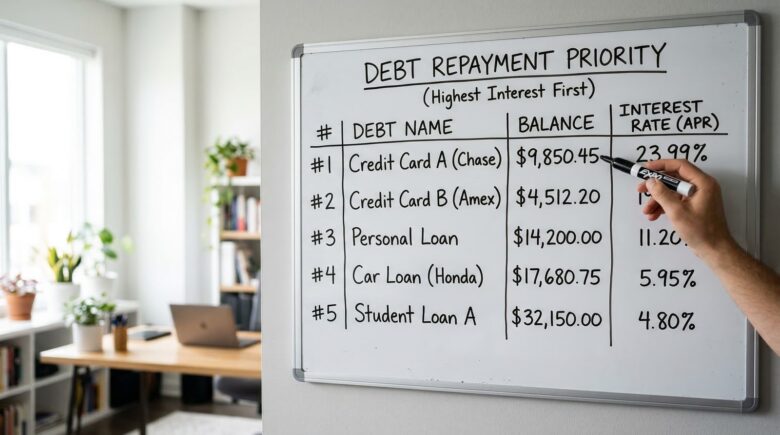
The avalanche method is mathematically optimal. You list all your debts by interest rate from highest to lowest, make minimum payments on everything, and direct all additional money toward the highest-rate balance. Once that balance is eliminated, you roll that payment into the next-highest-rate debt, and so on.
This approach minimizes the total interest you pay over the life of your debt. If you have a credit card at 24% APR sitting on top of your pile, every extra dollar applied there is working as hard as it possibly can. Analytical thinkers tend to respond well to this method because the numbers are clear: you can calculate exactly how much interest you’re avoiding and watch that figure grow over time.
The main challenge with the avalanche is patience. If your highest-rate debt also has a large balance, it can take months or even years before you eliminate your first account. During that time, the psychological reward is limited. You’re making progress — the math proves it — but you don’t get the satisfaction of crossing a debt off your list.
The Debt Snowball Method
The snowball method flips the priority: smallest balance first, regardless of interest rate. You make minimums across everything and put all extra payments toward your smallest debt. When it’s gone, you roll that freed-up payment into the next smallest. The payment “snowballs” as you eliminate accounts.
Dave Ramsey popularized this approach, and research in behavioral economics supports why it works for many people. A 2012 study in the Journal of Marketing Research found that people who focused on eliminating individual debts were more likely to stay on track and ultimately pay off more debt than those who optimized for interest minimization. The psychology of completion — of actually zeroing out an account — generates momentum that abstract interest savings don’t always provide.
The tradeoff is cost. If your smallest balance is also a low-rate debt and your highest-rate debt is much larger, you may pay significantly more in interest using the snowball. But paying more interest on a plan you actually follow beats paying less on a plan you abandon.
Which Method Is Right for You?
There’s no universal answer, but there are some useful signals:
- Choose the avalanche if: You’re analytically motivated, your highest-rate debt is also a reasonably achievable balance to eliminate within 6–12 months, and you can stay committed without frequent visible wins.
- Choose the snowball if: You’ve tried budgeting plans before and stopped due to frustration, you have several small debts you could eliminate quickly, or you know that a psychological win early on will keep you going.
- Consider a hybrid if: Your interest rates are clustered closely together (say, everything between 6% and 10%), in which case the snowball’s psychological benefits likely outweigh the small mathematical difference. Or if you have one or two very small balances you can eliminate in 1–2 months — do those first regardless of rate, then switch to avalanche.
The most important thing is to pick one approach and stick with it. Switching strategies mid-course typically means restarting the momentum you’ve built. Make a decision, set up automatic payments, and let the plan run. And remember — if you’re still figuring out whether debt is something to feel guilty about or simply solve, the framing matters: debt is a math problem, not a moral failure.
Before You Pick a Strategy: Get These Basics Right
The avalanche versus snowball debate is actually a secondary conversation. There are a few foundational things to handle first that will make either strategy more effective.
Build a Minimum Emergency Fund First
Before aggressively attacking debt, set aside a small cash buffer — typically $500 to $1,000. This isn’t a full emergency fund. It’s a backstop that prevents a single unexpected expense from sending you right back into high-interest debt. Without it, a $600 car repair mid-debt-payoff undoes months of progress.
Once your high-interest debt is eliminated, you can build that buffer into a proper emergency fund. But for now, even a small cushion changes your mathematical risk profile significantly. If building an emergency fund feels out of reach given your current budget, even $25 a week adds up faster than most people expect.
Automate Your Minimum Payments
Set up automatic minimum payments on every account that isn’t your current priority debt. This eliminates late fees, protects your credit score, and removes the cognitive load of tracking multiple due dates. Then you have one simple job each month: direct extra money to your target debt.
Check for Consolidation Opportunities
Before choosing a payoff order, see if you can improve the interest rate landscape first. Options worth exploring:
- Balance transfer cards with 0% introductory APR. Many cards offer 12–21 months interest-free on transferred balances. If you can pay off the balance within the promotional window, you eliminate interest entirely. Watch for balance transfer fees (typically 3–5% of the transferred amount) and ensure you won’t be left with a balance when the promotional rate expires.
- Personal loans for credit card consolidation. Personal loans often carry lower rates than credit cards — sometimes significantly so. Consolidating $10,000 in credit card debt at 22% into a personal loan at 10% materially changes your payoff math.
- Income-driven repayment for student loans. Federal student loan repayment plans that cap payments based on income free up cash that can be redirected to higher-rate consumer debt.
The Consumer Financial Protection Bureau offers free resources to evaluate debt consolidation options without pressure from lenders.
The Role of Your Budget in the Debt Payoff Equation
A debt payoff strategy only works if there’s actual money to apply to debt. This sounds obvious, but it’s worth stating: any payoff method assumes you can consistently direct extra funds beyond minimums to your priority balance. If the budget doesn’t support that, the method is irrelevant.
Before committing to either approach, look honestly at your monthly cash flow. What expenses could be temporarily reduced? What income opportunities exist — even small ones, like a few hours of freelance work or selling items you no longer need? Even an additional $50 per month applied consistently makes a real dent over 12–24 months.
If your budget is under genuine pressure every month, the issue isn’t choosing between avalanche and snowball — it’s what to do when paying bills is already a crisis. Stabilizing the basics comes before optimizing a payoff sequence.
Tracking Progress Without Obsessing Over It
One of the behavioral hazards of debt payoff is checking progress too frequently during slow stretches. In the early months of the avalanche method especially, your target balance may not drop dramatically — minimum payments on multiple accounts plus modest extra payments take time to compound into visible change.
A useful approach: check your totals once a month, not daily or weekly. Record your total debt balance each month on a simple tracker — a spreadsheet row or a note in your phone. The trend line over six months will show real progress even when individual account balances feel stuck. Seeing total debt shrink month over month is motivating in a way that doesn’t require the avalanche or snowball to deliver dramatic early wins.
Modern banking apps and budgeting tools make this easier. Many now include built-in debt payoff calculators that let you compare outcomes across different strategies using your actual balances and rates. Running those projections once — before you start — gives you a realistic sense of your timeline and reduces anxiety about the middle months when progress feels slow.
What to Do When Your Plan Gets Disrupted
Almost everyone’s debt payoff plan hits a setback at some point — a job change, a medical bill, a period where cash flow just tightens. The instinct is often to abandon the plan entirely, because it “didn’t work.” That’s usually the wrong call.
A better approach: treat disruptions as pauses, not failures. When the setback is resolved, return to the same strategy you were following. You don’t need to restart from zero; you just resume. If the disruption added new debt, reassess where that new balance fits in your payoff order and adjust accordingly. Small, consistent progress on debt compounds over time — the months you contributed even a modest extra payment are not wasted months.
Related Reading
- Debt Isn’t a Moral Failure — It’s a Math Problem
- A Simple Money System for People Who Hate Budgeting
- How Credit Scores Actually Work
Frequently Asked Questions
Does it really matter which debt I pay off first if I’m making all my minimum payments?
Yes, significantly. Minimum payments are designed to keep accounts current, not to eliminate debt efficiently. They’re calculated to maximize the interest you pay over time. Without a strategy for directing extra funds, you can spend years making minimum payments while barely reducing principal balances — especially on high-interest credit cards.
I have a mix of credit cards, a car loan, and student loans. Where do I start?
Rank by interest rate for the avalanche method or by balance for the snowball. For most people, credit cards sit at the top of the avalanche list because their rates are typically the highest. Car loans and student loans, particularly federal student loans, often carry lower rates and may benefit from income-driven repayment adjustments rather than aggressive extra payments.
Should I pay off debt before investing or saving for retirement?
This depends on your debt’s interest rate. If your employer offers a 401(k) match, always contribute enough to capture the full match first — it’s an immediate 50–100% return. Beyond that, if your debt carries interest above roughly 6–7%, paying it down typically beats the expected return from investments. Below that threshold, investing while carrying low-rate debt may make mathematical sense.
Can I negotiate a lower interest rate on my credit card?
Yes, and it’s more common than people realize. If you have a solid payment history with a lender, calling their customer service and directly asking for a rate reduction often works. Card issuers would rather reduce your rate than lose you as a customer or see you default. It doesn’t always succeed, but a single phone call could be worth hundreds of dollars annually in interest savings.
Marcus Tran is a personal finance educator and former credit union advisor who spent 15 years helping working families build realistic financial plans. His writing focuses on practical, no-judgment strategies for people dealing with real-world budget challenges. He’s based in Atlanta, GA.