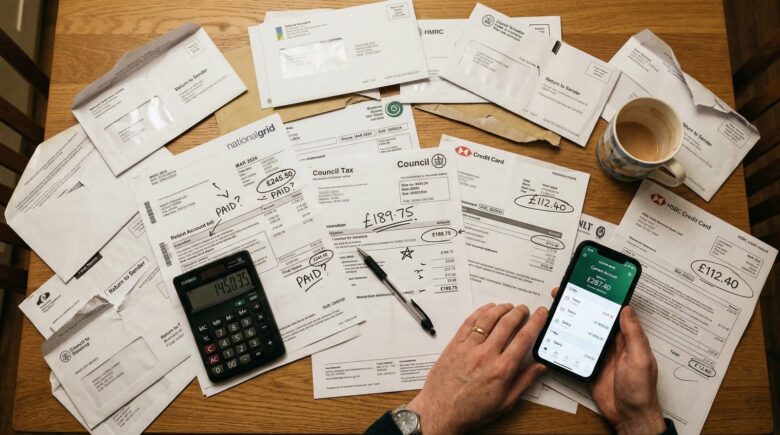
When Paying Bills Becomes a Monthly Crisis
You open your bank account app on the 25th of the month and feel that familiar knot in your stomach. Three bills are due tomorrow, rent is coming up in five days, and your checking balance looks painfully low. You start doing the math in your head — who gets paid first, who can wait — and the whole exercise turns something routine into a source of real dread.
This scenario repeats itself for millions of households every single month. It’s not because those people are careless with money. It’s because the timing of bills, the rhythm of income, and the constant low-level financial stress create a system that’s very easy to fall behind in — and very hard to escape without intentional changes.
📌 For more practical strategies on everyday financial decisions, explore our complete guide to managing money in real life.
According to a 2023 Federal Reserve survey, nearly 40% of Americans would struggle to cover a $400 emergency expense. For a lot of people, monthly bill payment stress isn’t a temporary problem waiting to resolve itself. It’s the baseline. But it doesn’t have to stay that way.
Why Your Paycheck Disappears Before Month’s End
The root of the monthly crisis is often a timing problem, not just an income problem. Most employers issue paychecks bi-weekly or semi-monthly. But your bills don’t follow that schedule. Rent hits on the first. Utilities land mid-month. Subscriptions scatter throughout the calendar. Insurance auto-drafts whenever it was set up. The result is a constant juggling act — money arriving in two chunks, obligations leaving in twelve different directions.
This misalignment alone can make a budget feel broken even when the total income and total expenses theoretically balance out. If your biggest bill falls two days before your paycheck, you’re in crisis mode even when you’re technically not overspending for the month.
The problem compounds quickly when unexpected expenses appear — a car repair, a medical copay, a school supply list, a broken appliance. These costs don’t wait for a convenient moment. They arrive randomly and demand immediate resolution. Without any buffer, you’re forced to choose which bills get paid first and which can wait — a game that typically leads to late fees and damaged credit scores over time.
The Weight of Structural Financial Pressures
It’s important to recognize that monthly bill crisis isn’t primarily a behavior problem. For many households, it’s a structural problem — one created by wage stagnation, rising housing costs, and debt loads that leave almost no room for error.
The Federal Reserve Bank of New York has reported that millennials carry an average of $33,000 in student loan debt. For borrowers on income-driven repayment plans, that might mean $200-$400/month leaving the budget every month before anything else. Combined with housing costs that now average 30-35% of take-home pay in major cities, the math for comfortable living simply doesn’t work out for many households — even those with steady employment.
Add in the fact that many millennials entered the workforce during or after the 2008 recession, spent years in underemployment or contract work, and were then hit by the COVID-19 pandemic before they’d had much chance to build reserves. The financial fragility many people experience today isn’t the result of poor decisions. It’s the accumulation of circumstances that left little room for savings or stability.
Understanding this doesn’t make the bills go away, but it does change how you approach solving the problem. You’re not fixing a personal failing. You’re redesigning a system that wasn’t built for your situation.
Lifestyle Inflation: The Subtle Drain
One pattern that quietly makes monthly bill management harder over time is lifestyle inflation — the tendency for spending to rise alongside income, often without conscious intention.
You get a raise, and suddenly the premium coffee subscription seems affordable. You upgrade your apartment. You add a streaming service or two. Each decision feels reasonable in isolation, but collectively they absorb the income growth that could have created breathing room. A year later, you’re making more money and somehow still running out before the month ends.
Digital payment systems have made this worse. One-click purchasing removes the psychological friction of handing over cash. Subscriptions auto-renew without prompting a conscious spending decision. A 2024 study found that Americans underestimate their monthly subscription spending by an average of $133. That gap — between what you think you’re spending and what you’re actually spending — is often the difference between a month that works and one that doesn’t.
Social pressure amplifies the effect. When your reference group is taking trips, dining out, and upgrading their wardrobes, the baseline for “normal” spending shifts upward. It takes real intentionality to not let your spending drift alongside it.
The Emergency Fund Gap and Why It Matters So Much
Most financial experts recommend maintaining three to six months of expenses in an emergency fund. In practice, a 2023 Bankrate survey found that only 44% of Americans could cover a $1,000 emergency from savings. For many households, that emergency fund simply doesn’t exist.
Without a buffer, every unexpected expense becomes a crisis that derails the entire monthly budget. The car repair goes on a credit card. Interest charges accumulate. Minimum payments increase next month. Now you’re paying for last month’s emergency while trying to cover this month’s bills. The cycle feeds itself, and the hole gets deeper with every unexpected expense.
This is one of the most important dynamics to interrupt, even if the progress is slow. A $25 automatic transfer per paycheck to a separate savings account doesn’t feel significant — but after a year, that’s $650 available for a tire replacement or a medical bill that would otherwise have gone on credit. Starting small isn’t settling. It’s the realistic path to a buffer that actually exists when you need it.
If you’re looking at the big picture, it helps to understand why emergency funds work the way they do and why the boring, gradual approach is almost always more effective than waiting until you can save “a real amount.”
Strategic Bill Management: The Alignment Approach
One of the most practical and underused tools for managing monthly bill stress is simply restructuring when you pay your bills to better match when you get paid.
Most service providers — utilities, internet, phone carriers, insurance companies — will accommodate requests to change your due date. It typically takes one phone call and a few weeks to take effect. If you get paid on the 1st and 15th, having your major bills due within a few days of each payday eliminates the timing mismatch that creates so much monthly anxiety.
Here’s a framework for restructuring your bill schedule:
- List every recurring bill and its current due date. Include subscriptions, insurance, loan payments, and utilities alongside rent or mortgage.
- Group them by paycheck. Assign roughly half your fixed obligations to fall after each paycheck. This prevents one payment cycle from carrying more weight than the other.
- Contact each provider to request a due date change. Most will say yes. For those that won’t, build a small timing buffer into that paycheck’s spending plan.
- Set up autopay after aligning dates. Autopay is powerful, but it only helps once your due dates are aligned with your income. Setting it up before that alignment just automates the timing problem.
This one structural change — aligning bills with income — can significantly reduce the chronic low-level stress of monthly money management without requiring any change to your total spending.
Using Technology to Gain Control
Modern fintech tools provide more visibility into your money than any previous generation has had access to. The challenge isn’t availability — it’s using these tools actively rather than passively.
Budgeting apps like YNAB (You Need A Budget), PocketGuard, and others connect to your accounts and automatically categorize transactions in real time. This visibility can reveal patterns you’d otherwise miss — which weeks you tend to overspend, which categories consistently run over, and where the disconnect between your mental budget and your actual spending lives.
Some banks and credit unions now offer early direct deposit, giving you access to your paycheck up to two days before the official payday. This modest timing shift can prevent overdraft fees when bills arrive just before your official payday — and those overdraft fees, compounding month after month, are a significant and often invisible drain on tight budgets.
Automated savings tools like Digit or Qapital analyze your income and spending patterns, then move small amounts to savings when the numbers suggest you can afford it. These micro-transfers happen without requiring willpower or a conscious decision each time, and the cumulative effect builds a buffer faster than most people expect.
Government resources can also bridge tight months. Programs like LIHEAP help with energy bills. SNAP benefits can meaningfully reduce food costs. Many states offer additional utility assistance that isn’t widely advertised. The Consumer Financial Protection Bureau maintains a database of available resources at consumerfinance.gov, and taking advantage of these programs isn’t a failure — it’s exactly what they exist for.
Breaking the Cycle: A Realistic Starting Point
The goal isn’t to fix everything at once. Trying to simultaneously restructure your bills, build an emergency fund, cut expenses, and eliminate debt is overwhelming and usually leads to doing none of it well. A more effective approach is to pick one thing, do it completely, and build from there.
Here’s a sequenced approach for households dealing with monthly bill stress:
- Stop the bleeding first. Identify any recurring expenses you’re paying for but not actively using. Subscriptions, especially, tend to accumulate silently. Canceling two or three unused subscriptions can free up $40-$80/month immediately — without affecting your daily life at all.
- Align one bill with your pay schedule. Pick your highest-stress bill — the one that most often causes timing anxiety — and call to change the due date. One successful change builds confidence for the rest.
- Set up one automatic transfer to savings. Even $25 per paycheck. The amount matters less than establishing the habit and the account. You can increase it later.
- Build a minimal timing buffer. Once you’ve freed up any subscription money, direct it toward keeping a small cushion — even $100-$200 — in your checking account. This absorbs small timing misalignments before they become overdrafts.
For more context on the bigger picture of why getting ahead financially feels so hard, it helps to understand the difference between getting by and getting ahead — and why the path from one to the other is more about systems than it is about income alone.
It’s also worth knowing that living paycheck to paycheck doesn’t mean you’re failing. Given the economic pressures most households face, it means you’re operating in a system with very thin margins. That’s a real constraint — but it doesn’t mean change isn’t possible. It just means the changes need to be structural and sustainable, not all-or-nothing.
And if you’re carrying credit card debt from past months of crisis, understanding the most effective order for paying off debt can help you direct any freed-up cash in the direction that makes the most mathematical and psychological sense.
Related Reading
- Debt Isn’t a Moral Failure — It’s a Math Problem
- The Right Order to Pay Off Debt (Avalanche vs Snowball)
- What Actually Breaks a Budget — It’s Not Coffee
- A Simple Money System for People Who Hate Budgeting
Frequently Asked Questions
What if I’ve already tried budgeting apps and they don’t seem to help?
Apps provide information but not action. If tracking your spending hasn’t changed the outcome, the issue is likely structural — a timing mismatch between bills and income, insufficient buffer in your checking account, or expenses that genuinely exceed your income at the level you’re currently at. Diagnosis is different from treatment. Use the app to identify the root cause, then focus on structural changes like aligning due dates or cutting recurring expenses rather than tracking alone.
Is it better to pay bills on autopay or manually?
Autopay prevents late fees and credit score damage — which are real and significant costs. But it only works well once your bill due dates are aligned with your income and you’re maintaining a small cushion in your checking account. Setting up autopay on a misaligned schedule with no buffer is a recipe for overdraft fees. Get the alignment right first, then automate.
How do I start saving for emergencies when I’m already stretched thin?
Start with an amount small enough that you genuinely won’t miss it — even $10 or $25 per paycheck. Put it in a separate account that’s inconvenient to access, ideally at a different bank from your checking account. The goal in the early stages isn’t growth — it’s establishing the habit and account structure. Once your first $100 is sitting there untouched, you have proof the system works and a reason to increase the transfer.
Should I prioritize paying off debt or building an emergency fund?
Do both simultaneously, even if both amounts are small. Building at least a small emergency buffer while paying down debt prevents the cycle where every unexpected expense goes back on the credit card, negating your debt repayment progress. A $500-$1,000 emergency fund alongside minimum debt payments is generally more effective than throwing everything at debt with no safety net — because the safety net prevents you from re-accumulating the same debt when the next emergency hits.
Marcus Tran is a personal finance educator and former credit union advisor who spent 15 years helping working families build realistic financial plans. His writing focuses on practical, no-judgment strategies for people dealing with real-world budget challenges. He’s based in Atlanta, GA.