Why Being “Bad With Money” Is Often a Systems Problem
Quick Answer
Being “bad with money” is frequently less a personal failing and more a predictable outcome of financial systems — including fee-driven banking practices, predatory lending products, and structural wage stagnation — that were never designed to help lower- and middle-income people succeed. Recognizing the systemic roots of financial struggle doesn’t eliminate personal responsibility, but it does shift the diagnosis from self-blame to productive action.
You’ve probably said it, or at least thought it: I’m just bad with money. Maybe after an overdraft notice. Maybe after checking your credit card balance at the end of a month that somehow got away from you. Maybe just as a low-grade, constant belief about yourself that you’ve carried for years.
That belief feels personal. It feels like a character flaw — a lack of discipline, a failure of self-control, evidence that you just don’t have what it takes to be financially responsible. But what if that story isn’t accurate? What if being “bad with money” is, in many cases, a predictable outcome of systems that were never designed to help you succeed — and in some cases were designed to profit from your struggles?
📌 To dig deeper into how emotions and beliefs shape your finances, read our complete guide to your relationship with money.
Key Takeaways
- Millennials earn approximately 20% less than baby boomers did at the same stage of life, adjusted for inflation, according to Pew Research Center — making structural wage stagnation, not personal discipline, the defining financial challenge of a generation.
- Just 9% of bank account holders paid 84% of all overdraft fees collected in the U.S., according to the Consumer Financial Protection Bureau (CFPB) — overwhelmingly low-income consumers already under financial strain.
- U.S. banks collected approximately $8.8 billion in overdraft fees in a single year, representing a massive transfer of wealth from financially vulnerable customers to highly profitable institutions.
- Payday loans carry annualized interest rates (APR) of 300–400% in many states, trapping borrowers in cycles of debt that are mathematically difficult to escape without outside intervention.
- Nearly 36% of U.S. workers now participate in the gig economy through primary or secondary work, according to Gallup, yet financial infrastructure — from FICO Score calculations to mortgage underwriting — remains built for traditional W-2 employees.
- Chronic financial scarcity reduces cognitive bandwidth available for long-term decision-making, a documented psychological effect that behavioral economists have linked directly to the conditions of financial stress — not to personal character.
This isn’t about making excuses. It’s about accurately diagnosing the problem. Because when you spend all your energy blaming yourself for outcomes that were partly engineered by broken systems, you exhaust yourself solving the wrong problem.
Related: Your Money Story Didn’t Start With You
The Cultural Myth of Personal Financial Failure
American culture has a deep, almost reflexive belief in individual financial responsibility. We celebrate the self-made success story. We tell people who are struggling that they just need more discipline, better habits, or a stricter budget. The implication is always the same: if you’re financially unstable, you probably did something wrong.
This narrative is not only oversimplified — it’s contradicted by data. According to research from the Pew Research Center, millennials earn approximately 20% less than baby boomers did at the same stage of life, adjusted for inflation. Meanwhile, housing costs have increased dramatically, healthcare expenses have ballooned, and student debt has become a defining financial burden for an entire generation. These are not individual failures. These are structural shifts.
No amount of personal discipline compensates for wages that don’t keep pace with the cost of living. You can do everything “right” — follow the budgeting advice, cut back on discretionary spending, automate your savings — and still find yourself financially stretched because the math at the structural level simply doesn’t add up.
“The framing of financial failure as a personal moral shortcoming is one of the most consequential myths in American economic life. When wages stagnate, housing costs surge, and debt-to-income ratios become structurally unworkable, blaming individuals for the resulting distress isn’t just wrong — it actively prevents the systemic reforms that could actually help,” says Dr. Terri Callahan, Ph.D., Associate Professor of Behavioral Economics, University of Illinois Chicago.
Financial Literacy Treats the Wrong Problem
One of the most well-intentioned but misguided responses to widespread financial struggle is the push for financial literacy education. The argument goes: if people just understood compound interest, how credit scores work, and how to build a budget, they’d make better financial decisions.
There’s value in financial knowledge. But financial literacy education operates on a flawed premise: that people fail financially because they lack information. In reality, many people struggle because they lack resources, not understanding. You can have a perfect grasp of how a high-yield savings account works and still be unable to put money into one because every dollar is already committed to keeping the lights on.
The financial literacy approach treats systemic inequality as an education problem — something that can be solved by teaching individuals to navigate a broken system more skillfully. It places the burden entirely on the person being failed by the system, rather than on the system itself. And it subtly reinforces the idea that those who struggle simply didn’t learn enough, rather than examining what structural barriers prevented them from getting ahead.
The Hidden Costs of Having Less
One of the most insidious aspects of our financial system is that it is genuinely, measurably more expensive to be poor. This isn’t a metaphor. It’s a documented pattern with real dollar costs.
- Overdraft fees: A single overdraft can cost $25–$35 per transaction. The Consumer Financial Protection Bureau (CFPB) found that just 9% of account holders paid 84% of all overdraft fees — overwhelmingly low-income consumers who are already financially stretched. Institutions including Chase, Bank of America, and Wells Fargo have faced regulatory scrutiny over these practices.
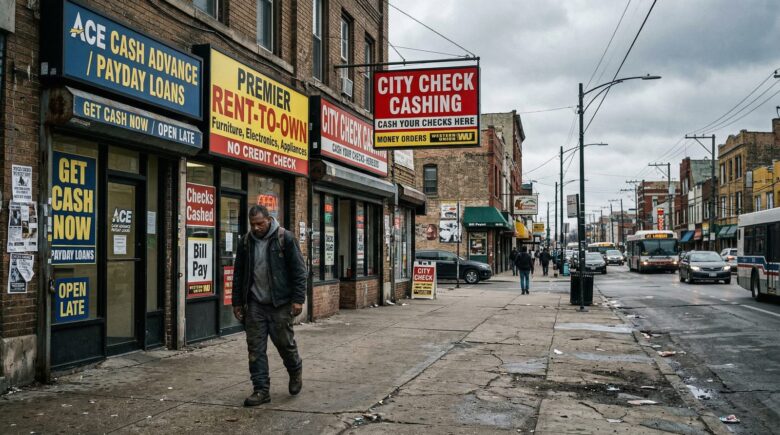
- Check-cashing services: People without bank accounts — often those who’ve been penalized out of the banking system — pay 1–3% of every paycheck just to access their own money. The Federal Deposit Insurance Corporation (FDIC) estimates that approximately 5.9 million U.S. households remain unbanked, disproportionately from lower-income communities.
- Payday loans: These products carry annualized interest rates (APR) of 300–400% in many states, trapping borrowers in cycles of debt that are mathematically nearly impossible to escape without outside intervention. The CFPB has repeatedly flagged payday lending as one of the most harmful consumer financial products in widespread use.
- Security deposits and upfront costs: Renting an apartment, starting utility service, or even buying a car often requires significant upfront cash that people with limited liquidity don’t have — forcing them into more expensive alternatives. A low FICO Score compounds this by triggering higher security deposit requirements or loan rejections entirely.
These costs function as a poverty tax. The financial system extracts more money from people who have less of it — and then calls the resulting financial instability a personal failing. The shame people carry about money is often rooted in a system that was never neutral to begin with. If you want to understand the quiet shame people carry about money, this is a significant part of the story.
| Financial Product or Cost | Who It Primarily Affects | Typical Cost or Rate | Annual Industry Revenue |
|---|---|---|---|
| Bank overdraft fees | 9% of account holders pay 84% of all fees (CFPB) | $25–$35 per transaction | ~$8.8 billion (2021) |
| Payday loan APR | Predominantly low-income, unbanked, or credit-constrained borrowers | 300–400% annualized APR | ~$9 billion annually (CFPB) |
| Check-cashing fees | ~5.9 million unbanked U.S. households (FDIC) | 1–3% of each check | ~$1.6 billion annually |
| Buy-now-pay-later late fees | Younger consumers, lower credit score borrowers | $7–$15 per missed payment; some products charge 29.99% APR after deferral | ~$1 billion+ annually (CFPB estimate) |
| Subprime auto loan interest | Borrowers with FICO Scores below 580 | 14–25% APR vs. 5–7% for prime borrowers | Tens of billions in excess interest annually |
How Banking Systems Are Designed to Generate Fees
Modern banking should, in theory, make managing money easier. But many standard banking practices create costly mistakes that are difficult to anticipate or avoid.
Banks have historically processed transactions in order of largest to smallest rather than chronologically — a practice that maximizes overdraft fees by depleting accounts faster. Mobile apps may display an “available balance” that doesn’t reflect pending transactions, creating a misleading picture of what you actually have. Payment processing times vary unpredictably: a check might clear in one day or four, and there’s no consistent way to know in advance.
A 2021 analysis found that U.S. banks collected approximately $8.8 billion in overdraft fees in a single year. That figure, while lower than previous peaks, represents a massive transfer of wealth from struggling customers — the exact people most harmed by a sudden fee — to highly profitable institutions. The Federal Reserve has acknowledged the disproportionate burden these fees place on low-balance account holders, and the CFPB under successive administrations has pushed for limits on overdraft fee structures at large banks, with mixed legislative results. This is not an accident of design. It is the design.
When you overdraft an account because a payment processed faster than expected, that’s not being bad with money. That’s being caught in a system engineered around information asymmetry — where the institution knows exactly when transactions will clear, and you don’t. Some fintech companies — including SoFi and Chime — have built products specifically around eliminating overdraft fees and offering early direct deposit access, which illustrates that the fee-first model is a choice, not a technical necessity.
“When we look at who actually pays overdraft fees, it becomes very clear very quickly that these aren’t random mistakes being made by financially careless people. They’re predictable outcomes for account holders who are living close to their balance — and the fee structures at many large institutions are calibrated to maximize revenue from exactly those customers,” says Marcus J. Holloway, J.D., Senior Fellow in Consumer Financial Policy, Georgetown University Law Center.
Government Services That Create Barriers Instead of Support
For people navigating financial hardship, government assistance programs are essential. But accessing them often requires navigating systems that seem designed to discourage use rather than facilitate it.
Applying for benefits can mean printing and mailing documents, visiting physical offices during hours that conflict with work schedules, waiting weeks for eligibility determinations, and reapplying repeatedly as circumstances change. Digital portals, where they exist, are often clunky, confusing, and not optimized for mobile devices — the primary way many lower-income households access the internet.
These friction points have real consequences. People who are entitled to support don’t receive it — not because they don’t qualify, but because the application process is too burdensome to complete while also managing work, childcare, and the daily logistics of financial stress. And when people fall through these cracks, the narrative often blames them for not taking advantage of available resources, rather than acknowledging that “available” and “accessible” are not the same thing.
Understanding how inherited beliefs about asking for help intersect with genuinely difficult systems is part of developing a clear-eyed view of your financial situation.
The Gig Economy and the Problem of Financial Infrastructure Built for Another Era
Nearly 36% of U.S. workers now participate in the gig economy through primary or secondary work, according to Gallup research. The financial infrastructure they’re trying to use was largely built for a different kind of worker — one with a stable employer, a predictable biweekly paycheck, and W-2 tax documentation.
For gig workers and freelancers, almost every standard financial process becomes harder. Qualifying for a mortgage or rental requires income documentation that’s difficult to produce when earnings vary month to month. Mortgage underwriters at institutions including Fannie Mae and Freddie Mac rely heavily on debt-to-income ratio (DTI) calculations that disadvantage borrowers with variable income, even when average annual earnings are comparable to salaried applicants. Building credit is more complex without traditional employment. A thin credit file — one with insufficient history for Experian, Equifax, or TransUnion to generate a reliable FICO Score — can block access to basic financial products entirely, even for people who have never missed a payment on anything they owed.
Managing taxes requires tracking quarterly estimated payments and understanding self-employment tax — obligations that don’t apply to salaried employees and that no one explains to you when you start gig work. The Internal Revenue Service (IRS) estimates that self-employment tax compliance errors are among the most common triggers for audits among lower-income filers, yet the guidance available to new gig workers remains inadequate.
People in this situation aren’t bad with money. They’re trying to use tools designed for a different economic reality — and the friction they experience is a systems failure, not a personal one. Irregular income exposes exactly why traditional financial advice fails large portions of the workforce.
Predatory Product Design and Psychological Manipulation
It’s not only legacy financial systems that work against consumers. Modern financial products — some dressed up in clean design and user-friendly interfaces — can be equally exploitative.
Buy-now-pay-later (BNPL) services have grown rapidly by offering what looks like interest-free financing. Providers including Klarna, Afterpay, and Affirm have attracted scrutiny from the CFPB, which in 2024 moved to classify many BNPL products under Truth in Lending Act (TILA) protections — a recognition that the sector had been operating with fewer consumer guardrails than traditional credit. These services can encourage spending beyond one’s means and often lack the consumer protections that govern traditional credit products carrying a clear APR disclosure.
App-based investing platforms have borrowed psychological techniques from casino game design — variable reward schedules, visual feedback loops, the dopamine hit of a winning trade — to maximize engagement in ways that don’t necessarily serve users’ financial interests. Cryptocurrency products have promised financial freedom while operating with minimal regulatory oversight, leaving ordinary investors vulnerable to fraud, market manipulation, and catastrophic losses with little recourse. The Securities and Exchange Commission (SEC) and the Commodity Futures Trading Commission (CFTC) have both pursued enforcement actions in this space, but regulatory frameworks remain fragmented.
These aren’t quirks of new technology — they are deliberate design choices that generate revenue by exploiting behavioral tendencies that all humans share. When someone loses money in a system built to extract it, calling that person bad with money misattributes the cause entirely.
The Emotional Weight of Systemic Financial Stress
Living inside broken financial systems doesn’t just cause practical hardship. It causes chronic stress — and chronic stress impairs exactly the kind of decision-making that would help you navigate it more effectively.
Research in behavioral economics has shown that financial scarcity occupies significant cognitive bandwidth. When you’re constantly worried about whether you’ll make rent or cover an unexpected bill, that mental load reduces your capacity for the kind of deliberate, long-term thinking that financial advice typically assumes. Economists Sendhil Mullainathan and Eldar Shafir documented this phenomenon extensively in their research on scarcity, demonstrating that the cognitive tax of financial stress is measurable and significant — not a product of individual character. You’re not making worse decisions because you have less self-control. You’re making decisions under conditions of sustained cognitive strain that would impair anyone’s judgment.
This is why financial anxiety feels so much worse than the numbers alone would suggest. The stress of living in financial precarity is its own compounding burden — one that systemic solutions need to address, not just personal discipline strategies.
Personal Agency Matters — Within Realistic Limits
Recognizing the systemic roots of financial struggle is not the same as concluding that individual choices are irrelevant. They matter. Building even a small emergency fund changes how you navigate financial shocks. Understanding how overdraft fees work helps you avoid them. Making a plan — even an imperfect one — for debt repayment creates real progress over time.
But individual strategies work best when you understand what they can and cannot accomplish. A budget won’t fix wages that are too low to cover basic expenses. Automating savings won’t resolve a housing market where rents have outpaced income growth. Personal financial skills are tools — useful tools — but they operate within a context that shapes how effective they can be. Products like high-yield savings accounts through online banks, fee-free credit union accounts, and secured credit cards designed to build a FICO Score from scratch are genuine resources worth knowing about — but they work best as part of a realistic strategy, not as replacements for structural reform.
The goal is to pursue a realistic path from getting by to getting ahead — which requires both individual effort and an honest accounting of the structural conditions you’re working within.
Shifting From Self-Blame to Productive Action
When you stop framing financial struggle as a personal moral failure, something shifts. Energy that was being spent on shame and self-criticism becomes available for actual problem-solving. You can look at your situation clearly — what’s within your control, what isn’t, and where the most useful leverage is.
That might mean pursuing systemic change: advocating for stronger consumer protections through the CFPB, supporting policies that address wage stagnation or housing costs, or simply refusing to accept predatory financial products as inevitable. It might mean making strategic personal choices: switching to a credit union with no-overdraft policies, finding a bank like SoFi or Chime that offers early direct deposit, or using a cash buffer account to smooth income variability.
Most importantly, it means releasing the exhausting narrative that your financial struggles are proof of some fundamental inadequacy. They’re not. They’re a reasonable response to systems that are working exactly as designed — just not in your favor.
Frequently Asked Questions
Does recognizing systemic problems mean I shouldn’t work on personal financial habits?
Not at all. Personal financial habits genuinely matter and can make a real difference in your outcomes. The point is that individual effort alone isn’t sufficient to overcome structural barriers, and directing all blame inward prevents you from seeing the full picture. Both things are true: systems are broken, and your choices still matter within those systems.
What are some concrete steps I can take to protect myself from predatory financial systems?
Consider switching to a credit union or online bank that offers no-fee accounts and no-overdraft policies. Read the fine print on buy-now-pay-later services before using them. Avoid payday lenders entirely if at all possible — the cost is rarely worth it. Check whether you qualify for any government assistance programs you may not be using. Small structural changes to where and how you bank can eliminate a significant portion of the fee burden that hits lower-income consumers hardest.
Why do so many financial programs focus on personal behavior rather than systemic change?
Changing individual behavior is easier to fund, easier to measure, and less politically contentious than addressing structural causes. Financial literacy programs can be delivered at scale without requiring regulatory changes or policy battles. They also put the burden of change on the individual rather than on the institutions and systems that benefit from the status quo — which makes them appealing to those invested in keeping those systems intact.
How does financial stress affect decision-making?
Behavioral research has shown that chronic financial stress occupies significant cognitive bandwidth — essentially reducing the mental capacity available for careful, long-term thinking. This isn’t a character flaw; it’s a documented psychological effect of operating under sustained scarcity. Understanding this dynamic helps explain why people sometimes make decisions that appear irrational from the outside but are entirely rational responses to the cognitive load they’re carrying.
Dana Whitfield is a financial therapist and writer who explores the emotional side of money. With a background in behavioral psychology and over a decade of work in community financial counseling, she helps readers understand why money feels the way it does — and what to do about it. She writes from Chicago, IL.
Sources
- Pew Research Center — “Millennials Stand Out for Their Technology Use” (wage comparison data)
- Consumer Financial Protection Bureau (CFPB) — Overdraft Fee Report: Distribution of Fees Among Account Holders
- CFPB — Data Spotlight: Overdraft and NSF Practices
- Federal Deposit Insurance Corporation (FDIC) — National Survey of Unbanked and Underbanked Households
- Federal Reserve — Report on the Economic Well-Being of U.S. Households (SHED)
- Gallup — “Workplace Leaders: Learn the Real Stats on the Gig Economy”
- CFPB — Buy-Now-Pay-Later Interpretive Rule and Consumer Protections (2024)
- Urban Institute — “Why Financial Capability Is Important for Improving Financial Health”
- Harvard Business Review — “Scarcity: Why Having Too Little Means So Much” (Mullainathan & Shafir)
- Internal Revenue Service (IRS) — Self-Employment Tax: Social Security and Medicare Taxes
- Federal Reserve Bank of St. Louis — “The Unbanked: Who Are They and Why Do They Remain Outside the Banking System?”
- CFPB — Research on Overdraft Revenue as a Primary Revenue Source for Large Banks
- Securities and Exchange Commission (SEC) — Enforcement Actions in Cryptocurrency and Digital Asset Fraud
- Urban Institute — “Payday Lending in America: Who Borrows, Where They Borrow, and Why”
- Brookings Institution — “Fintechs and the Future of Financial Services”