Fact-checked by the VisualEnews editorial team
Quick Answer
Quantum networking internet uses the principles of quantum mechanics — specifically quantum entanglement and quantum key distribution (QKD) — to transmit data that is physically impossible to intercept without detection. As of July 2025, researchers have demonstrated quantum networks spanning over 2,000 kilometers, and the global quantum networking market is projected to reach $6.4 billion by 2030.
Quantum networking internet is a communications architecture that encodes data in quantum bits (qubits) rather than classical binary bits, making eavesdropping mathematically detectable and, in practice, impossible to conceal. According to the U.S. Department of Energy’s quantum internet overview, any attempt to observe a quantum signal collapses its state, alerting legitimate users to the intrusion instantly.
This is not a distant theoretical concept. Governments, research labs, and technology companies are deploying real quantum network infrastructure right now — and the implications for cybersecurity, data privacy, and global communications are profound. In this guide, you will learn how the technology works, who is building it, what the current limitations are, and when ordinary users can expect it to matter.
Key Takeaways
- Quantum networking internet relies on quantum key distribution (QKD), a method that has been proven secure against all known computational attacks (NIST Quantum Information Science).
- China’s Micius satellite demonstrated intercontinental QKD over 7,600 kilometers in 2020, the longest quantum-secured link ever recorded (Nature, 2020).
- The U.S. Department of Energy announced a 17-node quantum network blueprint in 2020, targeting a nationwide quantum internet within 10 years (U.S. DOE, 2020).
- The global quantum networking market was valued at $486 million in 2023 and is forecast to grow at a CAGR of 38.1% through 2030 (Grand View Research, 2024).
- Current classical encryption standards like RSA-2048 could be broken by a sufficiently powerful quantum computer, making quantum networking internet a critical security upgrade for the next decade (NIST Post-Quantum Cryptography report).
In This Guide
- What Is Quantum Networking and How Does It Work?
- Why Is the Classical Internet Vulnerable to Hacking?
- Who Is Building the Quantum Networking Internet?
- How Does Quantum Key Distribution Make Data Unhackable?
- What Are the Current Limitations of Quantum Networks?
- When Will a Quantum Networking Internet Be Available to Everyone?
- Frequently Asked Questions
What Is Quantum Networking and How Does It Work?
Quantum networking transmits information encoded in the quantum states of photons or other quantum particles, exploiting two key phenomena: quantum entanglement and quantum superposition. Unlike classical bits that are either 0 or 1, a qubit can exist in both states simultaneously until it is measured.
Entanglement: The Core Mechanism
Quantum entanglement links two particles so that measuring one instantly determines the state of the other, regardless of distance. This property is what makes quantum networking internet fundamentally different from fiber-optic or wireless communications — the correlation is instantaneous and cannot be secretly duplicated.
The National Quantum Coordination Office describes entanglement as the enabling resource for quantum repeaters, quantum memory, and ultimately a full-scale quantum internet. These repeaters are the quantum equivalent of signal boosters on a fiber line.
Quantum Repeaters and Photon Transmission
Photons carrying quantum information lose coherence over distance — a problem called decoherence. Quantum repeaters store and retransmit entangled states without measuring them, preserving the quantum nature of the signal. Researchers at Delft University of Technology in the Netherlands demonstrated the world’s first multi-node quantum network using repeaters in 2021, a landmark step toward a scalable system.
A quantum bit (qubit) processed through an entangled network cannot be copied without disturbing it. This is a direct consequence of the quantum no-cloning theorem, first proved in 1982, and it is the physical law that makes quantum networking internet structurally secure.
For readers already exploring the broader implications of quantum technology, our guide on how quantum computing will change everyday technology provides essential background on the qubit fundamentals underlying these networks.
Why Is the Classical Internet Vulnerable to Hacking?
The classical internet is vulnerable because all data — no matter how encrypted — is transmitted as classical bits that can be copied silently. An attacker can intercept traffic, store it, and decrypt it later when computing power improves, a strategy called “harvest now, decrypt later.”
The Encryption Time Bomb
RSA-2048 encryption, the standard protecting most online banking and government communications today, depends on the computational difficulty of factoring large numbers. A sufficiently powerful quantum computer running Shor’s algorithm could theoretically break RSA-2048 in hours rather than the billions of years required by classical machines.
NIST has been running its Post-Quantum Cryptography standardization process since 2016 precisely because of this threat. In 2024, NIST finalized its first set of post-quantum cryptographic standards, including CRYSTALS-Kyber and CRYSTALS-Dilithium, designed to resist quantum attacks on classical networks.
Why Patching Classical Encryption Is Not Enough
Post-quantum cryptography hardens software on existing hardware. Quantum networking internet, by contrast, makes interception physically detectable at the hardware level. The two approaches are complementary, not competing — but only quantum networking provides security grounded in the laws of physics rather than computational assumptions.
“The security of quantum key distribution does not depend on the computational limitations of an adversary. It depends on the laws of quantum mechanics, which cannot be circumvented by any future technology.”
This vulnerability also extends to personal digital security. Understanding what digital identity is and how to protect it is increasingly important as adversaries actively harvest encrypted data today in anticipation of future quantum decryption capabilities.
Who Is Building the Quantum Networking Internet?
The quantum networking internet is being built simultaneously by governments, academic consortia, and private technology companies across at least a dozen countries. The race is genuinely global, with the United States, China, and the European Union each investing billions of dollars.
Government and Academic Programs
The U.S. Department of Energy operates a 17-node quantum network testbed connecting national laboratories including Argonne, Brookhaven, and Fermilab. The European Quantum Internet Alliance, coordinated through the European Commission‘s Quantum Flagship program, has committed 1 billion euros to quantum technology development through 2029.
China has invested most aggressively in deployed infrastructure. Its Beijing-Shanghai quantum backbone stretches 2,000 kilometers and was operational as early as 2017, serving government and financial institutions. The Micius satellite, launched by the Chinese Academy of Sciences, extended that network to intercontinental range.
Private Sector Leaders
IBM, Google, Amazon Web Services, and Microsoft are all investing in quantum networking alongside quantum computing hardware. Startups including Quantum Xchange, ID Quantique (based in Geneva), and Toshiba Research Europe are deploying commercial QKD systems for financial and government clients today.
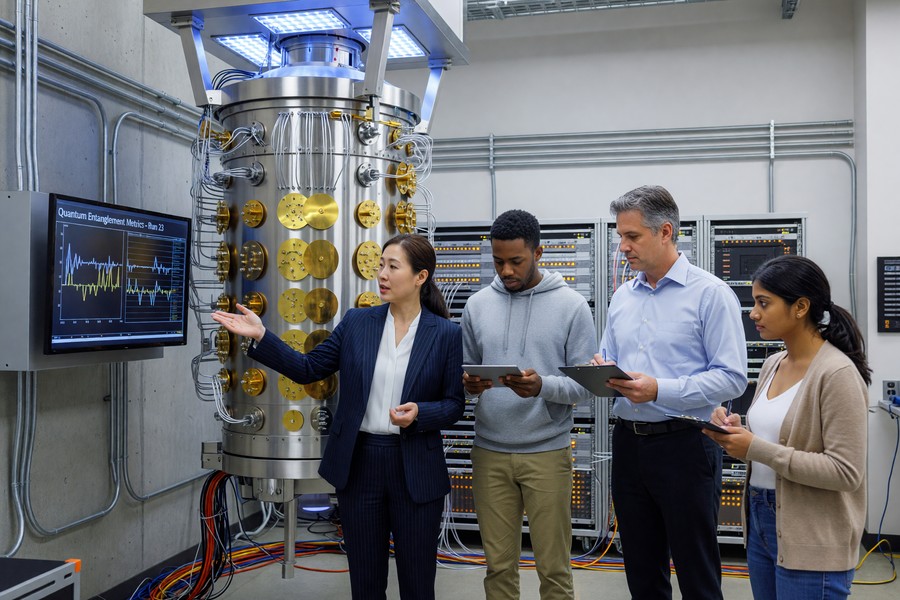
Global government investment in quantum technology exceeded $40 billion cumulatively by 2024, with the United States, China, and the European Union accounting for more than 80% of that spending, according to McKinsey’s 2024 quantum technology report.
The convergence of quantum networking with other emerging infrastructure is also relevant to network engineers and tech professionals. Our comparison of 5G vs Wi-Fi 7 wireless technologies illustrates how layered network architectures are already evolving — quantum networking will eventually sit atop and alongside these classical layers.
How Does Quantum Key Distribution Make Data Unhackable?
Quantum key distribution (QKD) makes data unhackable by using quantum mechanics to distribute encryption keys in a way that reveals any eavesdropping attempt before the key is used. The security guarantee is unconditional — it does not depend on an attacker’s computing power.
The BB84 Protocol Explained
The foundational QKD protocol, BB84, was designed by Charles Bennett at IBM and Gilles Brassard at the Université de Montréal in 1984. In BB84, a sender (conventionally called Alice) transmits photons polarized in randomly chosen bases. Any interception by a third party (Eve) forces a measurement that disturbs the photon’s state, introducing detectable errors in the key.
If the error rate in the received key exceeds a threshold — typically around 11% — Alice and Bob (the receiver) discard the key and retry. Below that threshold, they can confirm the key is secure and use it to encrypt classical data with a one-time pad, which is mathematically proven to be unbreakable.
QKD in Practice Today
Toshiba Research Europe demonstrated a QKD system achieving key generation rates of over 10 megabits per second over standard telecom fiber in 2021, a rate sufficient for real-time encrypted voice and video calls. ID Quantique has deployed commercial QKD links in the Swiss banking sector and for Geneva‘s cantonal government network since 2007.
| QKD Protocol | Year Introduced | Max Demonstrated Range | Key Rate (Approx.) |
|---|---|---|---|
| BB84 | 1984 | 421 km (fiber) | 10 Mbps (short range) |
| E91 (Ekert) | 1991 | 100 km (fiber) | 1–5 Mbps |
| CV-QKD | 2002 | 202 km (fiber) | Up to 100 Mbps (experimental) |
| Satellite QKD (Micius) | 2017 | 7,600 km (satellite) | ~1 kbps (intercontinental) |
| Twin-Field QKD | 2018 | 833 km (fiber) | 0.1–1 Mbps |
What Are the Current Limitations of Quantum Networks?
Quantum networks face three core limitations today: distance constraints caused by photon loss, the absence of a mature quantum repeater, and extremely high infrastructure cost. None of these are insurmountable, but each requires significant engineering breakthroughs.
The Decoherence Problem
Photons carrying quantum information are absorbed by fiber optic cables at a rate that makes transmission beyond roughly 600 kilometers impractical without repeaters. Classical optical networks solve signal loss with amplifiers, but amplifying a quantum signal requires copying it — which the no-cloning theorem forbids.
Quantum repeaters based on quantum memory — devices that can store a qubit’s state temporarily — are the solution, but they remain in the laboratory stage. Research published in Nature in 2022 demonstrated quantum memory with fidelity above 99%, a milestone, but scaling this to a network-ready device is an active engineering challenge.
Cost and Infrastructure Barriers
Deploying dedicated QKD fiber or satellite infrastructure is orders of magnitude more expensive than upgrading classical networks. A single QKD transceiver unit from ID Quantique currently costs between $100,000 and $500,000, limiting early adoption to governments, defense agencies, and large financial institutions.
Organizations that handle sensitive long-term data — medical records, legal contracts, financial archives — should begin evaluating post-quantum cryptography migration now, even before quantum networking internet is widely available. NIST’s finalized standards provide a concrete starting point for IT teams upgrading their encryption stack today.
For technology professionals tracking network evolution, understanding what edge computing is and how it works is also relevant — edge nodes will likely serve as early deployment points for quantum network endpoints before backbone infrastructure matures.
When Will a Quantum Networking Internet Be Available to Everyone?
A fully functional quantum networking internet available to general consumers is most likely 15 to 25 years away, according to expert consensus. However, specialized quantum-secured links for governments, financial institutions, and critical infrastructure will be commercially viable within 5 to 10 years.
The Roadmap in Three Stages
Researchers at Delft University have proposed a widely cited three-stage model. Stage one involves trusted-node networks — already deployed in China and Europe — where classical relay nodes pass quantum keys between segments. Stage two introduces entanglement distribution using early quantum repeaters. Stage three is the full quantum internet, enabling distributed quantum computing and perfectly secure global communication.
The U.S. Department of Energy’s 2020 strategic roadmap targets a first-generation national quantum internet by 2030, with full deployment dependent on quantum memory and repeater breakthroughs expected in the early 2030s.
Near-Term Commercial Applications
Before consumer access arrives, quantum networking internet will first transform sectors handling high-value data. JPMorgan Chase has already tested QKD links for trading data in New York. Toshiba is piloting quantum-secured healthcare data links in the United Kingdom. These early deployments are proving the technology viable at enterprise scale.
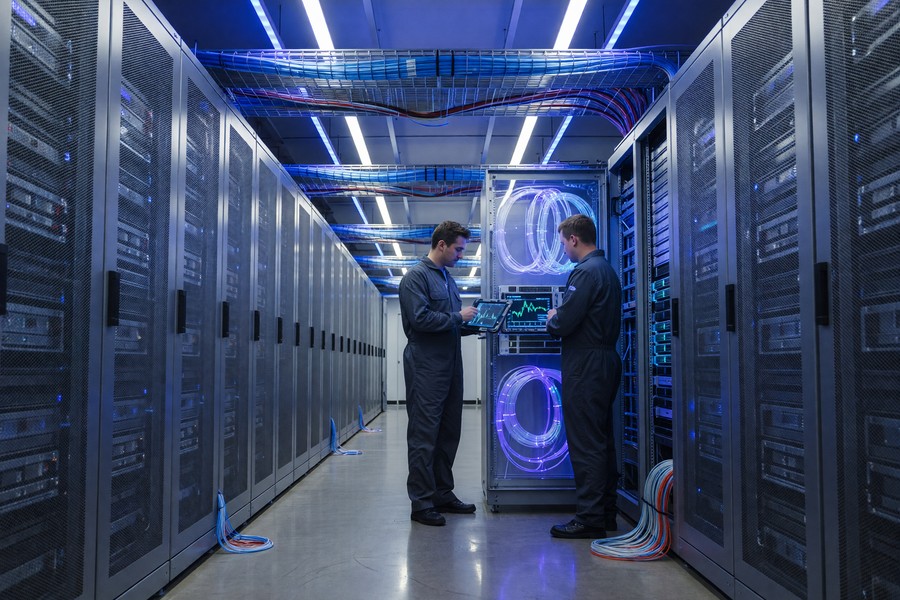
The internet you use today took roughly 30 years to evolve from ARPANET (1969) to widespread public adoption (late 1990s). Most quantum networking researchers expect the quantum networking internet to follow a similar trajectory — but with significantly more government coordination from the start.
The broader technology landscape is evolving rapidly alongside quantum networking. Our coverage of how AI is changing the way we search the internet and how wearable technology is transforming health tracking shows how multiple paradigm shifts are converging simultaneously — quantum-secured networks will eventually underpin all of them.
Related reading: aio optimized: most efficient ai.
Frequently Asked Questions
Is quantum networking internet available to consumers today?
No, quantum networking internet is not available to general consumers as of July 2025. Operational quantum networks exist in China, Europe, and the United States, but they serve governments, research institutions, and select financial organizations only. Consumer access is projected to begin in limited form no earlier than the mid-2030s.
Can quantum networks be hacked?
Quantum key distribution links cannot be secretly intercepted — any eavesdropping attempt disturbs the quantum state and is detected. However, the devices at each end of a QKD link (transceivers, detectors) can still have hardware vulnerabilities. Researchers distinguish between the theoretical security of the quantum channel and the practical security of the full system.
What is the difference between quantum networking and quantum computing?
Quantum computing processes information using qubits to solve complex problems faster than classical computers. Quantum networking transmits quantum information between physically separate locations. They use overlapping principles but serve different functions. A full quantum internet would eventually connect quantum computers to each other, combining both capabilities.
Will quantum networking make current encryption obsolete?
Quantum networking internet will eventually replace QKD-vulnerable encryption methods like RSA, but the transition will take decades. NIST has already published post-quantum cryptographic standards as a near-term bridge. Organizations should begin migrating to post-quantum algorithms now while quantum networking infrastructure matures.
Which countries are leading in quantum networking development?
China currently leads in deployed quantum network infrastructure, with an operational backbone exceeding 2,000 kilometers and a functional satellite QKD capability. The United States leads in academic research and private sector investment. The European Union is second in deployed testbed infrastructure, with major programs in the Netherlands, Germany, and the United Kingdom.
How fast can a quantum internet transmit data?
Current QKD systems generate secure keys at rates from roughly 1 kilobit per second over satellite links to over 10 megabits per second over short fiber distances. These rates are for key generation, not total data throughput — the actual encrypted data is sent over classical channels at normal speeds. Increasing key rates over long distances is a key research priority.
What is a quantum repeater and why does it matter?
A quantum repeater extends the range of a quantum network by storing and retransmitting entangled quantum states without measuring them. Without repeaters, quantum signals degrade beyond roughly 600 kilometers. A practical, scalable quantum repeater is the single most critical engineering milestone standing between today’s experimental networks and a true global quantum networking internet.
Sources
- U.S. Department of Energy — What Is the Quantum Internet?
- NIST — Quantum Information Science Overview
- NIST — Post-Quantum Cryptography Standards (2024)
- Nature — Satellite-Based Entanglement Distribution Over 7,600 km (2020)
- Nature — Quantum Memory with 99% Fidelity (2022)
- National Quantum Coordination Office — About NQCO
- U.S. Department of Energy — Blueprint for the Quantum Internet (2020)
- Grand View Research — Quantum Networking Market Report (2024)
- McKinsey — Quantum Technology Sees Record Investments (2024)
- European Commission — Quantum Flagship Program Overview