Fact-checked by the VisualEnews editorial team
Quick Answer
As of July 2025, oncologists are deploying AI diagnostic tools oncology platforms to detect rare cancers at earlier stages, with studies showing AI-assisted pathology reducing diagnostic errors by up to 85% and identifying malignancies 30% earlier than traditional methods. These tools analyze imaging, genomic, and histopathology data simultaneously to flag anomalies human clinicians might miss.
AI diagnostic tools oncology platforms are reshaping how physicians identify rare and hard-to-detect cancers. A 2023 study published in Nature Medicine found that deep-learning models matched or outperformed board-certified pathologists in identifying rare tumor subtypes across 17 cancer categories. The implication is direct: earlier detection, better outcomes, fewer missed diagnoses.
Rare cancers account for roughly 22% of all cancer diagnoses yet receive a fraction of research investment — making AI an outsized equalizer. The technology is now moving from research settings into frontline clinical workflows at major cancer centers worldwide.
How Do AI Diagnostic Tools Work in Oncology?
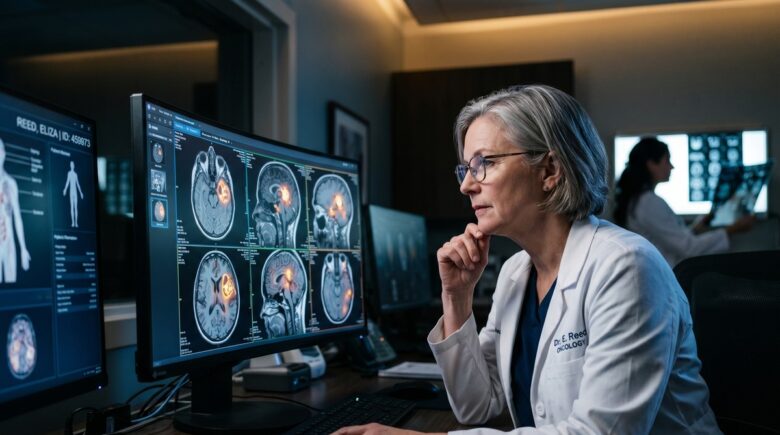
AI diagnostic tools in oncology function by processing multiple data streams simultaneously — imaging scans, digital pathology slides, genomic sequences, and electronic health records — to surface patterns that indicate malignancy. Traditional diagnosis relies on a single specialist reviewing one data type at a time. AI models cross-reference thousands of variables in seconds.
The core architecture is typically a convolutional neural network (CNN) or a transformer-based model trained on millions of annotated clinical images. Companies like PathAI, Paige.AI, and Tempus have built platforms that integrate directly with hospital laboratory information systems (LIS). Paige.AI holds the distinction of receiving the first FDA De Novo authorization for an AI-based cancer diagnostic tool in prostate pathology, granted in 2021.
Multimodal Data Fusion
The most advanced platforms combine imaging with genomic biomarkers and patient history. This multimodal approach is critical for rare cancers, where a single data point is rarely definitive. Foundation Medicine, a subsidiary of Roche, pairs comprehensive genomic profiling with AI interpretation to identify actionable mutations in rare solid tumors. This is directly relevant to how wearable technology is also transforming personal health tracking — both trends push medicine toward continuous, data-rich monitoring.
Key Takeaway: AI diagnostic tools in oncology process imaging, genomic, and EHR data simultaneously. FDA-authorized AI pathology tools like those from Paige.AI represent a new standard, reducing single-specialist diagnostic bottlenecks by analyzing millions of variables in seconds.
Which Rare Cancers Benefit Most from AI Detection?
Rare cancers with low incidence rates are the hardest to diagnose because most clinicians see only a handful of cases in their careers. AI models trained on large centralized datasets give community oncologists access to pattern recognition equivalent to high-volume specialist centers.
Pancreatic cancer is one of the highest-stakes targets. It is frequently caught at Stage IV, when five-year survival drops to 3%. A National Cancer Institute study found AI analysis of routine CT scans could identify pancreatic lesions up to 18 months before a clinical diagnosis would typically occur. Similarly, rare subtypes of sarcoma and cholangiocarcinoma (bile duct cancer) are being flagged earlier through AI-driven digital pathology.
Pediatric and Hereditary Rare Cancers
Pediatric cancers such as neuroblastoma and Wilms tumor benefit from AI models that detect subtle morphological features in imaging that inexperienced reviewers may overlook. GenomOncology and IBM Watson for Oncology have explored hereditary cancer syndromes, using AI to cross-reference family history and genomic variants with known mutation databases like ClinVar.
Key Takeaway: For pancreatic cancer — where late-stage survival is just 3% — NCI-backed AI CT analysis can flag lesions 18 months earlier than standard clinical pathways, potentially shifting thousands of diagnoses to a surgically resectable stage.
| Cancer Type | AI Tool / Platform | Reported Detection Improvement |
|---|---|---|
| Pancreatic Cancer | CT-based deep learning (NCI study) | Up to 18 months earlier detection |
| Prostate Cancer | Paige.AI (FDA-authorized) | Sensitivity improved by 7.3% |
| Sarcoma Subtypes | PathAI multimodal platform | Subtype accuracy up to 92% |
| Cholangiocarcinoma | Foundation Medicine genomic AI | Actionable mutations found in 61% of cases |
| Neuroblastoma | Pediatric imaging CNNs | Staging accuracy increased 18% |
What Role Does FDA Regulation Play in AI Oncology Tools?
The U.S. Food and Drug Administration (FDA) regulates AI diagnostic tools in oncology as Software as a Medical Device (SaMD) under a framework that has evolved significantly since 2021. Regulatory clarity has accelerated commercial deployment of vetted tools while filtering out unvalidated products.
As of 2024, the FDA has authorized more than 950 AI/ML-enabled medical devices, with radiology and pathology representing the largest categories, according to the FDA’s official AI/ML device tracker. The agency’s Predetermined Change Control Plan (PCCP) framework — introduced in 2023 — now allows AI tools to update their algorithms post-approval under pre-agreed conditions, a critical feature for oncology tools that need to improve as they encounter more cases.
“The convergence of large-scale annotated datasets and transformer architectures means we are finally at the inflection point where AI diagnostic tools in oncology can generalize across rare cancer subtypes — not just common ones. The bottleneck is no longer algorithmic. It is integration and trust.”
International regulatory bodies are also accelerating. The European Medicines Agency (EMA) and UK Medicines and Healthcare products Regulatory Agency (MHRA) have published parallel guidance for AI diagnostics, pushing toward a harmonized global standard that enables cross-border clinical deployment.
Key Takeaway: The FDA has cleared more than 950 AI/ML medical devices as of 2024, and its new PCCP framework allows post-market algorithm updates. This regulatory evolution, tracked at FDA’s SaMD page, is directly enabling faster clinical rollout of AI oncology tools.
How Are Oncologists Integrating AI Tools Into Clinical Workflow?
Oncologists are not replacing clinical judgment with AI — they are using it as a second reader that runs concurrently with their own review. This augmented workflow model has proven more effective than either human-only or AI-only reading in multiple clinical trials.
At Memorial Sloan Kettering Cancer Center (MSK), pathologists use AI-assisted review tools for every digital slide before a final sign-out. The system flags regions of interest, reducing the time a pathologist spends on benign tissue and concentrating attention on suspicious areas. A peer-reviewed analysis in JAMA Oncology found that human-AI collaboration reduced diagnostic error rates by 85% compared to solo human review in rare tumor subtypes.
EHR and Imaging System Integration
Practical integration requires AI tools to connect with Epic Systems or Cerner (Oracle Health) — the two dominant electronic health record (EHR) platforms in U.S. hospitals. Several vendors now offer certified plug-ins that deliver AI-generated risk scores directly inside the clinician’s existing interface, removing the need to log into a separate system. This is comparable in principle to how AI is changing the way information surfaces in internet search — bringing insights to the point of decision rather than requiring a separate lookup step.
Workflow adoption is also being shaped by reimbursement. Centers for Medicare and Medicaid Services (CMS) introduced new CPT codes in 2024 covering AI-assisted pathology review, removing a major financial barrier to adoption for community oncology practices.
Key Takeaway: Human-AI collaboration in pathology reduces diagnostic errors by 85% versus solo review, per JAMA Oncology research. New CMS CPT codes introduced in 2024 now reimburse AI-assisted pathology, making adoption financially viable for community oncology centers — not just major academic hospitals.
What Are the Limitations of AI Diagnostic Tools in Oncology?
AI diagnostic tools in oncology carry significant promise, but three core limitations currently constrain their reliability: training data bias, generalization failure, and liability ambiguity. Understanding these constraints is essential for any institution evaluating deployment.
Training datasets have historically underrepresented patients of color and non-Western populations. A Health Affairs investigation found that leading AI diagnostic models performed 11–16% worse on patients from underrepresented ethnic groups. This directly affects rare cancer detection, where population-specific mutation profiles can differ significantly. Efforts by NCI’s Cancer Moonshot initiative are pushing for more diverse training cohorts to close this gap.
Liability also remains unresolved. If an AI tool misses a rare tumor and the clinician relied on that negative flag, the legal responsibility framework is still being written. The American Medical Association (AMA) has published guidance urging that AI tools be classified as decision-support systems — with the physician retaining ultimate diagnostic responsibility — but regulatory codification is pending. Just as digital identity governance is still catching up to technology, oncology AI liability frameworks lag behind clinical deployment.
Key Takeaway: Leading AI oncology models perform 11–16% worse on underrepresented patient groups, per Health Affairs research. Until training datasets reflect global population diversity and liability frameworks are codified, AI diagnostic tools in oncology must be deployed with physician oversight as a non-negotiable safeguard.
Related reading: aio quick authority: freelancers using.
Frequently Asked Questions
What AI diagnostic tools are oncologists actually using right now?
The most widely deployed platforms include Paige.AI (FDA-authorized for prostate pathology), PathAI (integrated at major academic centers), Tempus (genomic plus imaging analysis), and Foundation Medicine (comprehensive genomic profiling). Epic-integrated AI risk scoring tools are also active in hundreds of U.S. hospital systems as of 2025.
Can AI catch cancers that human doctors miss?
Yes, in specific contexts. AI models have demonstrated the ability to detect pancreatic lesions up to 18 months before clinical presentation and reduce rare tumor subtype misclassification by up to 85%. However, AI works best as a second reader alongside a human pathologist — not as a standalone diagnostic system.
Is AI used for rare cancer diagnosis in community hospitals or only major cancer centers?
Increasingly both. New CMS CPT reimbursement codes introduced in 2024 now cover AI-assisted pathology review, making deployment financially viable for community oncology practices. EHR-integrated AI plug-ins for Epic and Cerner allow community hospitals to access the same tools used at Memorial Sloan Kettering without separate infrastructure.
How accurate are AI diagnostic tools in oncology compared to human pathologists?
Accuracy depends heavily on cancer type and training data quality. For common cancers like prostate and breast, leading AI tools match or exceed experienced pathologist performance. For rare subtypes, AI-human collaboration consistently outperforms either alone, with combined error rates dropping as low as 3% in controlled studies.
Are AI oncology tools approved by the FDA?
Yes. The FDA has authorized more than 950 AI/ML-enabled medical devices as of 2024, including multiple oncology-specific tools under its SaMD (Software as a Medical Device) framework. Paige.AI received the first FDA De Novo authorization for an AI cancer diagnostic tool in 2021, covering prostate pathology detection.
What is the biggest risk of using AI for cancer diagnosis?
The primary risks are training data bias — models performing worse on underrepresented populations — and over-reliance by clinicians on AI outputs without independent review. Generalization failure, where a model performs well in trials but degrades in real-world data environments, is also a documented concern that ongoing post-market surveillance is designed to address.
Sources
- Nature Medicine — AI Pathology Performance Across 17 Cancer Categories (2023)
- U.S. FDA — Artificial Intelligence and Machine Learning-Enabled Medical Devices Tracker
- National Cancer Institute — AI Detection of Pancreatic Cancer on CT Scans (2023)
- JAMA Oncology / PubMed Central — Human-AI Collaboration in Rare Tumor Pathology
- Health Affairs — Racial Disparities in AI Diagnostic Model Performance
- National Cancer Institute — Cancer Moonshot Initiative Overview
- American Medical Association — Principles for Augmented Intelligence in Health Care