Fact-checked by the VisualEnews editorial team
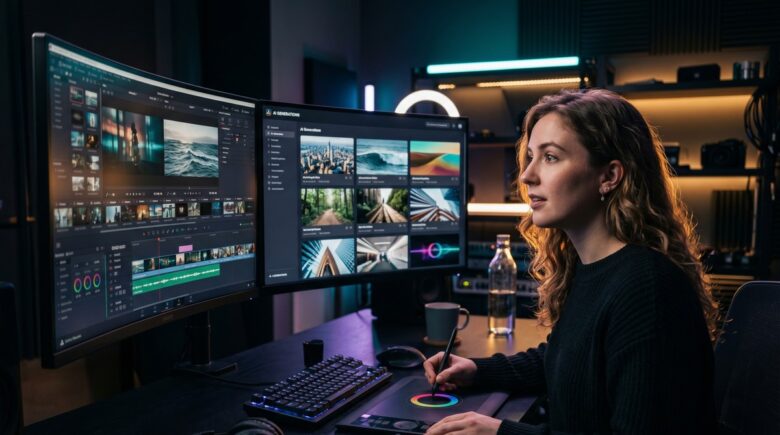
You’ve spent hours filming your talking-head video, your screen recording is crisp, your script is polished — and then you hit the edit and realize you have almost no B-roll to cut to. Stock footage sites want $79 per clip. Royalty-free libraries look like they were filmed in 2009. And shooting your own supplemental footage? That costs time most creators simply don’t have. This is exactly where AI b-roll video apps are changing the game entirely, generating cinematic cutaway footage from a text prompt in seconds.
The scale of this problem is genuinely staggering. According to Statista’s video content research, over 500 hours of video are uploaded to YouTube every single minute. Yet a 2023 survey by Wyzowl found that 73% of video creators cite B-roll sourcing as one of their top three production bottlenecks. Premium stock video subscriptions like Shutterstock or Getty Images run between $199 and $999 per month for commercial licenses — costs that obliterate the margins of independent creators and small businesses alike.
This guide gives you a definitive, tool-by-tool breakdown of the best AI b-roll video apps available right now. What each tool costs. What it actually produces. Where it falls flat. And how to stack these tools into a real production workflow that actually saves you money. Whether you’re a solo YouTuber, a social media manager, or a video agency scaling output, this is your complete blueprint for cutting B-roll costs by up to 90% without sacrificing quality.
Key Takeaways
- Premium stock footage subscriptions cost $199–$999/month; leading AI b-roll tools start at $8–$24/month — a savings of up to 92%.
- AI video generation models like Runway Gen-3 Alpha can produce a 10-second clip in under 60 seconds from a single text prompt.
- The global AI video generation market was valued at $554 million in 2023 and is projected to reach $4.7 billion by 2030, a CAGR of 35.6%.
- Creators using AI b-roll tools report reducing their average post-production time by 40–60% per project, according to early adopter surveys.
- Most leading AI b-roll video apps now offer 4K output, though motion consistency and hand rendering remain known limitations as of 2024.
- Free tiers across major platforms (Pika, Runway, Kling) offer 10–100 generation credits monthly — enough for light users to test without spending a dollar.
In This Guide
- Why AI B-Roll Is Reshaping Video Production
- How AI Video Generation Actually Works
- The Top AI B-Roll Video Apps Compared
- Runway Gen-3 Alpha: The Professional’s Choice
- Pika Labs and Kling AI: Speed Over Perfection
- OpenAI Sora and Google Lumiere: The Coming Wave
- Stable Video Diffusion and Open-Source Options
- Integrating AI B-Roll Into Your Production Workflow
- Pricing, ROI, and When to Upgrade
- Legal, Copyright, and Ethical Considerations
Why AI B-Roll Is Reshaping Video Production
B-roll is the connective tissue of any compelling video. It’s the coffee cup being lifted while someone talks about their morning routine, the city skyline that cuts in while a narrator describes urban growth. Without it, talking-head videos feel flat and amateur. With it, they feel produced — trustworthy, even.
Here’s the thing: the traditional path to quality B-roll has always been expensive. Hiring a videographer to shoot custom B-roll runs $500–$2,500 per day. Even mid-tier platforms like Pond5 charge $59–$199 per individual clip. For a single YouTube video requiring 20 B-roll cuts, that math becomes untenable fast. Really fast.
AI is disrupting this economics entirely. Tools trained on billions of video frames can now synthesize footage that literally didn’t exist before you typed a sentence — a futuristic cityscape, an abstract data visualization, a close-up of hands typing on a glowing keyboard. For creators who learn to use these tools well, this might be the most significant cost reduction in video production history.
The Creator Economy Is Scaling Faster Than Budgets
There are now over 50 million people who consider themselves content creators globally, according to YouTube’s own creator data. But only a tiny fraction have production budgets that match professional standards. The gap between what audiences now expect — cinematic, polished content — and what solo creators can actually afford has never been wider.
AI b-roll video apps close that gap. They democratize access to visual richness that was previously gated behind serious budget. A solo creator spending $19/month on an AI tool can now produce content that visually competes with teams spending thousands per video. That’s not hype — that’s just where the technology is right now.
The global AI video generation market is projected to grow from $554 million in 2023 to $4.7 billion by 2030 — a compound annual growth rate of 35.6%, making it one of the fastest-growing segments in AI tools.
Audience Retention Depends on Visual Variety
YouTube’s own internal data, cited by multiple creator economy researchers, shows that videos with frequent scene changes and B-roll cuts retain viewers 35–50% longer than static talking-head videos. That retention lift directly translates to algorithmic favor — more recommendations, more impressions, more revenue.
This isn’t just an aesthetic preference. It’s a measurable growth lever. Creators who master visual variety outperform those who don’t, regardless of how strong their scripting or audio quality is. You can have the best ideas in your niche and still lose to someone with more visual variety. That’s the reality of the platform.
How AI Video Generation Actually Works
Understanding the technology helps you use these tools more effectively. Most leading AI b-roll video apps are built on diffusion models — the same underlying architecture that powers AI image generators like Stable Diffusion and DALL-E. They learn statistical relationships between billions of image frames and their descriptions.
Video generation adds a temporal dimension, and that’s where things get genuinely hard. The model doesn’t just generate one frame — it generates a sequence of frames with coherent motion. This is exponentially more difficult than image generation, which is why video AI has lagged behind image AI by roughly 18–24 months in capability. The progress over the last two years, though, has been remarkable.
Text-to-Video vs. Image-to-Video
Two primary generation modes. Text-to-video takes a written prompt and produces footage from scratch. Image-to-video takes a still image you provide and animates it — adding motion, parallax, or simulated camera movement. Both matter, but for different reasons.
For B-roll purposes, image-to-video is often the more controllable option. You can generate a specific still in an image tool, then animate it precisely. Text-to-video offers more creative range but less precision, especially for specific compositional needs. Honestly, most experienced AI video creators end up using both depending on what the shot requires.
Use an AI image generator (like Midjourney or DALL-E 3) to create your ideal still frame first, then feed it into an image-to-video tool like Runway or Pika. This hybrid approach gives you far more control over composition than pure text-to-video prompting.
Key Technical Specs to Evaluate
When comparing AI b-roll video apps, these are the specs that actually matter for production use. Resolution, frame rate, clip duration, and motion consistency are your four core metrics.
| Spec | Why It Matters | Minimum Viable Standard |
|---|---|---|
| Resolution | Determines print quality and cropping flexibility | 1080p minimum; 4K preferred |
| Frame Rate | Affects motion smoothness in editing | 24fps minimum; 30fps preferred |
| Clip Duration | Limits how long each AI clip runs | 5–10 seconds per clip |
| Motion Consistency | Prevents visual “drift” in generated footage | Stable objects across all frames |
| Generation Time | Affects production workflow speed | Under 2 minutes per clip |
The Top AI B-Roll Video Apps Compared
The market for AI b-roll video apps has genuinely exploded since 2023 — at least a dozen credible platforms are now competing for creator dollars, and not all of them are equal. Some excel at photorealistic footage. Others shine for motion graphics and abstract visuals. The right tool almost always depends on your content category and what you can actually afford to spend.
Below is a master comparison of the leading contenders as of mid-2024. Prices reflect monthly billing; annual plans typically save 20–30%.
| App | Starting Price | Max Resolution | Max Clip Length | Best For |
|---|---|---|---|---|
| Runway Gen-3 Alpha | $15/month | 1280×768 | 10 seconds | Cinematic realism |
| Pika Labs | $8/month | 1080p | 10 seconds | Social media creators |
| Kling AI | $9.99/month | 1080p | 30 seconds | Long-form B-roll |
| Luma Dream Machine | Free / $29.99/month | 1080p | 5 seconds | Physics-accurate motion |
| Stable Video Diffusion | Free (self-hosted) | 576p | 4 seconds | Tech-savvy users |
| Sora (OpenAI) | Included w/ ChatGPT Plus ($20/month) | 1080p | 20 seconds | Long narrative sequences |
This landscape moves fast. New model versions and competitors get announced nearly every quarter, so staying current on capability changes is just as important as picking the right tool today. Following AI news through sources like TechCrunch’s AI coverage helps you track meaningful updates without drowning in noise.
Runway ML has raised over $237 million in funding and processes millions of video generations per month, making it the highest-capitalized pure-play AI video company as of 2024.
Runway Gen-3 Alpha: The Professional’s Choice
Runway Gen-3 Alpha is the current gold standard among AI b-roll video apps for professional-grade output. Launched in mid-2024, it represents a significant leap over Gen-2 in motion consistency, prompt adherence, and cinematic quality — and studios including major advertising agencies have actually started using it in commercial production. That’s not a demo. That’s real work.
The platform runs on a credit system. Basic plan at $15/month includes 625 credits. Standard is $35/month for 2,250 credits. Pro runs $95/month for 7,250 credits. One 10-second generation at standard quality costs approximately 50 credits — meaning the Basic plan yields about 12–15 quality clips per month. Not enormous, but enough to meaningfully supplement a production workflow.
What Runway Does Best
Runway excels at photorealistic human environments and cinematic camera moves. Prompts involving slow dolly shots, rack focuses, and aerial perspectives produce particularly strong results. It also handles lighting transitions exceptionally well — a sunset over water, flickering candlelight, neon reflections on rain-slicked pavement. These atmospheric shots look genuinely cinematic.
For tech content specifically, Runway produces excellent footage of glowing interfaces, abstract data visualizations, and futuristic workspaces — exactly the kind of B-roll that tech YouTubers and corporate explainer producers need constantly.
Runway’s Limitations
Hand and finger rendering remains a known weakness, as it is for nearly all generative video models right now. If your B-roll requires close-ups of hands manipulating objects, expect to regenerate multiple times or consider alternative sourcing. Complex multi-person scenes also degrade in quality compared to solo-subject or no-subject abstract footage. Know the tool’s limits before you depend on it.
“Runway Gen-3 is the first AI video tool I’ve actually used in a paying client deliverable. The motion consistency crossed a threshold that makes it production-viable, not just demo-impressive.”

Pika Labs and Kling AI: Speed Over Perfection
Pika Labs has earned a genuinely devoted following among social media creators who prioritize speed and accessibility. Its interface is one of the most beginner-friendly in the category — and its Discord-based community has grown to over 500,000 users, which tells you something. Pika’s generations are fast. Typically 20–40 seconds per clip. And the output quality for social-media-sized content is genuinely impressive for the price.
At $8/month for the Basic plan (250 credits) and $28/month for the Standard plan (700 credits), Pika is among the most affordable premium options out there. It supports 1080p output and a range of aspect ratios including the 9:16 vertical format that’s critical for Reels and TikTok B-roll inserts. If you’re primarily a short-form creator, Pika probably deserves your first look.
Kling AI’s Longer Clip Advantage
Kling AI, developed by Chinese tech firm Kuaishou, is notable for one genuinely standout capability: clip lengths up to 30 seconds. Every other major competitor caps at 5–10 seconds. For creators who need a continuous B-roll shot — a slow pan across a landscape, an extended time-lapse effect — this is a meaningful differentiator. It’s not a minor detail.
Kling’s motion physics are also notably strong. In independent tests by AI researcher Kaito Hayashi published on Hugging Face, Kling outperformed Runway Gen-2 and Pika on object permanence and physics-accurate motion simulations. It lags slightly behind Runway Gen-3 on overall cinematic realism, but the gap is smaller than you might expect.
Kling AI was built by Kuaishou — the same company behind Kwai, a short-video platform with over 700 million monthly active users. Their video AI is trained on one of the largest proprietary video datasets in existence.
Side-by-Side: Pika vs. Kling for B-Roll Use Cases
| Use Case | Pika Labs | Kling AI |
|---|---|---|
| Short social clips (5s) | Excellent | Good |
| Long continuous shots (15–30s) | Not supported | Excellent |
| Vertical 9:16 format | Native support | Available |
| Generation speed | 20–40 seconds | 2–4 minutes |
| Photorealism | Good | Very good |
| Starting price | $8/month | $9.99/month |
OpenAI Sora and Google Lumiere: The Coming Wave
OpenAI’s Sora made global headlines when it debuted in February 2024 with demo footage that surpassed anything the public had seen from a generative video model. Full stop. As of late 2024, Sora is available to ChatGPT Plus subscribers at $20/month and ChatGPT Pro subscribers at $200/month, with the Pro tier offering higher-resolution and longer generation capabilities.
Sora generates clips up to 20 seconds at 1080p, with notably strong scene coherence over time. Its ability to maintain consistent characters across a multi-shot sequence is particularly impressive — a capability no competitor has fully matched. For narrative-driven B-roll that needs to feel like a continuous world, Sora currently leads the field.
Google’s Lumiere and Veo
Now, Google Lumiere and its successor Google Veo represent the search giant’s serious entry into this space. Veo, announced at Google I/O 2024, produces 1080p clips in cinematic styles with strong prompt adherence. It’s currently in limited access via Google DeepMind’s VideoFX tool, with wider availability expected through Google’s Vertex AI platform for enterprise users.
Google’s advantage is infrastructure — and it’s a significant one. With access to Google Cloud’s TPU clusters and YouTube’s vast training data, Veo’s future trajectory is genuinely compelling. Enterprise pricing through Vertex AI starts at approximately $0.50 per second of generated video — expensive for solo creators, but potentially cost-effective for agencies generating hundreds of clips monthly.
“We’re watching the same disruption that happened to stock photography play out in video. The question isn’t whether AI replaces stock footage — it’s how fast.”
Stable Video Diffusion and Open-Source Options
Stable Video Diffusion (SVD) is Stability AI’s open-source video generation model, released in late 2023. Unlike every commercial platform above, SVD can be downloaded and run locally on a capable GPU — making it free to use at scale once you have the hardware. For creators with a gaming PC or workstation (a GPU with at least 16GB VRAM is recommended), this is a powerful zero-marginal-cost option. Worth knowing about.
The trade-off is real, though. Running SVD requires familiarity with Python environments, Hugging Face model downloads, and inference scripts. It is not a point-and-click tool. Output resolution is currently limited to 576p in the base model, though community-developed upscaling pipelines can enhance this with varying results.
ComfyUI and AnimateDiff for Advanced Users
ComfyUI is a node-based interface that lets technically proficient users chain AI models together in custom pipelines. Combined with AnimateDiff — a motion module that adds animation to Stable Diffusion image generators — it enables sophisticated B-roll generation workflows that would cost $100+ per month on commercial platforms.
The learning curve is steep. Expect 10–20 hours of setup and experimentation before producing consistently usable output. But for creators willing to invest that time, the long-term savings are substantial. Many professional video editors in AI communities on Reddit and Discord report generating 50+ clips per month at zero software cost. Zero. That’s hard to argue with.
Running Stable Video Diffusion locally requires a GPU with at least 16GB VRAM. Attempting to run it on consumer cards with less memory (like an RTX 3060 with 12GB) will result in crashes or severely degraded output. Check your hardware specs carefully before investing setup time.

Integrating AI B-Roll Into Your Production Workflow
Owning an AI b-roll video app is only half the equation. Honestly, maybe less than half. Knowing where it fits in your production pipeline is what separates creators who genuinely save time from those who just create new headaches. Most successful AI video users build a three-stage integration: pre-production planning, mid-production generation, and post-production quality control.
The pre-production stage is the most important — and the most skipped. Before you shoot anything, identify every B-roll moment in your script. Mark them with a simple notation: a timestamp and a one-line description of what the shot needs to convey. These become your AI generation prompts. This single habit will change how smoothly everything else goes.
Building an Effective Prompt Library
Prompt quality drives output quality. Vague prompts produce generic results. Specific, cinematic prompts produce usable footage. A good AI b-roll prompt includes: a subject, an environment, a camera move, a lighting condition, and a mood or style reference.
Look at the difference. Weak prompt: “office footage.” Strong prompt: “slow dolly forward into a modern open-plan office, late afternoon golden light streaming through floor-to-ceiling windows, desks empty, plants in foreground, cinematic depth of field.” The second prompt will produce footage 3–5x more usable on the first generation attempt. That’s not an exaggeration — it’s what experienced users consistently report.
| Prompt Element | Weak Version | Strong Version |
|---|---|---|
| Subject | office | modern open-plan office, desks empty |
| Camera Move | (omitted) | slow dolly forward |
| Lighting | (omitted) | late afternoon golden light through windows |
| Style Reference | (omitted) | cinematic depth of field, film grain |
| Expected Usability | 20–30% | 60–80% |
Post-Production Quality Control
Not every AI generation will be usable. Budget for a 40–60% acceptance rate when you’re starting out, improving to 70–85% as your prompting skills develop. Always generate 3–5 variations of each shot and select the best — most platforms allow this in a single batch. Never bet your project on a single generation.
In your NLE (Premiere Pro, Final Cut Pro, DaVinci Resolve), apply a subtle film grain overlay and a slight color grade to AI clips to match them to your primary footage. This 10-minute step dramatically improves cohesion between native and AI-generated material. It’s one of those small things that makes a huge difference to how polished the final video feels.
If you’re thinking about the hardware side of your production setup, our guide to best laptops for remote workers in 2026 covers machines with the GPU power needed to handle AI video workflows efficiently. And if you’re managing the costs of multiple tools across your production stack, it’s worth doing a digital subscription audit to ensure you’re not overpaying for platforms you underuse.
Pricing, ROI, and When to Upgrade
The ROI calculation for AI b-roll video apps is straightforward once you quantify what you’re currently spending. Add up your monthly spend on stock footage platforms, the hourly cost of time spent searching for clips, and any fees paid to contractors for custom shoot days. That’s your baseline. Most creators are genuinely surprised by that number when they actually sit down and do the math.
For most independent creators, that figure falls somewhere between $50 and $300 per month. The leading AI tools deliver comparable or better output for $8–$35/month. Even at the high end, that’s an 80–90% reduction in B-roll acquisition cost within the first 30 days of switching.
Free Tier vs. Paid: What You Actually Get
Most platforms offer free tiers with meaningful but limited generation capacity. Runway’s free plan gives you 125 one-time credits. Pika’s free tier offers limited daily generations. Luma Dream Machine’s free tier allows 30 generations per month. These are genuine trial periods — enough to evaluate quality before committing any money.
For a detailed breakdown of what you give up on free tiers versus paid plans across AI tools generally, see our analysis of free vs. paid apps and what you actually sacrifice. The pattern holds in AI video: free tiers prioritize slower queues and lower-resolution outputs, while paid tiers unlock the quality that’s actually production-ready.
A typical YouTube creator spending $150/month on stock footage and 6 hours/month sourcing clips (valued at $35/hour) has an effective B-roll cost of $360/month. Switching to a $35/month AI b-roll tool plus 2 hours of prompt work cuts this to approximately $105/month — a 71% reduction.
When to Move to Enterprise Pricing
If you’re generating more than 100 clips per month, it’s time to evaluate platform enterprise tiers or API access. Runway’s API, for example, charges $0.05–$0.10 per second of generated video at scale. For agencies producing weekly video content across multiple client accounts, this can be more cost-effective than per-seat monthly licenses. The math shifts considerably at volume.
The AI tools landscape is also shifting how we think about AI-driven costs more broadly — much like AI-powered budgeting apps are changing personal finance by automating decisions that previously required manual effort. The same efficiency logic applies here: automate the repetitive sourcing work, reallocate creative hours to higher-value tasks.
Legal, Copyright, and Ethical Considerations
The legal landscape around AI-generated video is evolving rapidly — and that’s putting it mildly. As of 2024, the U.S. Copyright Office has clarified that purely AI-generated content without meaningful human creative input is not eligible for copyright protection under current law. This cuts both ways: your AI B-roll may not be protectable, but it also generally cannot infringe on existing works.
Commercial licensing terms vary significantly by platform. Runway, Pika, and Kling all grant commercial usage rights on paid plans. Free tier usage on most platforms is restricted to non-commercial projects. Always read the terms of service before using AI-generated content in monetized videos or client deliverables. Always.
Training Data and Ethical Concerns
Many AI video models were trained on datasets that included copyrighted footage without explicit creator consent. This remains an active area of litigation. Getty Images, for instance, has filed lawsuits against Stability AI over training data practices. While these suits target the developers — not end users — the ethical dimension is worth considering, particularly for brands with reputational risk to manage.
Several platforms have begun offering “clean” models trained exclusively on licensed datasets. Adobe Firefly’s video generation tools (in beta as of 2024) explicitly use only Adobe Stock-licensed footage for training. For enterprise clients where legal clarity is non-negotiable, that distinction matters significantly.
Free plan terms on most AI video platforms prohibit
Related reading: AIO Decision: Should You Invest in Multimodal AI for Your E.