Fact-checked by the VisualEnews editorial team
Quick Answer
Use a manual camera app when you need precise control over ISO, shutter speed, or RAW output — situations where the default camera fails, such as low-light events or professional shoots. Default cameras handle 90%+ of everyday shots well using computational photography. As of July 2025, top manual apps like Halide and ProCamera outperform defaults in edge-case scenarios by a measurable margin.
The debate around manual camera app vs default comes down to control versus convenience. Default cameras on iPhone and Android now use multi-frame computational photography — Apple’s Photonic Engine and Google’s HDR+ process dozens of frames per shot — making them excellent for casual use. But they make aggressive choices about exposure, color, and sharpening that a professional or enthusiast may not want.
Smartphone camera capabilities have expanded dramatically, yet the manual vs. default decision is more nuanced than ever — especially as AI-assisted processing reshapes what “default” even means in 2025.
What Does a Manual Camera App Actually Do?
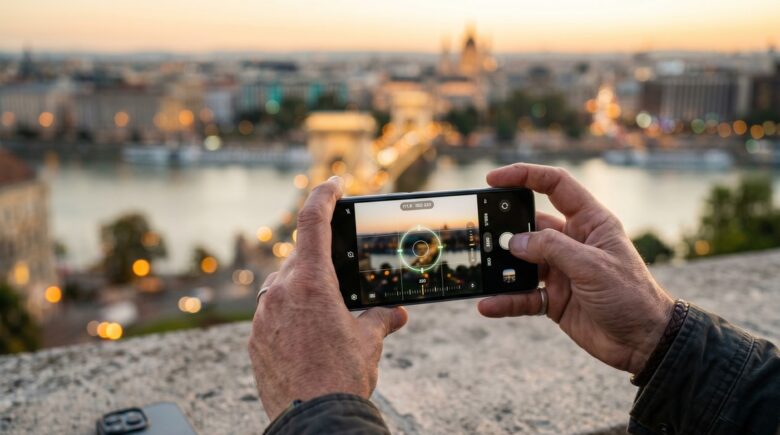
A manual camera app gives you direct control over every core exposure parameter — ISO, shutter speed, white balance, and focus distance — without the phone’s AI overriding your choices. This is the fundamental difference when comparing manual camera app vs default: you become the decision-maker, not the algorithm.
Apps like Halide Mark III (iOS), ProCamera, and Camera FV-5 (Android) also provide access to uncompressed RAW or DNG files. These files retain far more tonal and color data than the HEIC or JPEG formats that default cameras produce. According to DPReview’s smartphone RAW analysis, RAW files captured on flagship phones contain up to 12–14 stops of dynamic range, compared to the 8–10 stops a processed JPEG typically retains.
Core Controls You Get
- ISO — controls sensor sensitivity; critical for low-light without relying on AI brightening
- Shutter speed — freeze or blur motion deliberately
- White balance — lock color temperature for consistent shots in mixed lighting
- Focus peaking — visualize exact focus plane, unavailable in most default apps
- RAW/DNG output — maximum post-processing latitude in Adobe Lightroom or Darkroom
These controls matter most in edge-case scenarios: astrophotography, product photography, live events with mixed artificial lighting, and long-exposure cityscapes. For everything else, the computational pipeline in a default camera is hard to beat for speed and reliability.
Key Takeaway: Manual camera apps unlock RAW files with up to 14 stops of dynamic range and full exposure control — giving photographers precise results that default cameras’ AI pipelines cannot replicate, according to DPReview’s smartphone imaging research.
When Does the Default Camera Win?
The default camera wins in speed, consistency, and computational power for the vast majority of shooting situations. Apple, Google, and Samsung have invested billions into on-device image signal processors (ISPs) that make split-second decisions faster than any manual adjustment.
Google’s Pixel 9 camera, for example, uses Google’s Tensor G4 chip to merge up to 15 bracketed frames in Night Sight mode, a feat that a manual app shooting a single RAW frame cannot replicate without a tripod and significant post-processing time. Samsung’s Galaxy S25 Ultra similarly uses multi-frame stacking for its 200MP sensor in standard mode.
Scenarios Where Default Beats Manual
- Fast-moving subjects (kids, pets, sports) — default burst tracking is superior
- Social media snapshots — HEIC/JPEG output is immediately shareable
- Video recording — default apps optimize stabilization and audio sync automatically
- Point-and-shoot casual photography — zero setup time required
If you are interested in how mobile hardware improvements drive these capabilities, our overview of how sensor technology is reshaping personal devices provides useful context on the broader trend of intelligent on-device processing.
Key Takeaway: Default cameras use multi-frame merging — up to 15 frames per shot on Google Pixel 9 — delivering results in milliseconds that manual apps require a tripod and post-processing to match, making defaults the correct choice for everyday and fast-action photography.
How Do Manual Camera Apps Compare to Defaults Across Key Scenarios?
The manual camera app vs default comparison is not one-size-fits-all — it varies significantly by use case, lighting condition, and output format. The table below breaks down performance across the most common scenarios.
| Scenario | Manual Camera App | Default Camera |
|---|---|---|
| Low-Light / Night | Superior with tripod; RAW retains shadow detail up to 14 stops | Good handheld; multi-frame stacking (up to 15 frames) reduces noise automatically |
| RAW Output | Full DNG access; editable in Lightroom or Darkroom | Limited (iPhone ProRAW on Pro models only; not all Android defaults) |
| Fast Action / Sport | Risk of missed shots; manual settings slow response | Superior; 30+ fps burst with AI subject tracking |
| Astrophotography | Best option; control over 20–30 second exposures at ISO 800–3200 | Adequate; dedicated Astrophoto modes on Pixel and Samsung only |
| Product / Studio | Best option; locked white balance, manual focus, RAW workflow | AI sharpening and color shifts interfere with studio accuracy |
| Everyday Social | Overkill; slower workflow, large file sizes (15–25 MB per DNG) | Best option; instant, shareable output in 2–5 MB HEIC/JPEG |
| Cost | $0–$14.99 one-time or $9.99/year (Halide) | Free (built-in) |
As the table shows, neither option is universally superior. The right tool depends entirely on what you are shooting and how you plan to use the output. Understanding the broader question of what you sacrifice by choosing free tools is explored in depth in our article on free vs. paid apps and what you actually give up.
“Computational photography has made the default camera exceptional for 80 to 90 percent of shots. But the moment you need repeatable, predictable output — controlled color science, exposure locked to your creative intent — a manual app is the only honest tool.”
Key Takeaway: Manual apps excel in studio and astrophotography, where locked settings and RAW files (up to 25 MB per DNG) are essential. Default cameras win in burst speed at 30+ fps and everyday sharing, per GSMArena’s comparative camera benchmarks.
Which Manual Camera Apps Are Worth Using in 2025?
The best manual camera apps in 2025 are Halide Mark III (iOS, $9.99/year), ProCamera (iOS, $14.99 one-time), and Camera FV-5 (Android, $3.95 one-time) — each offering a distinct balance of interface depth and RAW quality. Choosing between them matters as much as choosing manual camera app vs default in the first place.
Halide Mark III is widely regarded as the most refined iOS option, offering a gesture-based interface designed specifically for one-handed use. Its Process Zero mode bypasses Apple’s ISP entirely, delivering a pure sensor readout — a capability no default iPhone camera offers. Lux Optics documents the technical depth of Process Zero in detail, noting it is aimed squarely at photographers who post-process every image.
Android Options
Camera FV-5 remains the most capable Android manual app, offering DSLR-style controls including ETTR (Expose To The Right) metering and full manual video. Open Camera is a free alternative with manual controls, though it lacks the RAW quality of Camera FV-5. For Samsung users, Expert RAW — Samsung’s own manual app — integrates tightly with Galaxy hardware and is free on Galaxy S and Z series devices.
If you are evaluating whether a paid manual camera app justifies its cost, the framework we outline in our piece on what you give up with free apps applies directly to this decision.
Key Takeaway: Halide Mark III at $9.99/year and Camera FV-5 at $3.95 one-time are the top-rated manual camera apps on iOS and Android respectively in 2025, with Samsung’s free Expert RAW offering a strong built-in alternative for Galaxy users, per DPReview’s app evaluations.
Should You Switch From the Default to a Manual Camera App?
Switch to a manual camera app if you regularly shoot in controlled environments, output images for professional use, or find the default camera’s AI processing actively harming your results. The manual camera app vs default decision ultimately hinges on whether you want predictability or automation.
Three clear signals indicate it is time to switch. First, you are consistently unhappy with exposure or color in the default output and cannot correct it in post. Second, you are shooting for print, commercial use, or editorial publication where RAW files are required. Third, you have a consistent editing workflow in Adobe Lightroom Mobile or Darkroom and need files that support non-destructive editing at full bit depth.
On the other hand, if your primary output is Instagram, WhatsApp, or Google Photos, the default camera is objectively faster and produces immediately usable files. The GSMArena camera comparison database consistently shows flagship default cameras scoring above 90 points on DXOMark in standard conditions — a benchmark that manual apps do not change, since they use the same physical sensor.
It is also worth noting that the choice is not permanent. Many photographers use both: the default for quick, shareable moments and a manual app for deliberate, controlled sessions. This hybrid approach costs nothing extra if you already own a paid app. For a broader look at how app ecosystems shape your digital spending habits, see our breakdown of auditing your digital subscriptions before adding another recurring cost.
Key Takeaway: Switch to a manual camera app if you shoot for print, commercial, or editorial use requiring RAW files. Flagship defaults score above 90 on DXOMark in standard conditions, making them sufficient for social and casual use without any app upgrade, per DXOMark’s 2025 smartphone rankings.
Frequently Asked Questions
Is a manual camera app better than the default iPhone camera?
Not universally — it depends on the use case. Manual camera apps outperform the default iPhone camera in controlled scenarios (studio, astrophotography, RAW workflow) but are slower and less effective for fast-moving subjects or casual photos. The default iPhone camera’s Photonic Engine is optimized for speed and computational quality that no manual app can replicate in handheld, spontaneous shooting.
Does using a manual camera app improve photo quality?
A manual app can improve quality in specific situations, but it does not change the physical sensor. Improvement comes from bypassing aggressive AI processing and capturing RAW files with more tonal data — up to 14 stops of dynamic range versus 8–10 stops in a processed JPEG. Poor exposure choices in a manual app will produce worse results than the default camera.
What is the best manual camera app for Android in 2025?
Camera FV-5 is the most capable paid option at $3.95, and Samsung Expert RAW is the best free option for Galaxy device owners. Open Camera is a widely used free alternative with manual controls, though its RAW output quality is lower than Camera FV-5. All three give you ISO, shutter speed, and white balance control that Android’s default camera withholds.
Can I shoot RAW with the default iPhone camera?
ProRAW is available on iPhone 12 Pro and later Pro models, but only within Apple’s default Camera app and with limited control over when it engages. It does not give you manual control over ISO or shutter speed. A dedicated manual app like Halide gives you both RAW output and full manual exposure control simultaneously.
Is the manual camera app vs default debate relevant for video?
For video, the default camera remains superior in almost all cases. Default video modes use sophisticated real-time stabilization, audio processing, and codec optimization that manual apps rarely match. Apps like Blackmagic Camera (free) are exceptions — they offer LOG video recording and manual video controls suited to professional video workflows on iPhone.
How much do the best manual camera apps cost?
Top manual camera apps range from free to $14.99. Halide Mark III costs $9.99 per year on iOS; ProCamera is $14.99 as a one-time purchase; Camera FV-5 is $3.95 one-time on Android; Samsung Expert RAW and Blackmagic Camera are free. The paid apps offer meaningfully deeper RAW integration and interface polish compared to free alternatives.
Sources
- Apple — iPhone Photography and Photonic Engine Overview
- DPReview — RAW Shooting on Smartphones: Dynamic Range Analysis
- DXOMark — 2025 Smartphone Camera Rankings and Benchmark Scores
- Lux Optics — Halide Mark III: Process Zero and Manual Camera Features
- GSMArena — Smartphone Camera Comparison Database
- Google — Pixel 9 Camera and Tensor G4 Computational Photography
- Samsung — Galaxy S25 Ultra Camera Specifications