Fact-checked by the VisualEnews editorial team
Quick Answer
Neural interface technology directly connects the human brain to external devices using electrodes, algorithms, and signal processing. As of July 2025, companies like Neuralink have implanted devices in over 10 patients, while the global brain-computer interface market is projected to reach $6.2 billion by 2030. These systems can restore movement, communication, and sensory function in people with paralysis or neurological disease.
Neural interface technology — also called brain-computer interface (BCI) technology — translates electrical signals from neurons into commands that machines can execute. According to a 2023 Nature Medicine study, a BCI system enabled a paralyzed patient to communicate at 62 words per minute, surpassing previous records by a significant margin. This is not a distant concept — it is already in clinical trials and moving toward consumer applications.
The convergence of advanced neuroscience, miniaturized hardware, and AI signal processing has accelerated this field dramatically. What was once purely experimental is now attracting billions in venture capital and regulatory attention from the FDA.
How Does Neural Interface Technology Actually Work?
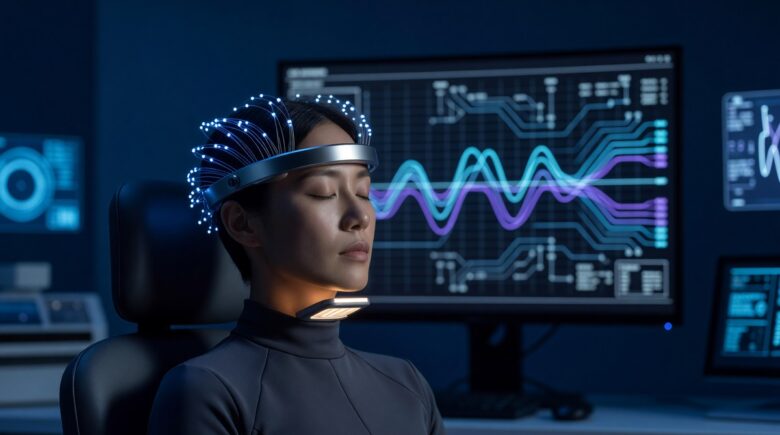
Neural interface technology works by recording electrical activity from neurons, converting that activity into digital signals, and sending those signals to a computer or device. The process runs in milliseconds and relies on three core components: the electrode array, the signal processor, and the output device.
Electrode arrays are placed on or inside the brain to detect neural firing patterns. Invasive systems like the Utah Array penetrate cortical tissue to capture high-resolution signals. Non-invasive systems like electroencephalography (EEG) headsets read signals through the skull, trading resolution for safety. Intermediate approaches, such as electrocorticography (ECoG), place electrodes on the brain’s surface without penetrating tissue.
The Role of AI in Signal Decoding
Raw neural signals are noisy and complex. Machine learning algorithms — trained on thousands of hours of neural data — decode intended movements or speech from those signals. Neuralink’s N1 chip processes data from 1,024 electrodes simultaneously, according to Neuralink’s published PRIME study update. This level of parallelism was impossible a decade ago.
The decoded output can control a cursor, a robotic arm, a speech synthesizer, or even stimulate muscles directly. The bidirectional potential — where the machine also sends signals back to the brain — opens the door to sensory restoration and memory augmentation. This intersection of AI and neuroscience is also explored in our coverage of how AI is changing the way we process and retrieve information.
Key Takeaway: Neural interface technology uses electrode arrays and AI algorithms to translate brain signals into device commands. Neuralink’s N1 chip reads from 1,024 electrodes simultaneously, according to Neuralink’s PRIME study data — a scale that makes high-fidelity neural decoding clinically viable for the first time.
What Companies Are Leading Neural Interface Technology Development?
Several well-funded companies are competing to define the standard for neural interface technology. Each takes a different technical approach, targeting different patient populations and use cases.
Neuralink, founded by Elon Musk in 2016, is the most publicly visible player. It received FDA Breakthrough Device designation in 2023 and began its first human trial, the PRIME Study, the same year. Synchron, a competing firm backed by Bill Gates and Jeff Bezos, takes a less invasive approach — its Stentrode device is implanted through a blood vessel rather than open-brain surgery. Blackrock Neurotech is the clinical workhorse, with more human BCI implants than any other company, powering research at dozens of academic medical centers.
On the non-invasive side, Emotiv and Neurosity sell consumer-grade EEG headsets for productivity and gaming applications. These devices cannot match the signal resolution of implanted arrays, but they serve as entry points for the broader market.
| Company | Approach | Key Stat / Milestone |
|---|---|---|
| Neuralink | Fully implanted, 1,024 electrodes | FDA Breakthrough Device, 2023; 10+ human implants by mid-2025 |
| Synchron | Endovascular (blood vessel) | No open-brain surgery required; 10 patients in U.S. trial by 2024 |
| Blackrock Neurotech | Utah Array, research-grade | Most clinical BCI implants globally; 50+ peer-reviewed studies |
| BrainGate | Academic consortium, Utah Array | Enabled 62 words/min speech decoding in 2023 Nature Medicine trial |
| Emotiv | Non-invasive EEG headset | Consumer devices sold in 100+ countries; under $1,000 retail price point |
Key Takeaway: The neural interface market has at least 5 major competing approaches, from fully implanted chips to consumer EEG headsets. Synchron’s endovascular method requires no open-brain surgery, potentially lowering adoption barriers — details at Synchron’s official site.
What Medical Applications Exist for Neural Interface Technology Today?
The most immediate and proven medical applications of neural interface technology are restoring communication and motor function in people with paralysis, ALS, and locked-in syndrome. These are not experimental concepts — they are active clinical realities.
The BrainGate consortium, a collaboration between Brown University, Massachusetts General Hospital, and other institutions, has enabled patients with tetraplegia to control robotic arms and computer cursors using thought alone. In 2023, researchers at UC San Francisco and UC Berkeley published results showing a BCI system decoded full sentences from a patient who had been unable to speak for 18 years, as reported by the New England Journal of Medicine.
Beyond Paralysis: Psychiatric and Neurological Uses
Neural interfaces are also entering psychiatric treatment. Deep Brain Stimulation (DBS), a form of closed-loop neural interface, is already FDA-approved for treatment-resistant depression and Parkinson’s disease. The UCSF Weill Institute reported in 2021 that a personalized closed-loop DBS system reduced a patient’s depression severity score by 91%, according to Nature Medicine’s published findings.
This trajectory parallels how other wearable health technologies evolved from clinical tools to everyday devices — a pattern well documented in our analysis of how wearable technology is transforming personal health tracking.
“We are at an inflection point. The question is no longer whether we can decode the brain — we clearly can. The question is how precisely, how safely, and how equitably we deploy that capability.”
Key Takeaway: Neural interface technology already has FDA-approved clinical applications in Parkinson’s and depression treatment. A closed-loop deep brain stimulation system reduced one patient’s depression severity by 91%, per Nature Medicine’s 2021 report — marking a shift from assistive to therapeutic use.
What Are the Ethical and Privacy Risks of Neural Interface Technology?
Neural interface technology raises profound ethical questions about data ownership, cognitive liberty, and equitable access. These risks are not hypothetical — regulators and bioethicists are already calling for frameworks.
Neural data is uniquely sensitive. Unlike a password, you cannot change your brain’s signal patterns. If a company collects and monetizes neural data, the user has limited recourse. Neurorights Foundation, led by neuroscientist Rafael Yuste at Columbia University, has lobbied for constitutional protections for mental privacy. Chile became the first country to pass a Neurorights Law in 2021, protecting mental integrity and cognitive liberty at the constitutional level, as documented by Nature’s coverage of the landmark legislation.
Security vulnerabilities present another vector. A brain-connected device that can receive signals could theoretically be hacked to deliver harmful stimulation or intercept private thoughts. The FDA has flagged cybersecurity as a required consideration in its medical device cybersecurity guidance for implantable neural devices.
The question of digital identity becomes newly complex when cognitive data enters the picture — an issue we examine in depth in our piece on what digital identity means and why you should protect it.
Key Takeaway: Neural data privacy is a recognized legal risk. Chile became the world’s first country to constitutionally protect neurorights in 2021, and the Neurorights Foundation is pushing for similar laws globally, as covered by Nature’s neurorights analysis.
What Is the Future of Neural Interface Technology?
The next decade of neural interface technology will be defined by miniaturization, wireless capability, and the shift from assistive to enhancement applications. The boundaries of what is medically necessary versus electively desired will blur fast.
Current research targets fully wireless, battery-free implants that communicate via near-field radio. DARPA’s Next-Generation Nonsurgical Neurotechnology (N3) program has funded research into external neural interfaces that achieve near-implant resolution without surgery — a goal that would radically expand the addressable population. Meanwhile, the global BCI market, valued at $2.04 billion in 2022, is forecast to grow at a compound annual growth rate of 17.1% through 2030, according to Grand View Research’s BCI market analysis.
The consumer frontier is approaching quickly. Companies are already positioning BCIs as productivity tools — a direction that echoes how smartphones evolved from niche business devices to universal infrastructure. Just as quantum computing is poised to reshape everyday technology, neural interfaces could redefine human-computer interaction at its most fundamental level.
Key Takeaway: The BCI market is growing at 17.1% CAGR and is projected to reach $6.2 billion by 2030, per Grand View Research. DARPA’s N3 program is actively funding non-surgical approaches that could bring neural interfaces to non-clinical consumers within this decade.
Frequently Asked Questions
What is neural interface technology in simple terms?
Neural interface technology is a system that reads electrical signals from the brain and translates them into commands for external devices like computers, robotic limbs, or communication software. It combines neuroscience, hardware engineering, and machine learning. The technology can also send signals back to the brain to restore sensation or treat neurological conditions.
Is neural interface technology available to the public right now?
Invasive BCIs are currently limited to clinical trials for people with paralysis or severe neurological disorders. Non-invasive consumer devices, such as EEG headsets from Emotiv and Neurosity, are commercially available for under $1,000. Fully implanted consumer-grade devices are likely at least 5 to 10 years from widespread availability.
How safe are brain-computer implants?
FDA-reviewed implantable BCIs have demonstrated acceptable safety profiles in clinical trials, but risks include infection, electrode degradation, and signal drift over time. Neuralink’s first human subject experienced retraction of some electrode threads post-implant, requiring a software recalibration. Long-term safety data beyond five years is still limited across the field.
Who owns the neural data collected by a brain implant?
Data ownership rights vary by company and jurisdiction and are not yet governed by a universal legal standard. Most current device agreements assign data rights to the company, not the patient. Chile’s 2021 Neurorights Law is the only constitutional protection of its kind, and advocates are pushing for similar frameworks in the U.S. and EU.
Can neural interface technology read your thoughts?
Current systems can decode intended movements and some speech patterns, but they cannot read abstract thoughts or emotions with precision. They work by pattern-matching specific trained neural signatures, not by interpreting open-ended cognition. As AI decoding improves, the gap between “motor intent” and “thought” will narrow, which is why privacy regulations are being developed now.
What is the difference between a BCI and deep brain stimulation?
Deep Brain Stimulation (DBS) is a type of neural interface that sends electrical pulses into specific brain regions to treat conditions like Parkinson’s disease and depression. Standard BCIs primarily read neural signals as outputs. Modern closed-loop systems do both — recording activity and responding with targeted stimulation — making them a more advanced hybrid of the two approaches.
Sources
- Nature Medicine — Speech BCI Enables 62 Words Per Minute in Paralyzed Patient (2023)
- New England Journal of Medicine — Restored Speech Communication via Brain-Computer Interface (2023)
- Nature Medicine — Closed-Loop Deep Brain Stimulation Reduces Depression Severity by 91% (2021)
- Nature — Chile Becomes First Country to Protect Neurorights in Law (2021)
- Neuralink — PRIME Study Progress Update (2024)
- Grand View Research — Brain-Computer Interface Market Size and Forecast to 2030
- U.S. FDA — Medical Device Cybersecurity Guidance