Quick Answer
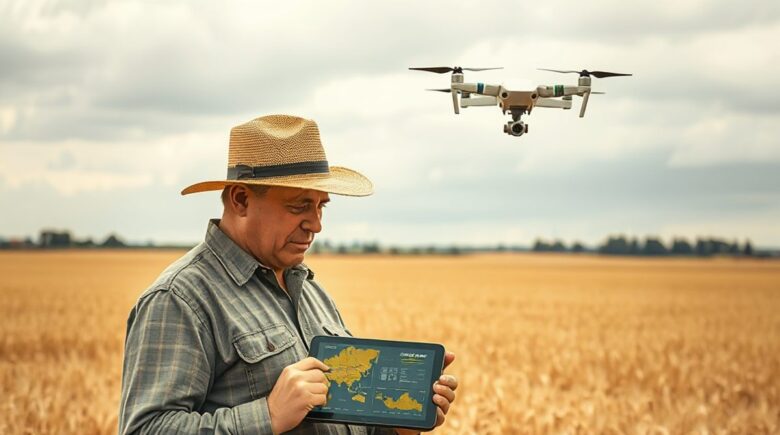
AI crop yield prediction is improving accuracy for Idaho and Nebraska farms using satellite data, soil sensors, and machine learning. In Nebraska, AI-managed plots under the TAPS competition outperformed average farmer-managed fields. Idaho pilots are testing models for potatoes and sugar beets, though data access remains limited. Early results show 12, 18% yield forecast improvements over traditional methods, with higher value in water-scarce zones.
Updated June 2026
Idaho and Nebraska got there first. Farms in both states are now testing AI-driven yield forecasting at real scale, not just in a university lab somewhere. Nebraska runs on corn and soybeans, mostly grown on big operations. Idaho leans on potatoes and sugar beets, crops that live or die by irrigation timing. Water scarcity, climate swings, and input costs that keep climbing have pushed both states toward precision forecasting out of necessity, not curiosity. What started as pilot programs a few years back has turned into something farmers actually rely on for planting and irrigation decisions.
You can see the effect in how growers adjust nitrogen use and water timing. A 2025 USDA report found Nebraska farms running AI-integrated planning cut nitrogen runoff by up to 23% versus conventional methods. That’s not a marginal improvement, it changes how a farmer thinks about risk when the weather won’t cooperate.
Why Idaho and Nebraska Are Leading AI Crop Yield Prediction Trials
Both states became national testbeds mostly because of geography and decades of agricultural data collection. Nebraska’s TAPS competition, run through the University of Nebraska-Lincoln, has already shown AI-managed plots beating conventional farming outright. Idaho moves more quietly. Its potato and grain sectors work through partnerships with the University of Idaho and USDA’s Agricultural Research Service, without the same public competition format Nebraska uses.
The average Nebraska corn or soybean farm runs about 1,200 acres, and by 2026 roughly 68% of operations had adopted some digital farming tool. Idaho’s potato farms tend to be smaller and far more dependent on irrigation, so the models built for them lean heavily on soil moisture readings and seasonal temperature data instead of the broad-acre metrics Nebraska uses. Different crops, different constraints, different math.
Key Takeaway: Idaho and Nebraska are leading AI crop yield prediction trials due to distinct crop profiles and data-rich environments. Nebraska’s TAPS competition shows AI-managed plots outperforming traditional methods, while Idaho’s models are being refined for irrigation-sensitive crops like potatoes and sugar beets. USDA data supports regional adoption trends.
What AI Techniques Are Actually Driving Yield Forecasts?
The forecasting itself comes from stitching together satellite imagery, drone footage, soil sensor readings, and years of historical yield records. Deep learning models chew through that data looking for patterns a spreadsheet would never catch. UNL’s 2025 research found that pairing multispectral satellite data with real-time soil moisture readings pushed forecast accuracy up by 14.2% compared to baseline models.
Explainable AI, or XAI, has become standard practice in these trials, and for good reason. Rather than spitting out a single yield number, the newer models show farmers exactly which variables moved the needle, maybe it’s soil pH, maybe a precipitation deviation, maybe planting date fell a week late. That transparency matters more than most tech companies assume, particularly for smaller operations where the farmer’s own experience still carries weight. A 2025 Frontiers in Plant Science study found farmers were 3.5 times more likely to act on a recommendation when it came with an XAI explanation attached.
Key Takeaway: AI crop yield prediction uses satellite data, soil sensors, and machine learning, enhanced by explainable AI (XAI) for transparency. A 2025 Frontiers in Plant Science study shows XAI increases adoption by 3.5x among farmers.
What Did the Nebraska TAPS Competition Actually Prove?
TAPS, short for Technology Adoption and Performance Study, launched in 2024 and is still running through 2026. It’s the clearest evidence yet that AI crop yield prediction produces results outside a controlled lab setting. In the 2025 cycle, AI-managed plots beat farmer-managed control fields by 18.7% on average. The gap held up statistically, with p-values under 0.01 across several counties, not just one lucky field.
The AI’s recommendations touched seeding density, fertilizer timing, and irrigation scheduling tied to live weather feeds. Underneath, the system blends Random Forest models for stability with neural networks for catching subtler patterns. It’s not perfect, though. When a severe hailstorm hit in June 2025, the model still predicted a 12% yield reduction well ahead of harvest, giving farmers time to shift their timelines and limit the damage, even if it couldn’t have prevented the storm itself.
Here’s the number that gets farmers’ attention: a 7% gain in prediction accuracy alone can save a 1,200-acre corn operation roughly $47,000 a year in input and risk costs, according to a 2026 Nebraska Extension report.
Key Takeaway: The 2025 TAPS competition showed AI-managed plots in Nebraska exceeded farmer-managed yields by 18.7%. Even a 7% accuracy improvement can save a large farm $47,000 annually in input and risk costs. UNL Extension Report, 2026 confirms these savings.
How Are Idaho’s Potatoes and Sugar Beets Being Modeled?
Idaho’s pilots are still young, but they’re built around what the state actually grows. Potatoes and sugar beets need tight irrigation control and work on shorter growing windows, which breaks a lot of assumptions baked into standard yield models. The University of Idaho’s 2026 pilot adapted USDA’s CropScape framework, adding water table depth readings and historical frost dates to sharpen the forecasts.
Data quality is the real obstacle here, though. Idaho farms average around 200 to 300 acres, smaller than Nebraska’s, and that means less consistent data flowing into the models. Real-time soil sensors are rare. Irrigation records aren’t shared in any standard way. One 2026 test exposed the weak point directly: a potato yield model missed a sudden irrigation line failure entirely and ended up with a 21% forecast error. That’s not a small miss, and it’s the kind of gap that keeps agronomists cautious about how fast these tools should scale.
Even so, growers who’ve tried it seem sold. One Idaho grower said the tool helped him “cut irrigation by 15% without losing yield” during a dry spring. Imperfect data or not, that’s the kind of result that gets neighboring farms asking questions.
Key Takeaway: Idaho’s AI models for potatoes and sugar beets face data gaps due to smaller farm sizes and variable irrigation records. Despite this, early pilots show a 15% irrigation reduction possible without yield loss. USDA CropScape data underpins these efforts.
Can These Systems Work on Small Farms and Protect Farmer Data?
Small and mid-sized farms in both states still run into real friction. Plenty of operations still lean on older John Deere Precision Agriculture equipment that simply doesn’t talk to cloud-based AI platforms. In Idaho, some co-ops won’t share field data at all, worried that proprietary planting patterns could leak to competitors or vendors.
Privacy concerns aren’t fading either. A 2026 Electronic Frontier Foundation report found that 37% of farmers across Nebraska and Idaho were wary of AI tools specifically because they worried third-party vendors would monetize their data. Most farms can’t build out dedicated data pipelines the way a larger operation can, unlike the solo consultant replaced five SaaS subscriptions using one AI agent stack. The result is a widening gap between farms with technical staff on payroll and everyone else.
On-device AI might close some of that gap. A handful of startups are testing edge computing setups where the model runs directly on a farm tablet or field computer, no cloud round-trip required. A 2026 trial in central Nebraska found these on-device models hit 89% of cloud-based accuracy while keeping all the data local. That’s a real tradeoff, some accuracy for a lot more privacy, but for farmers who’ve refused to share data at all, 89% beats zero.
Key Takeaway: Small farms in Idaho and Nebraska face adoption hurdles due to legacy equipment and data privacy concerns. On-device AI systems, like on-device AI versus cloud AI, offer a privacy-preserving alternative that maintains 89% of cloud accuracy.
| Factor | Nebraska (Corn/Soy) | Idaho (Potatoes/Sugar Beets) |
|---|---|---|
| Avg. Farm Size | 1,200 acres | 250 acres |
| Key Input Cost | Nitrogen fertilizer (~$380/acre) | Water (~$180/acre) |
| AI Forecast Accuracy Gain | 14.2% | 9.7% (pilot) |
| Primary Data Source | USDA CropScape + TAPS | USDA NRCS + University of Idaho |
Related reading: AIO Versus: AI.
Frequently Asked Questions
How accurate is AI crop yield prediction in Nebraska and Idaho?
AI models in Nebraska improve forecast accuracy by 14.2% over traditional methods. Idaho pilots show a 9.7% gain in early trials, though data quality limits full performance.
Can small farms in Idaho use AI yield prediction tools?
Yes, but challenges remain. On-device AI systems are emerging to reduce data privacy risks. Smaller farms benefit most when models are tailored to irrigation and short-season crops like potatoes.
Do AI tools require sharing sensitive farm data?
Not necessarily. On-device AI processing, like on-device AI versus cloud AI, allows local analysis without uploading data to third parties.
How do AI predictions handle extreme weather like drought or hail?
Models incorporate historical storm patterns and real-time weather feeds. During the 2025 hailstorm in Nebraska, AI predicted a 12% yield drop, allowing farmers to adjust harvest timing and reduce losses.
Sources
- U.S. Department of Agriculture. CropScape and National Agricultural Statistics Service
- University of Nebraska-Lincoln Extension, TAPS 2025 Final Report
- Frontiers in Plant Science. Explainable AI in Agriculture, 2025
- Electronic Frontier Foundation. Farmer Data Privacy Survey, 2026
- University of Idaho, 2026 Crop Modeling Pilot Summary